Underfloor Heating in Halifax
Underfloor heating has become one of the most sought-after home upgrades in Halifax over the past decade, and it's not hard to see why. Sitting on the edge of the Pennines, Halifax endures some genuinely cold winters, and traditional radiator systems often struggle to heat older properties evenly. Whether you're renovating a characterful Edwardian semi in Savile Park or fitting out a new-build on one of the town's growing modern developments, underfloor heating offers a more efficient, comfortable alternative. It frees up wall space, eliminates cold spots, and when paired with a modern heat pump or condensing boiler, can meaningfully reduce your energy bills over time.
Plumbing Conditions in Halifax
Soft water — Pennine reservoir water
Mixed housing stock across different eras. With 22% of properties built before 1919, older pipework and drainage systems are common — specialist knowledge of period properties matters.
Underfloor Heating in Halifax — Local Expertise
Halifax's housing stock is genuinely varied, and that variety matters enormously when planning an underfloor heating installation. Edwardian semis — common throughout areas like King Cross, Skircoat Green, and Savile Park — typically have solid ground floors and original joisted upper floors, which means the approach differs floor by floor. Wet underfloor heating is usually the better long-term choice in these properties, but the floor build-up needs careful consideration, particularly where original tiled hallways or period features are being preserved. Post-war council and private estates across Mixenden, Illingworth, and Ovenden often have suspended timber floors at ground level, making electric systems or low-profile wet systems more practical. Newer developments in and around Halifax are the straightforward cases — concrete slab construction suits wet underfloor heating beautifully. One genuinely useful local note: Halifax is supplied by soft Pennine reservoir water, which is actually a mild advantage for wet underfloor heating systems. Soft water causes less limescale build-up in pipework and manifolds over time, potentially extending system life compared to hard-water areas in the south.
How We Work
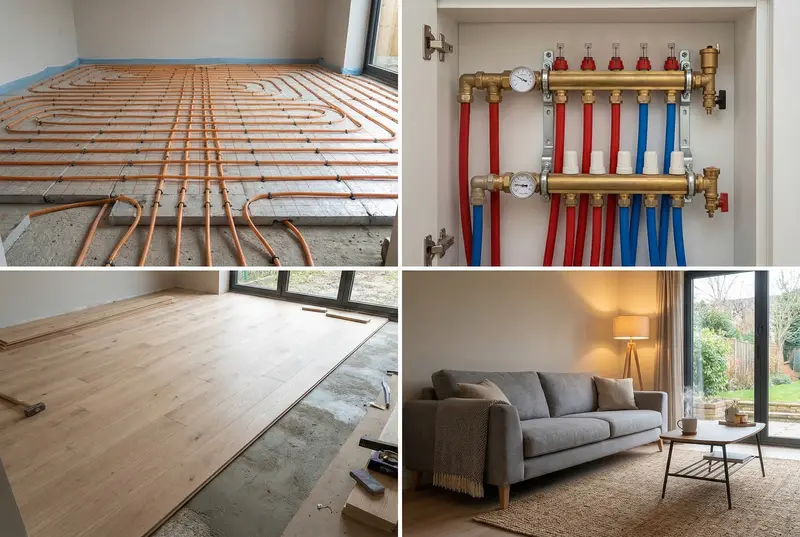
A proper underfloor heating installation in Halifax follows a clear sequence, and understanding it helps you plan realistically. The process begins with a heat loss survey of your home — a qualified installer will calculate how much heat each room needs based on its size, insulation levels, glazing, and how the property is built. This isn't a step to skip; undersizing a system is the most common reason homeowners end up disappointed with the results. Once the design is agreed, installation of a wet system involves laying a manifold — usually in a cupboard or utility area — and running cross-linked polyethylene (PEX or PE-RT) pipework in loops across the floor. In a new-build or full renovation, this pipework is embedded in a liquid screed or sand-and-cement screed, which then needs to cure properly before the floor finish goes down. In a retrofit situation on a suspended timber floor, specialist low-profile systems can be fitted between or beneath the joists with minimal height gain. Electric systems, by contrast, involve laying heating mats or cables and connect directly to your existing electrical supply — these are quicker to install and suit single rooms like bathrooms or extensions particularly well. Throughout Halifax, most full ground-floor wet installations take between two and five days depending on property size, followed by a screed curing period of several weeks before commissioning.
Why Choose a Local Halifax Specialist
Choosing a Halifax-based installer rather than a national firm makes a practical difference on a job like this. Local tradespeople understand the town's housing stock intimately — they've worked in Victorian back-to-backs, post-war semis, and modern infill developments across the borough and know the quirks that come with each. They're also easier to hold accountable if anything needs revisiting after installation, and many have established relationships with local screed contractors and suppliers, which can keep costs and lead times down. When you're investing anywhere from three to eight thousand pounds, that local knowledge and accountability genuinely counts.
Frequently Asked Questions
Can underfloor heating be installed in an Edwardian semi in Halifax without raising the floor height significantly?
Yes, but it requires careful planning. In rooms where raising the floor by 80–100mm is acceptable, a standard wet system in screed works well. Where height gain is an issue — particularly in hallways with original tiled floors — low-profile systems using aluminium diffuser plates within the existing floor structure are a practical alternative, adding as little as 15–20mm.
Does soft water in Halifax affect how an underfloor heating system performs or is maintained?
Soft Pennine water is actually a slight advantage for wet underfloor heating. Hard water causes limescale to accumulate inside pipework and at the manifold over time, reducing efficiency and eventually causing blockages. Halifax's naturally soft water supply means this is much less of a concern, though installers still typically add an inhibitor to the system fluid as standard practice.
How long does it take for underfloor heating to warm a room compared to standard radiators?
Underfloor heating has a slower response time than radiators — typically 30 to 60 minutes to reach target temperature from cold. This is why it works best when left running at a lower, steady temperature rather than switching on and off. Modern smart thermostats with scheduling can manage this automatically, making the slower warm-up time a non-issue in everyday use.
Is underfloor heating compatible with the heat pumps being installed in Halifax homes under government incentive schemes?
Yes — and it's arguably the best pairing available. Air source heat pumps operate most efficiently when producing lower-temperature heat (around 35–45°C), which is exactly what underfloor heating is designed to use. Radiator systems often need higher temperatures that push heat pumps into less efficient operating ranges. If you're considering a heat pump through the Boiler Upgrade Scheme, installing underfloor heating at the same time is well worth planning for.
Other Plumbing Services in Halifax
What do you need?
Select your service and urgency level