Leak Detection & Repair in Halifax
Leak detection and repair is one of those jobs where acting quickly really matters — a slow drip behind a wall or under a floor can quietly cause hundreds of pounds of damage before you even notice the damp patch. Halifax has its own particular set of plumbing challenges, from ageing pipework in older terraces to the quirks of modern developments where pipes are buried deep in screed floors. Whether your water bill has crept up unexpectedly, you've spotted a damp patch on a ceiling, or you can hear water running when everything should be off, getting a proper leak detection survey done sooner rather than later is almost always the cheaper option.
Plumbing Conditions in Halifax
Soft water — Pennine reservoir water
Mixed housing stock across different eras. With 22% of properties built before 1919, older pipework and drainage systems are common — specialist knowledge of period properties matters.
Leak Detection & Repair in Halifax — Local Expertise
Halifax's housing stock is genuinely varied, and that variety matters when it comes to tracing leaks. In the Edwardian semis common across areas like King Cross, Savile Park, and parts of Skircoat, original lead or early copper pipework is still present in some properties — these older systems are more prone to pinhole leaks and joint failures as they age. Post-war council estates and private developments, which make up a large chunk of Halifax's residential areas, often have mid-century copper installations that are now reaching the end of their service life. Newer developments in places like Northowram or the edge of Brighouse tend to use plastic push-fit systems, which are generally reliable but occasionally suffer from poorly seated joints during the original build. Halifax is also supplied by soft Pennine reservoir water, which is low in limescale — this is actually good news in one sense, as you won't get the heavy furring in pipes seen in hard water areas. However, soft water can be slightly more aggressive towards certain metals over time, which is worth knowing if you have older copper or brass fittings.
How We Work
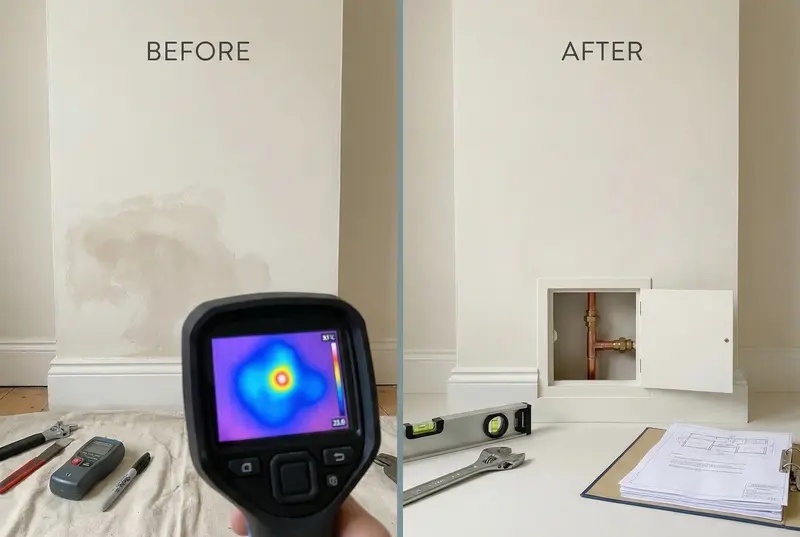
When a plumber arrives to carry out leak detection in Halifax, the first step is a proper diagnosis — not just a visual inspection, but a systematic process of elimination. The engineer will start by checking your water meter to confirm there is indeed an active leak, then isolate different parts of the system to narrow down where the water loss is occurring. For concealed leaks, specialist equipment comes into play. Acoustic listening devices can pick up the sound of pressurised water escaping through a pipe, even beneath a concrete floor or behind a plastered wall. Thermal imaging cameras are useful for spotting temperature differences caused by water tracking along surfaces. In some cases, tracer gas is used — a safe mixture of nitrogen and hydrogen is pumped into the pipework and detected at the surface, pinpointing the exact location without unnecessary excavation. Once the leak is found, you'll get a clear explanation of what's needed to fix it. Minor repairs — such as resoldering a joint, replacing a section of pipe, or fitting a new valve — can often be completed in the same visit. More involved work, like lifting a section of floor screed on a post-war Halifax estate property or accessing a buried pipe in a newer development, will require a follow-up appointment and a more detailed quote. Throughout the process, a good local plumber will keep disruption to an absolute minimum and explain every step before they proceed.
Why Choose a Local Halifax Specialist
Choosing a plumber who actually knows Halifax makes a practical difference. A local tradesperson will know the kind of pipework typically found in a 1930s semi off Huddersfield Road versus a 1970s council property in Mixenden, and that background knowledge can save real time on a job. They'll also have established relationships with local merchants for parts, which means fewer delays waiting for uncommon fittings. And frankly, a plumber who works in Halifax and relies on local word-of-mouth has every reason to do a thorough, honest job — their reputation in the town depends on it. It's not just a matter of convenience; local knowledge genuinely translates into better outcomes on jobs like leak detection.
Frequently Asked Questions
My water meter is spinning but I can't see any obvious leak — what should I do?
This usually means you have a hidden leak somewhere in the supply pipe between the meter and your home, or within the internal pipework. In Halifax, this is reasonably common in Edwardian properties with older pipe runs. Turn off the internal stopcock and check whether the meter stops moving — if it does, the leak is inside. If it doesn't, the issue is likely in the external supply pipe. Either way, call a plumber with leak detection equipment rather than starting to open up walls yourself.
Does Halifax's soft water affect how quickly pipes wear out?
Soft Pennine water doesn't fur up pipes the way hard water does, so you're unlikely to see limescale-related blockages. However, soft water can be slightly more corrosive to older copper and brass over many decades. In practice, Halifax homes with pre-1980s copper pipework may see more pinhole corrosion than equivalent properties in hard water areas further south. It's not a major risk in most cases, but it's worth having older pipe runs checked if you're buying or renovating.
How much disruption will leak detection cause to my home?
Less than most people expect, provided the right equipment is used. Acoustic detection and thermal imaging are entirely non-invasive. Tracer gas detection involves a small injection point into the system but no significant mess. The disruption increases at the repair stage — if the leak is under a tiled floor or behind a wall, some access work will be needed — but a good Halifax plumber will always explain the minimum intervention needed before going ahead.
I've got a damp patch on my ceiling but the bathroom above seems fine — could it still be a pipe leak?
Absolutely, and this is one of the trickier scenarios to diagnose. Water tracks along joists and surfaces before dripping, so the visible damp patch is often not directly below the source. In Halifax's post-war semi-detached properties, heating pipework often runs through floor voids and can weep for weeks before the staining becomes obvious. A thermal imaging survey is often the most effective way to trace the route of the water without unnecessary damage to ceilings or floors.
Other Plumbing Services in Halifax
What do you need?
Select your service and urgency level