Boiler Installation in Halifax
Halifax sits high in the Pennine foothills, and anyone who's lived through a West Yorkshire winter knows exactly what that means for a heating system. When a boiler packs in during January, it's not a minor inconvenience — it's genuinely urgent. But boiler installation isn't just an emergency fix; for most Halifax homeowners, it's a planned investment that makes a real difference to comfort, energy bills, and the long-term value of their property. Whether you're replacing an ageing unit that's limping through its last season or upgrading as part of a wider renovation, understanding what's involved — and what it should cost in this area — means you're far less likely to get caught out.
Plumbing Conditions in Halifax
Soft water — Pennine reservoir water
Mixed housing stock across different eras. With 22% of properties built before 1919, older pipework and drainage systems are common — specialist knowledge of period properties matters.
Boiler Installation in Halifax — Local Expertise
Halifax has a genuinely mixed housing stock, and the type of property you own shapes almost every aspect of a boiler installation. The town's Edwardian semis — common across areas like King Cross, Savile Park, and Skircoat — tend to have larger floor plans with multiple bathrooms, older pipework that may need partial replacement, and sometimes original gravity-fed systems that need converting to modern pressurised setups. Post-war estates, particularly around Mixenden and Illingworth, often have smaller plant rooms and existing system layouts that are more straightforward to work with. Newer developments in places like Brighouse Road corridors are usually compatible with combi boilers straight off. On the water side, Halifax benefits from a soft water supply drawn from Pennine reservoirs — this is actually an advantage for boiler longevity, since limescale build-up in the heat exchanger and pipework is far less of a problem here than in hard water areas further south. It's still worth fitting a magnetic filter, but the system generally stays cleaner for longer.
How We Work
A proper boiler installation in Halifax follows a clear sequence, and a good engineer will walk you through each stage before any work begins. It starts with a heat loss survey — this is where the engineer assesses the size of your property, the number of radiators, how well-insulated the building is, and your hot water demand. Skipping this step and just swapping like-for-like is a common shortcut that often results in an undersized or oversized boiler. Once the right specification is agreed, you'll discuss the flue position and route, which matters more than people realise — Edwardian semis in Halifax can present awkward flue runs that add time and cost. The old boiler and any redundant pipework is removed, the new unit is fitted and connected, and the system is flushed using a power flush or chemical cleanse to remove any sludge before the new boiler fires up. A magnetic filter is fitted to the return pipe to capture future debris. The engineer then commissions the boiler, sets up the controls or smart thermostat, and registers the installation with Gas Safe — this is a legal requirement, not optional. You should receive a Building Regulations compliance certificate (usually a Benchmark document) on the same day. The whole job typically takes one full day for a straightforward swap, or up to two days if pipework alterations are needed.
Why Choose a Local Halifax Specialist
Choosing a Halifax-based installer rather than a national call centre isn't just about local pride — it has practical benefits. A local Gas Safe engineer will know the housing stock here: they'll have worked inside dozens of Edwardian semis and post-war terraces and will spot potential complications early rather than discovering them halfway through a job. They can usually respond faster for follow-up queries, and if something needs attention under guarantee, you're not waiting on a national scheduling system. Word of mouth still matters enormously in a town like Halifax, which means local tradespeople have a strong incentive to do the job properly the first time.
Frequently Asked Questions
How long does a boiler installation take in a typical Halifax home?
For most Halifax properties — including standard Edwardian semis and post-war homes — a like-for-like combi swap takes one full working day. If pipework needs rerouting, the system requires converting from a gravity-fed setup, or a power flush is carried out as part of the same visit, it's more realistic to allow two days. Your engineer should give you a clear timeline before work starts.
Does Halifax's soft water supply affect which boiler I should choose?
Not significantly in terms of brand choice, but it does mean limescale-related failures are less of a concern than in hard water regions. Halifax's Pennine reservoir supply is naturally soft, so you're unlikely to need a dedicated scale reducer on the incoming supply. A magnetic filter on the return pipe is still recommended to catch system debris and protect the heat exchanger over time.
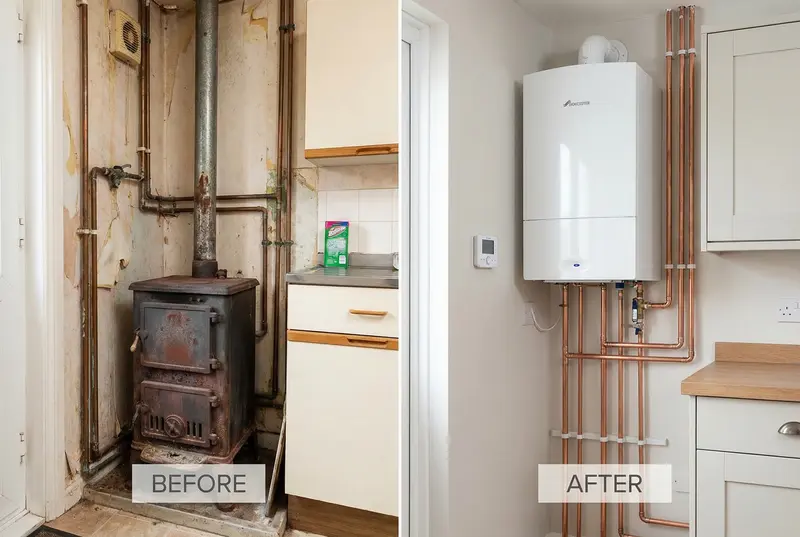
I have an Edwardian semi in Halifax with an old back boiler — is it expensive to replace?
Back boiler removals are more involved than standard swaps because the old unit sits behind a fire surround and connects to a gravity-fed system. It's a bigger job but the efficiency gains are substantial.
Do I need to notify anyone when a new boiler is installed in Halifax?
Your installer is legally required to notify the local authority via a Building Regulations compliance scheme — in practice, this is handled through Gas Safe Register's Benchmark scheme. You shouldn't need to do anything yourself, but do make sure you receive the signed Benchmark commissioning document and the Gas Safe installation certificate on completion. Keep these safe as you'll need them if you sell the property.
Other Plumbing Services in Halifax
What do you need?
Select your service and urgency level