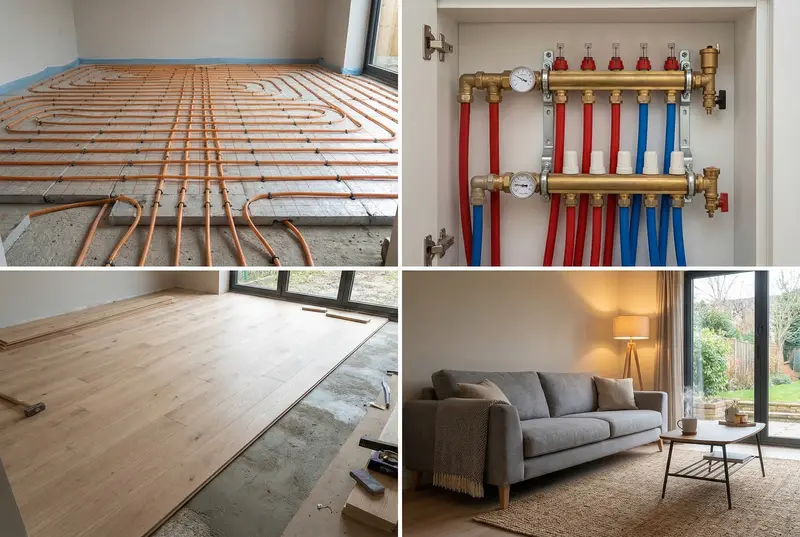
Underfloor Heating in Bradford
Bradford is a city that runs on older housing stock, and if you live in one of the many Victorian terraces or Edwardian semis spread across areas like Manningham, Heaton, or Shipley, you'll know that keeping those properties warm through a West Yorkshire winter is no small challenge. Underfloor heating has become an increasingly popular upgrade for Bradford homeowners who want to move away from clunky radiators and uneven heat distribution. Done properly, it transforms how a room feels — warmth rising evenly from the floor up, no cold spots, no bulky pipework on the walls. It's a significant investment, but one that pays dividends in comfort and energy efficiency for decades.
Plumbing Conditions in Bradford
Soft water — Pennine reservoir water
Mixed housing stock across different eras. With 22% of properties built before 1919, older pipework and drainage systems are common — specialist knowledge of period properties matters.
Underfloor Heating in Bradford — Local Expertise
The character of Bradford's housing presents some specific considerations when planning an underfloor heating installation. Victorian terraces and Edwardian semis — which make up a huge proportion of homes across BD1 through to BD18 — typically have solid ground floors rather than suspended timber, which actually makes wet underfloor heating installation more straightforward in many cases. However, these older properties often lack adequate floor insulation beneath the screed, and without addressing that first, you'll be pumping heat into the ground rather than up into the room. Any reputable installer working in Bradford will survey the existing floor build-up and insulation levels before quoting. On the water side, Bradford sits in a soft water area supplied by Pennine reservoirs, which is genuinely good news for underfloor heating systems. Soft water causes far less limescale build-up in pipework and manifolds than the hard water found in parts of southern England, meaning your system should have a longer service life with less maintenance required over time.
How We Work
A typical underfloor heating installation in Bradford follows a clear process, and understanding each stage helps you plan realistically. It starts with a site survey, where a qualified installer assesses your floor construction, insulation, existing boiler capacity, and room dimensions. Victorian and Edwardian properties in Bradford sometimes need a boiler upgrade at this stage — older combination boilers may not run efficiently with the lower flow temperatures that underfloor heating works best at, so this is worth discussing upfront. Once the design is agreed, the installation itself begins with laying a layer of rigid insulation board across the floor — this is non-negotiable if you want an efficient system. The heating pipework is then laid in loops across the insulation, connected back to a manifold, which acts as the control hub for each zone. After pressure testing the pipework to check for any leaks, a liquid screed or traditional sand-and-cement screed is poured over the top and left to cure — typically two to four weeks depending on the product used. Throughout the curing period the system is commissioned gradually, starting at low temperatures and slowly increasing. This prevents cracking. Once cured, your flooring can be laid on top. The whole installation from start to finished floor typically takes three to five days for a ground floor, excluding the curing time. A good installer will walk you through the commissioning process and leave you confident using the controls.
Why Choose a Local Bradford Specialist
Choosing a Bradford-based installer rather than a national firm genuinely matters for a job like this. Local tradespeople understand the specific floor constructions common in Bradford's Victorian and Edwardian housing — they've seen what's under the screed before and know what surprises to plan for. They're also familiar with local building control requirements and know which suppliers carry the right materials locally, which keeps lead times short. When the curing period is done and it's time for commissioning, a local installer can get back to you quickly rather than scheduling weeks in advance. That ongoing relationship matters for a system you'll rely on for the next 20 years.
Frequently Asked Questions
Can underfloor heating be installed in a Victorian terrace in Bradford?
Yes, and Bradford's Victorian terraces are actually quite well-suited to it, especially those with solid concrete ground floors. The main consideration is floor depth — you'll lose around 100–150mm of floor height once insulation and screed are accounted for. In rooms with low ceilings, this needs careful thought. A survey will confirm whether it's practical for your specific property.
Does Bradford's soft water supply affect underfloor heating systems?
It works in your favour. Soft Pennine water causes significantly less limescale in underfloor heating pipework and manifolds than hard water areas experience. You'll still want inhibitor added to the system during commissioning to protect against corrosion, but limescale-related blockages and efficiency losses are much less of a concern in Bradford than in southern England.
How long does the screed take to dry before I can lay flooring in Bradford?
Traditional sand-and-cement screed typically needs four to six weeks to fully cure before flooring goes down. Liquid anhydrite screeds, which many Bradford installers now use, can be ready in as little as two to three weeks. During curing, the heating system is run at progressively higher temperatures — your installer will manage this commissioning schedule and confirm when it's safe to proceed with floor coverings.
Will I need a new boiler to run underfloor heating in my Bradford home?
Not always, but it's worth checking. Underfloor heating runs most efficiently at lower flow temperatures — around 35–45°C rather than the 70–80°C conventional radiators need. Modern condensing boilers handle this well, but older boilers in Bradford's period properties may not modulate down efficiently. A heat pump is another option increasingly popular in Bradford for exactly this reason, and may qualify for government grants.
Other Plumbing Services in Bradford
What do you need?
Select your service and urgency level