Underfloor Heating in Manchester
Underfloor heating is one of those upgrades that sounds like a luxury until you've actually lived with it — then it quickly becomes a necessity. Manchester's winters are long, damp, and grey, and the city's older housing stock tends to hold onto the cold in ways that radiators alone struggle to fix. Whether you're renovating a Victorian terrace in Levenshulme or extending a semi in Didsbury, underfloor heating transforms how a room feels, distributes heat more efficiently, and frees up wall space you'd otherwise lose to bulky radiators. Done properly, it's one of the most worthwhile home improvements you can make in Manchester.
Plumbing Conditions in Manchester
Soft water — Pennine reservoir supply
Mixed housing stock across different eras. With 22% of properties built before 1919, older pipework and drainage systems are common — specialist knowledge of period properties matters.
Underfloor Heating in Manchester — Local Expertise
The challenge in Manchester is that the majority of the city's housing was built between 1870 and 1920. Victorian terraces and Edwardian semis dominate suburbs like Chorlton, Stretford, Fallowfield, and Levenshulme, and these properties bring a specific set of considerations for underfloor heating. Original suspended timber ground floors need careful assessment — electric underfloor heating mats are often the most practical solution here, sitting beneath engineered wood or tile without requiring the floor to be dug up. Where solid concrete subfloors exist, typically in extensions or homes that have already had the ground floor updated, wet underfloor heating systems become viable and cost-effective to run. Manchester is also a soft water area, supplied from Pennine reservoirs, which is genuinely good news for wet underfloor heating systems — soft water causes far less limescale build-up in pipework and manifolds than hard water areas, meaning your system is likely to stay in better condition for longer with less maintenance.
How We Work
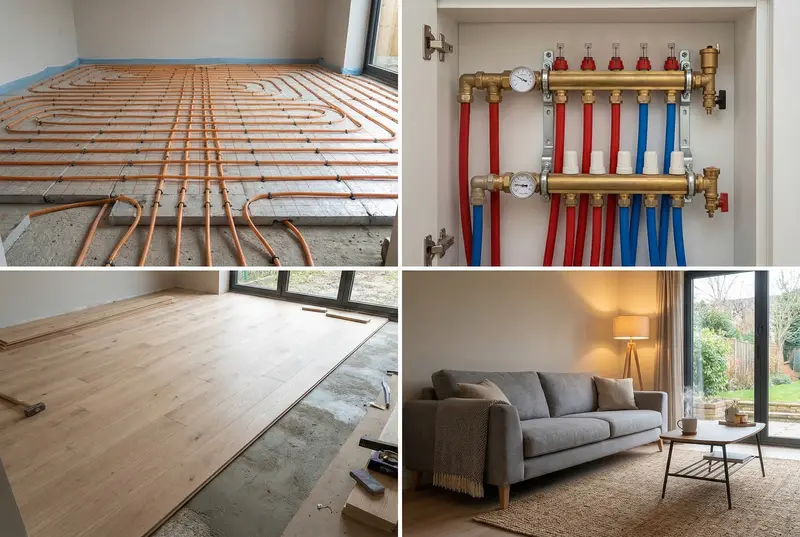
The installation process depends heavily on the system type and your floor construction. For wet underfloor heating — where warm water circulates through pipes connected to your boiler or heat pump — the first stage is a site survey to assess your subfloor, existing heating system, and room layout. A manifold is installed, usually in a utility cupboard or purpose-built housing, which controls the flow of water to each zone. Pipework is laid in loops across the floor area, then either embedded in a liquid screed or covered with a low-profile overlay system if floor height is a concern in your Manchester home. The system is then pressure-tested before the floor finish goes down. Electric underfloor heating is simpler to install, particularly in Manchester's many Victorian terraces with timber floors — heating mats or cable systems are laid directly beneath the floor covering, wired to a dedicated thermostat, and don't require any changes to your boiler. For both systems, thermostats are installed room by room, allowing you to control temperatures independently across the house. From survey to sign-off, a full ground floor wet system installation typically takes three to five days, while electric installations in one or two rooms can often be completed in a day.
Why Choose a Local Manchester Specialist
Choosing a Manchester-based installer matters more than it might seem. Local tradespeople understand the quirks of the city's Victorian and Edwardian housing stock — suspended floors, original joists, and the varying subfloor conditions you'll find street to street across Manchester's suburbs. They're also familiar with local building control requirements and know which suppliers offer the best lead times in the area. A local installer can visit quickly for a proper survey, give you an accurate quote without padding for travel time, and be on hand if any follow-up work is needed after installation.
Frequently Asked Questions
Can underfloor heating be installed under the original floorboards in a Victorian terrace?
Yes, though it requires some planning. Electric heating mats can often be installed beneath engineered wood or tiles without disturbing the original floor structure. For wet systems, the void beneath suspended timber floors can sometimes be used, but insulation between joists is essential to push heat upward rather than losing it downward. A site survey will clarify what's feasible in your specific Manchester property.
Will underfloor heating work with my existing combi boiler?
In most cases, yes. Many Manchester homes have combi boilers, and wet underfloor heating can be connected to them. However, underfloor systems run at lower flow temperatures than radiators, so a weather compensation control or mixing valve is often added to optimise efficiency. If your boiler is older or undersized, an upgrade may be recommended at the same time.
How long does it take for a new underfloor heating system to start working properly?
If your floor has been screeded, you'll need to follow a curing programme before running the system at full temperature — this can take several weeks. Once fully cured, underfloor heating takes longer to warm a room than a radiator would, but it holds heat more evenly and for longer. Most Manchester homeowners find the system most effective when left on a low, consistent setting rather than switched on and off.
Is underfloor heating expensive to run in Manchester?
Running costs depend on your system type, insulation levels, and how you control it. Wet underfloor heating connected to a modern boiler or heat pump is generally cheaper to run per hour than electric systems, especially in larger spaces. Manchester's soft water supply helps keep the system efficient over time by reducing limescale in the pipework. Good thermostat zoning and proper insulation under the floor make the biggest difference to ongoing bills.
Other Plumbing Services in Manchester
What do you need?
Select your service and urgency level