Underfloor Heating in Dewsbury
Underfloor heating is one of those upgrades that genuinely changes how a home feels to live in — no cold spots, no radiators eating into your floor space, and running costs that can beat a conventional system when it's set up properly. That's a significant investment, but for a whole-house installation or a well-planned extension, the long-term comfort and efficiency gains make it one of the more sensible things you can spend money on.
Plumbing Conditions in Dewsbury
Soft water — Pennine reservoir water
Mixed housing stock across different eras. With 22% of properties built before 1919, older pipework and drainage systems are common — specialist knowledge of period properties matters.
Underfloor Heating in Dewsbury — Local Expertise
Dewsbury's housing stock is genuinely varied, and that variation matters when it comes to underfloor heating. Edwardian semis — common in areas like Thornhill and parts of Ravensthorpe — often have solid floors or suspended timber ground floors, which affects which system is practical and what prep work is needed. Solid floors suit a wet system buried in screed, but suspended timber floors are better served by low-profile electric mats or a carefully designed wet system using aluminium spreader plates to minimise floor height gain. Post-war estates across Dewsbury tend to have solid concrete ground floors that are well-suited to wet systems, though insulation below the screed is critical to stop heat disappearing downward. Modern developments are the easiest case — builders increasingly design them with underfloor heating in mind from the start. One additional consideration for Dewsbury homes is the moderately hard water supply in West Yorkshire. If you're installing a wet hydronic system connected to your boiler, fitting an inhibitor and considering a system filter from day one will protect the pipework and manifold from scale build-up and extend the life of the installation significantly.
How We Work
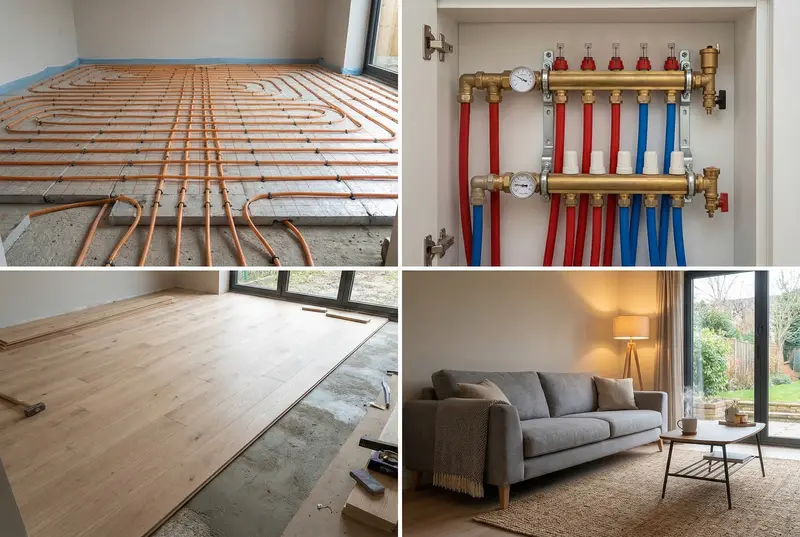
A wet underfloor heating installation in Dewsbury typically follows a clear sequence of stages. The first visit is a survey — a good installer will check your existing boiler capacity, measure the rooms, assess floor construction, and advise on zoning. Most homes benefit from splitting the system into zones (downstairs living areas, kitchen, bathrooms) so you're not heating rooms you're not using. Once the design is agreed, insulation boards go down first — this is non-negotiable for efficiency and is often skipped by less experienced fitters, so make sure it's included in any quote you receive. The pipe loops are then laid in the agreed pattern, connected back to a central manifold, and pressure-tested before any screed or floor covering goes on top. The screed curing process takes time — typically three to four weeks before it's fully ready for floor coverings — and the system needs to be commissioned carefully, starting at low temperatures and gradually increasing over several days to avoid cracking. For electric systems, the process is quicker: heating mats or cables are laid, a thermostat is wired in, and the system can often be operational within a day or two. Either way, a proper handover — where you're shown how to use the controls and set the zones correctly — is part of what you should expect from any decent installer in Dewsbury.
Why Choose a Local Dewsbury Specialist
Choosing an installer who knows Dewsbury well genuinely matters. A local tradesperson will understand the typical floor constructions found in the area's Edwardian semis and post-war housing, know which suppliers are nearby for materials, and be accessible for any follow-up if a zone isn't performing as expected after commissioning. They're also more likely to be familiar with the specific quirks of local boiler setups and water conditions. Beyond the practical side, working with someone based in or around Dewsbury means you're supporting local trades rather than a national firm that may subcontract the work to someone with no local knowledge at all.
Frequently Asked Questions
Can underfloor heating be added to an older Edwardian semi in Dewsbury without raising the floor height significantly?
Yes, but it depends on the floor type. If the ground floor is solid, a low-profile screed system using thinner insulation boards can limit the height increase to around 50–70mm. On suspended timber floors, aluminium spreader plate systems add very little height. A proper survey will confirm what's feasible in your specific property before any commitment is made.
Will my existing boiler in Dewsbury cope with an underfloor heating system?
Many modern combination and system boilers handle underfloor heating well, since UFH runs at lower flow temperatures than radiators — typically 35–45°C rather than 70–80°C. Older boilers or undersized units may need an upgrade or a buffer tank. An installer should assess your boiler output and age during the survey stage rather than assuming it will be fine.
Does the moderately hard water in Dewsbury cause any issues with underfloor heating pipework?
It can, over time. Scale build-up in the pipework and manifold is a real risk in hard water areas, and Dewsbury falls into that category. Adding a quality inhibitor to the system fluid and fitting a magnetic filter at the manifold when the system is installed gives good long-term protection. Annual inhibitor checks as part of a boiler service are sensible practice.
How long does underfloor heating installation take in a typical Dewsbury home?
For a wet system covering the ground floor, the physical installation usually takes two to five days depending on the size and complexity. After that, screed needs three to four weeks to cure fully before floor coverings go down and the system is commissioned properly. Electric mat systems are much quicker — often complete and operational within one to two days.
Other Plumbing Services in Dewsbury
What do you need?
Select your service and urgency level