Underfloor Heating in Islington
Underfloor heating has become one of the most sought-after home improvements across Islington, and it's easy to understand why. With energy costs still a real concern and a growing appetite for more comfortable, clutter-free living spaces, homeowners throughout the borough are moving away from traditional radiators and investing in systems that heat from the ground up. Whether you're renovating a flat in Highbury, extending a terrace in Canonbury, or fitting out a new-build in the redeveloped areas around King's Cross, underfloor heating can be a genuinely transformative upgrade — provided it's planned and installed properly from the outset.
Plumbing Conditions in Islington
Very Hard water — significant limescale buildup, annual boiler servicing essential
Mixed housing stock across different eras. With 22% of properties built before 1919, older pipework and drainage systems are common — specialist knowledge of period properties matters.
Underfloor Heating in Islington — Local Expertise
Islington's housing stock is one of the most varied in London, and that variation directly affects how underfloor heating is planned and installed. The borough is dominated by Victorian and Edwardian terraces — particularly in areas like Barnsbury, Canonbury, and Tufnell Park — where solid ground floors and suspended timber upper floors each require very different approaches. Solid floors typically suit wet (hydronic) systems, while suspended timber floors often work better with electric mat systems or require careful structural assessment before a wet system is fitted. Post-war council-built properties, found across estates in Finsbury and Holloway, often have concrete floors that are well-suited to wet UFH but may have lower ceiling heights that make screed depth a consideration. Newer developments, particularly around the Old Street and Angel areas, are usually easier to retrofit or may already have provisions for underfloor heating. Islington sits in a moderately hard water area, so if you're installing a wet hydronic system, using an appropriate inhibitor and fitting a good scale filter is advisable to protect your pipework and manifold over the long term.
How We Work
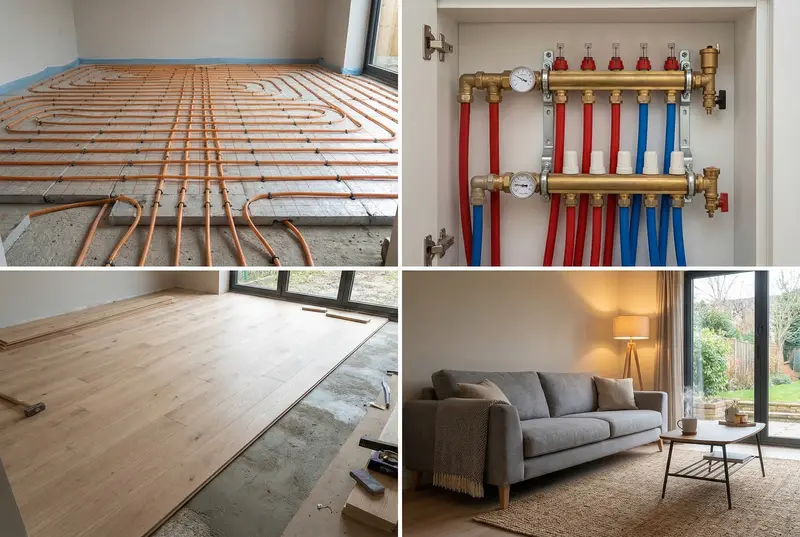
A proper underfloor heating installation in Islington follows a clear sequence, and rushing any stage tends to create expensive problems later. The process begins with a heat loss calculation — your installer should assess each room individually, factoring in the floor construction, insulation levels, glazing, and ceiling height. This determines whether the output will be sufficient and helps specify the right pipe spacing or mat density. For wet systems, the next stage is laying insulation boards directly onto the subfloor (typically 50–100mm, depending on the existing floor depth and the property's thermal performance). The UFH pipes are then clipped or stapled at calculated centres across each zone, connected back to a central manifold, and pressure tested before any screed or covering goes down. A liquid screed is commonly used in Islington properties being renovated because it flows around the pipes cleanly and reaches full strength relatively quickly, though traditional sand and cement screed remains an option. For electric systems, the heating mat is rolled out, connected to a thermostat, and embedded in adhesive or a thin screed. Either way, a curing period is essential — you should not run the system at full temperature immediately, as this can cause cracking. Each zone is then commissioned and balanced, and thermostats are programmed. Expect the full installation to take two to five days depending on property size and floor type.
Why Choose a Local Islington Specialist
Choosing a tradesperson who regularly works in Islington makes a real practical difference. They'll be familiar with the borough's planning sensitivities, particularly in the many conservation areas covering parts of Barnsbury, Canonbury, and Highbury Fields. They'll also have experience with the range of property types you find in the area — from full Georgian townhouses to purpose-built ex-council flats — and will know where problems typically arise during installation. Local engineers are also easier to call back for commissioning, adjustments, or warranty work, which matters on a long-term system like underfloor heating where you want confidence in the aftercare.
Frequently Asked Questions
Can underfloor heating be installed in a Victorian terrace in Islington?
Yes, and it's done regularly across the borough. The approach depends on whether you have a solid or suspended ground floor. Solid floors are generally straightforward to retrofit with a wet system and screed. Suspended timber floors require more planning — either an electric mat system or a specialist low-profile wet system designed to sit between or beneath the joists without significantly raising floor height.
How long does underfloor heating take to heat up compared to radiators?
Wet underfloor heating has a slower response time than radiators — typically 30 to 60 minutes to reach comfortable temperature — but it maintains heat more evenly and efficiently once up to temperature. Modern smart thermostats handle this well by learning your schedule and pre-heating accordingly. Electric systems respond faster, making them better suited to rooms used less frequently, like bathrooms or home offices.
Will underfloor heating work with my existing boiler, or do I need a new one?
In many Islington homes, your existing boiler can supply a wet underfloor heating system, though it may need to operate at a lower flow temperature than it currently does for maximum efficiency. A heating engineer should assess this as part of the survey stage. If you're planning to install a heat pump in the future, designing the UFH system for low-temperature operation from the start makes that transition considerably more straightforward.
Do I need planning permission to install underfloor heating in Islington?
In most cases, underfloor heating is treated as permitted development and doesn't require planning permission. However, if your property is listed — and there are a number of listed buildings in Islington's conservation areas — you'll need listed building consent before carrying out any work that affects the fabric of the building, including floor construction. Your installer should flag this early, and your local Islington planning office can confirm the status of your property if you're unsure.
Other Plumbing Services in Islington
What do you need?
Select your service and urgency level