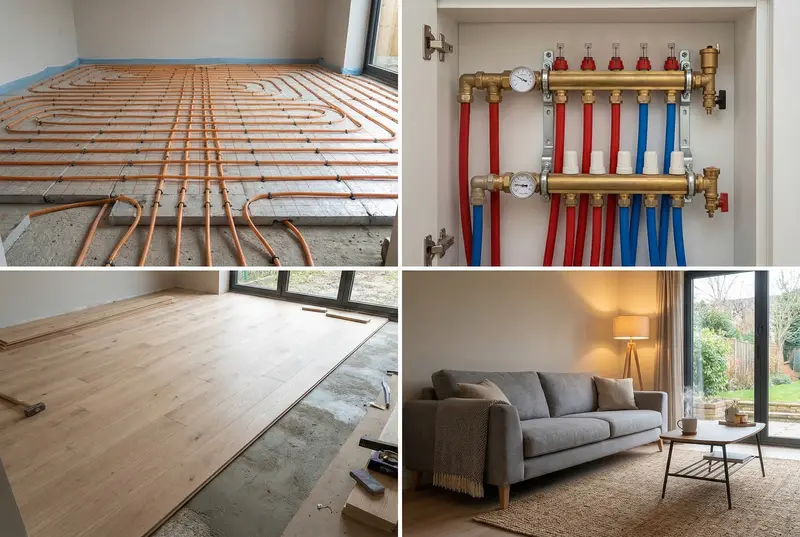
Underfloor Heating in Hackney
Underfloor heating has become one of the most sought-after home upgrades across Hackney, and it's easy to see why. Whether you're renovating a Victorian terrace in London Fields, extending a post-war flat in Homerton, or fitting out a new-build apartment near Hackney Wick, a well-installed underfloor heating system transforms how a home feels — and how efficiently it runs. Unlike radiators that blast heat from one point on a wall, underfloor heating spreads warmth evenly across the whole floor, eliminating cold spots and freeing up valuable wall space. It's a premium investment, but in Hackney's competitive property market, it consistently adds value and appeal.
Plumbing Conditions in Hackney
Very Hard water — significant limescale buildup, annual boiler servicing essential
Mixed housing stock across different eras. With 22% of properties built before 1919, older pipework and drainage systems are common — specialist knowledge of period properties matters.
Underfloor Heating in Hackney — Local Expertise
Hackney's housing stock is genuinely varied, and that variety has a real impact on how underfloor heating is specified and installed. Victorian terraces — common in areas like Stoke Newington, Clapton, and De Beauvoir — present specific challenges: solid ground floors, suspended timber upper floors, and often limited ceiling height that makes deep screed systems impractical. In these properties, low-profile electric mat systems or slim-profile wet systems using self-levelling compound are often the most sensible route. Post-war council-built properties across estates in Hackney Central and Hoxton tend to have concrete floors that accept screed-based wet systems more readily. Modern apartments and new-builds near Hackney Wick or the canal corridor often arrive partially prepared for wet underfloor heating already. It's also worth noting that Hackney sits in a moderately hard water area, which means that for wet underfloor heating systems, fitting an inline scale inhibitor or dosing the system with inhibitor fluid is genuinely important — hard water deposits inside the pipework will reduce efficiency and shorten system lifespan over time.
How We Work
A professional underfloor heating installation in Hackney begins with a proper site survey. An experienced installer will assess your floor construction, existing heat source (combi boiler, heat pump, or new boiler), insulation levels, and room dimensions before recommending wet or electric systems — or a combination of both. Skipping this step is where problems start, so don't let anyone quote you without seeing the property first. For a wet underfloor heating system, the process involves laying insulation boards to prevent heat loss downward, then routing flexible pipework in a continuous loop pattern across the floor. A manifold connects each zone back to the boiler or heat pump, and a programmable thermostat is fitted in each room. The floor is then covered either with a poured screed (which needs time to cure — usually 4 to 6 weeks before heavy foot traffic or final floor coverings) or a low-profile overlay board system that's walk-on within 24 hours. Electric mat systems are quicker to install — typically a day per room — and suit bathrooms, kitchens, or areas where a full wet system isn't cost-effective. Once installation is complete, the system is commissioned, pressure-tested, and balanced across zones to ensure even heat output. Your installer should walk you through the thermostat controls and explain the initial warm-up period, which can take a few days as the floor reaches its working temperature for the first time.
Why Choose a Local Hackney Specialist
Choosing a heating engineer who genuinely knows Hackney makes a practical difference. Local tradespeople understand the quirks of the borough's Victorian and post-war housing stock — the suspended floors, the older drainage layouts, the planning sensitivities in conservation areas around Stoke Newington and De Beauvoir. They'll know which suppliers are nearby, can revisit easily if anything needs adjusting, and often have existing relationships with local building control if your project requires a notification under Part L of the Building Regulations. An engineer who has worked across Hackney's varied property types will give you a more accurate quote and fewer surprises on the day.
Frequently Asked Questions
Can underfloor heating be installed in a Victorian terraced house in Hackney?
Yes, but it requires careful planning. Most Hackney Victorians have suspended timber ground floors, which means a low-profile overlay system or electric mats are often more practical than deep wet screed. An experienced installer will assess your specific floor construction and recommend the best approach — it's very much doable, just not one-size-fits-all.
How does hard water in Hackney affect an underfloor heating system?
Hackney's moderately hard water can cause limescale to build up inside wet underfloor heating pipework over time, reducing efficiency and potentially causing blockages. A good installer will either fit an inline scale inhibitor or add a corrosion and scale inhibitor fluid to the system at commissioning. This is a straightforward precaution that protects your investment long-term.
How long does underfloor heating installation take in a typical Hackney home?
A ground-floor wet system in a Hackney terrace or flat typically takes two to four days to install, not including screed curing time. Electric mat systems in a single room can be done in a day. If screeding is involved, you'll need to wait four to six weeks before laying final floor coverings, so factor this into your renovation timeline.
Is underfloor heating compatible with the combi boiler already in my Hackney flat?
Many modern combi boilers can run underfloor heating, but it depends on the boiler's output and the size of the area being heated. Underfloor systems work best at lower flow temperatures than conventional radiators, so your engineer may adjust the boiler settings or recommend a mixing valve. A proper heat loss calculation at survey stage will confirm whether your existing boiler is adequate.
Other Plumbing Services in Hackney
What do you need?
Select your service and urgency level