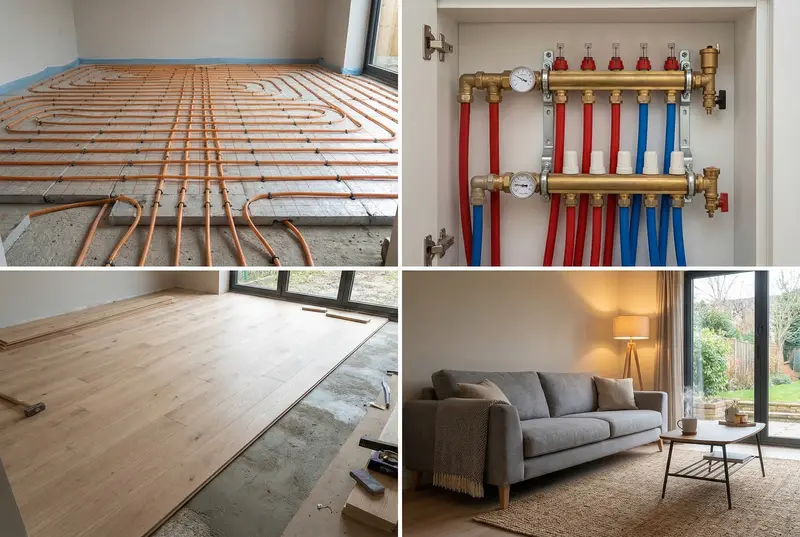
Underfloor Heating in Greenwich
You've just had new flooring laid in your Greenwich townhouse and you're seriously considering ditching the radiators for good. It's a thought more and more homeowners across SE10 are acting on — underfloor heating transforms how a room feels, frees up wall space, and runs more efficiently than traditional heating systems when paired with a modern heat pump or condensing boiler. Whether you're renovating a period conversion near Blackheath or fitting out a new-build flat in Greenwich Peninsula, getting the installation right from the start is everything. This guide covers what's involved, what it costs, and what questions to ask before you commit.
Plumbing Conditions in Greenwich
Very Hard water — significant limescale buildup, annual boiler servicing essential
Mixed housing stock across different eras. With 22% of properties built before 1919, older pipework and drainage systems are common — specialist knowledge of period properties matters.
Underfloor Heating in Greenwich — Local Expertise
Greenwich's housing stock is genuinely varied, and that variation matters enormously when planning underfloor heating. Victorian and Edwardian terraces — common around East Greenwich and Maze Hill — often have solid ground floors with limited depth, which makes wet underfloor heating more of a project than a simple fit. These properties typically require either a screed overlay, adding around 75–100mm of floor height, or a low-profile system using pre-formed boards to keep the build-up minimal. Post-war semis and council-era properties tend to have suspended timber floors, which suit electric mat systems or specially designed low-output wet systems with insulation boards fitted between joists. Modern apartments and new-builds on the Greenwich Peninsula and Woolwich waterfront are often pre-plumbed for underfloor heating already, making installation far more straightforward. On the water quality side, Greenwich sits in a moderately hard water area, which means treating your underfloor heating system with a suitable inhibitor is important — limescale buildup inside the pipework can reduce efficiency over time and shorten system life.
How We Work
A professional underfloor heating installation in Greenwich typically follows a clear sequence of stages. The first step is a site survey, where an installer assesses your floor construction, existing heat source, room dimensions, and insulation levels. This shapes every decision that follows — including whether a wet (hydronic) or electric system is the better fit for each room. Wet systems are generally better suited to whole-house installations and work well with heat pumps, while electric mat systems are often more practical for single rooms like bathrooms or extensions where running pipework would be disruptive. Once the system type is agreed, the installer will design the pipe or mat layout, calculate heat output requirements, and confirm manifold or thermostat positioning. For wet systems, installation involves laying insulation boards or screed to accept the pipework, connecting loops back to a manifold, pressure testing the circuit, and commissioning the system with the heat source. Electric systems involve laying heating mats under the floor finish, wiring to a dedicated thermostat, and testing continuity before the floor goes down. A full single-room electric installation can often be completed in a day; a whole-house wet system across multiple zones in a Greenwich Victorian terrace may take three to five days. After installation, the system needs a slow commissioning process — particularly for screed floors, which should be gradually brought up to temperature over several days to cure properly.
Why Choose a Local Greenwich Specialist
Choosing a tradesperson who regularly works in Greenwich makes a real practical difference. They'll understand the quirks of local property types — the shallow floor voids in Maze Hill terraces, the suspended timber floors in Greenwich's post-war housing, and the build-up constraints in period conversions where ceiling height is already compromised. A local installer is also more familiar with Greenwich planning considerations if your property sits within a conservation area, and they're accessible for any follow-up questions or adjustments after commissioning. Word-of-mouth reputation in a community like Greenwich matters, and established local tradespeople have a strong incentive to get the job right.
Frequently Asked Questions
Is underfloor heating practical in a Victorian terrace in Greenwich?
Yes, but it takes more planning than in a modern home. Solid ground floors often need a screed overlay or low-profile system to keep floor height manageable. Suspended timber upper floors can accommodate underfloor heating using insulated panels fitted between joists. A good installer will assess your specific floor construction and recommend the most practical approach for each room.
Will underfloor heating work with my existing boiler?
In most cases, yes. Modern condensing boilers in Greenwich homes are compatible with underfloor heating, though they perform best when the flow temperature is kept low — ideally 45–55°C rather than the higher temperatures used for radiators. If your boiler is older or oversized, an installer may suggest a blending valve or system upgrade. Heat pumps are an excellent pairing and are increasingly popular in Greenwich new-builds.
How does hard water in Greenwich affect an underfloor heating system?
Greenwich's moderately hard water supply means limescale can gradually build up inside underfloor pipework, reducing heat output and potentially causing long-term damage. A reputable installer will add a corrosion and scale inhibitor to the system at commissioning and may recommend a magnetic filter on the manifold. Annual system checks should include testing inhibitor levels to keep the system protected.
How long does underfloor heating take to heat a room compared to radiators?
Underfloor heating responds more slowly than radiators — typically 30 to 60 minutes to bring a room up to temperature, compared to 10 to 20 minutes for a radiator. This means it works best as a background heating system, left on at a lower temperature for longer periods. Smart thermostats with scheduling help manage this effectively, and running costs are often lower as a result.
Other Plumbing Services in Greenwich
What do you need?
Select your service and urgency level