Underfloor Heating in Camden
Wet (hydronic) systems are the more popular choice for whole-home installations and offer better long-term running costs, while electric mat systems suit smaller rooms or renovation projects where ripping up floors isn't practical. Camden homeowners increasingly see underfloor heating as a smart investment — it frees up wall space, works brilliantly with modern heat pumps, and adds genuine appeal when it comes time to sell.
Plumbing Conditions in Camden
Very Hard water — significant limescale buildup, annual boiler servicing essential
Mixed housing stock across different eras. With 22% of properties built before 1919, older pipework and drainage systems are common — specialist knowledge of period properties matters.
Underfloor Heating in Camden — Local Expertise
Camden's housing stock is one of the most varied in London, and that variety has a direct impact on underfloor heating projects. Victorian terraces — which make up a large proportion of homes in areas like Kentish Town, Tufnell Park, and Gospel Oak — often have suspended timber floors with limited depth beneath them, which can complicate wet system installations and sometimes makes electric systems a more practical option. Post-war properties, particularly the council-built stock across parts of Camden Town and Somers Town, tend to have solid concrete floors that are well-suited to wet underfloor systems, though insulation beneath the screed is essential to avoid heating the slab rather than the room. Newer builds and conversions in areas like King's Cross and Primrose Hill are increasingly being designed with underfloor heating in mind from the outset. Camden sits in a moderately hard water area, so any wet system should be installed with a quality inhibitor and ideally a magnetic filter to protect the manifold and pipework from limescale buildup over time.
How We Work
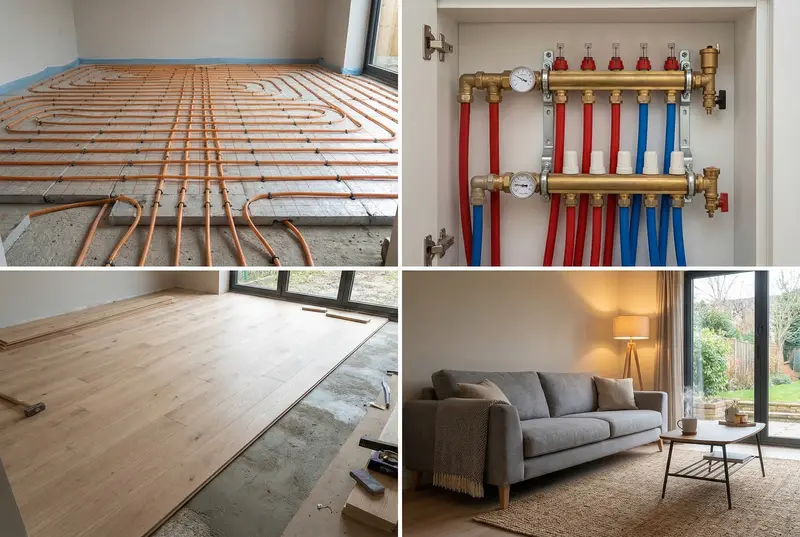
A proper underfloor heating installation in Camden starts well before anyone lifts a floorboard. A good installer will carry out a heat loss calculation for each room to make sure the system is correctly sized — undersized systems are one of the most common reasons underfloor heating disappoints homeowners. Once the design is agreed, the practical work begins with preparing the subfloor. For wet systems in solid floors, this typically involves laying insulation board, then running flexible polybutylene pipe in loops across the floor before pouring a liquid screed or sand-and-cement screed over the top. The screed needs to cure — usually around four to six weeks — before the system is gradually commissioned at low temperatures to prevent cracking. For suspended timber floors, the pipe is typically clipped into pre-routed insulation panels fitted between the joists, then boarded over. Electric mat systems are quicker to install and can often be fitted in a day per room beneath tiles or stone flooring. Once the underfloor circuits are laid, they connect to a manifold, which in turn links to your boiler or heat pump. Thermostats are fitted in each zone, giving you independent control room by room. The entire installation for a typical Camden house takes between three and ten days depending on scope, and a good installer will pressure-test the system before screeding and again before handover.
Why Choose a Local Camden Specialist
Choosing a heating engineer who knows Camden well makes a practical difference. Local installers understand which neighbourhoods are dominated by deep-joist Victorian floors and which post-war estates have the solid slabs that suit wet systems best. They'll have navigated the borough's planning considerations around listed buildings and conservation areas — relevant in parts of Primrose Hill and Hampstead — and they're familiar with the access challenges that come with narrow Camden terraces and basement flats. A local tradesperson also has established relationships with nearby suppliers, which can speed up lead times on materials and reduce costs passed on to you.
Frequently Asked Questions
Can underfloor heating be installed in a Victorian terraced house in Camden?
Yes, though it requires more planning than a modern property. Victorian terraces with suspended timber floors are best suited to low-profile electric systems or specially designed wet systems using slim insulation panels fitted between joists. A surveyor or heating engineer should assess the floor void depth before you commit to a system type, as this varies considerably across Camden's older housing stock.
How long does underfloor heating take to install in a typical Camden home?
For a wet system covering most of a house, expect the installation itself to take around five to ten days. The screed then needs four to six weeks to cure before the system can be fully commissioned. Electric systems are much faster — a single room can often be completed in a day. Planning the work to coincide with a kitchen or bathroom renovation is often the most cost-effective approach.
Does Camden's hard water affect underfloor heating systems?
Camden sits in a moderately hard water area, which means limescale is a genuine concern for wet underfloor systems over time. A quality corrosion inhibitor should be added at installation, and a magnetic system filter fitted to the manifold is strongly recommended. These are small costs that significantly extend the life of your pipework and protect against blockages that are expensive to remedy once a floor is screeded over.
Is underfloor heating compatible with a heat pump in a Camden property?
Underfloor heating and heat pumps are an excellent pairing. Heat pumps operate most efficiently at lower flow temperatures — typically 35 to 45°C — which is exactly what underfloor systems are designed for. Many Camden homeowners are now combining the two as part of broader energy upgrades. If you're planning a heat pump installation, designing the underfloor system to work with it from the outset will give you better efficiency and lower running costs.
Other Plumbing Services in Camden
What do you need?
Select your service and urgency level