Underfloor Heating in London
Underfloor heating is one of the most sought-after home upgrades in London right now, and it's easy to see why. Rising energy costs, cold winters, and the sheer pleasure of warm floors make it a compelling investment — especially in a city where heating bills can be eye-watering. But installing underfloor heating in London properties isn't as straightforward as it might seem. The city's housing stock comes with its own quirks, and getting it right requires someone who genuinely understands how these systems behave in real London homes, not just in showrooms.
Plumbing Conditions in London
Very Hard water — significant limescale buildup, annual boiler servicing essential
Mixed housing stock across different eras. With 22% of properties built before 1919, older pipework and drainage systems are common — specialist knowledge of period properties matters.
Underfloor Heating in London — Local Expertise
The vast majority of London's residential housing consists of Victorian terraces and Edwardian semis — beautiful homes, but ones that were never designed with modern heating systems in mind. Solid ground floors, suspended timber joists, low ceiling heights, and cramped understairs runs all present challenges that a straightforward new-build installation simply wouldn't face. Retrofitting underfloor heating into a Victorian terrace in Hackney or an Edwardian semi in Ealing means working carefully around existing structures, and sometimes choosing between wet (hydronic) and electric systems based purely on what the building can accommodate. London is also a hard water area, served by Thames Water and Affinity Water. This matters for wet underfloor heating systems because limescale build-up inside pipework can reduce efficiency and shorten system life. A competent installer working in London should be recommending inhibitor treatments and, in many cases, an inline scale reducer or water softener as part of the installation package.
How We Work
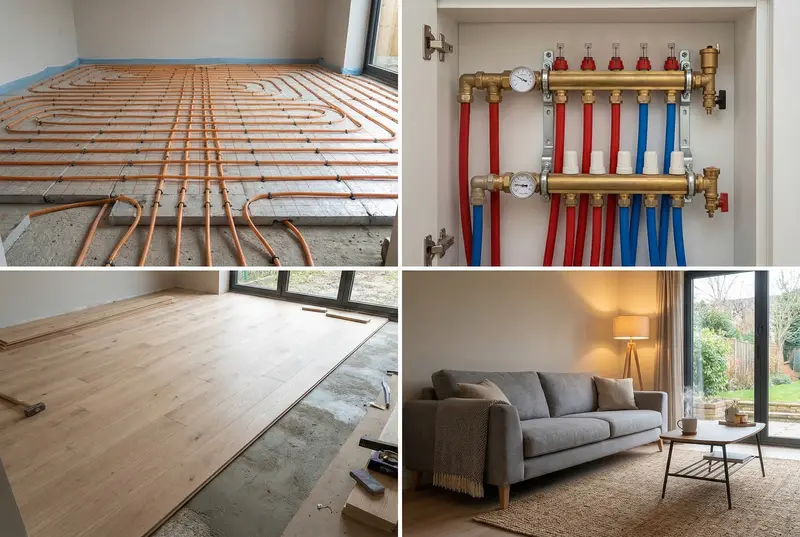
A proper underfloor heating installation in London starts well before anyone lifts a floorboard. The first stage is a survey — a good installer will assess your floor construction, the heat load of each room, your boiler capacity (for wet systems), and whether your insulation is up to scratch. Insulation is critical: without adequate coverage beneath the pipes or cables, you're essentially heating the ground rather than your home, and energy bills will reflect that painfully. For wet systems, manifolds are installed — typically housed in a cupboard — and loops of flexible pipe are laid across the floor in a measured pattern before screed or boarding is placed over them. For electric systems, heating mats or cables are laid directly under tiles or engineered flooring. The process in a Victorian terrace often involves lifting existing floorboards, installing rigid insulation between joists, laying the pipework or cables, and reinstating the floor finish. In rooms with solid floors, a self-levelling screed is usually poured over the pipes. Throughout London, planning access — parking permits, skip licences, managing works in terraced streets — is part of the job too. Most full-room installations take between one and three days per room, depending on complexity. After installation, the system needs a commissioning period: wet systems require a slow heat-up cycle over several days to cure the screed properly before the floor covering goes down.
Why Choose a Local London Specialist
Underfloor heating isn't a job to hand to someone unfamiliar with London's housing stock. A local installer will have worked inside dozens of Victorian terraces and Edwardian semis and will know the common structural surprises — the awkward joist runs, the uneven solid floors, the undersized boilers that need upgrading before a wet system will perform properly. They'll also understand London's logistical realities: parking restrictions, conservation area rules in many inner-London boroughs, and the lead times involved in getting materials delivered to congested addresses. Local knowledge genuinely saves time and money on a project of this size.
Frequently Asked Questions
Can underfloor heating be installed in a Victorian terrace with suspended timber floors?
Yes, and it's actually one of the more common installations we carry out across London. The boards are lifted, rigid insulation is fitted between the joists, and pipework or heating cables are run across the insulation before the floor is reinstated. It adds time compared to a solid floor, but it's entirely achievable and very effective when done properly.
Will London's hard water affect my underfloor heating system?
It can do, yes. London's hard water supply from Thames Water and Affinity Water means limescale can accumulate inside wet underfloor heating pipework over time, reducing flow and efficiency. A good installer will add a corrosion and scale inhibitor to the system at commissioning and may recommend an inline scale filter — particularly in older London properties where the incoming water is especially hard.
How long does a full underfloor heating installation take in a London home?
For a ground floor wet system in a typical Victorian terrace or Edwardian semi, allow three to seven days for the physical installation, depending on room count and floor type. After that, screeded floors need a slow curing and commissioning period — usually one to two weeks — before floor coverings go down. Your installer should provide a detailed programme before work starts.
Do I need planning permission to install underfloor heating in London?
In most cases, no. Underfloor heating is considered permitted development for standard residential properties. However, if your London home is a listed building or sits within a conservation area — common in many inner-London boroughs — you should check with your local council before starting work, as there may be restrictions on the types of work or floor finishes that are permitted.
Other Plumbing Services in London
What do you need?
Select your service and urgency level