Underfloor Heating in Plymouth
Most people in Plymouth start thinking seriously about underfloor heating when they're already mid-renovation — pulling up old carpets, replumbing a bathroom, or extending into the garden. It's one of those upgrades that makes most sense when the floor is already coming up, so the labour costs don't feel like they're doubling your budget. Underfloor heating delivers a noticeably different kind of warmth: even, radiant heat from below rather than hot air blasting from a radiator. For a city like Plymouth, where damp Atlantic winters can make older homes feel perpetually cold, it's an investment that genuinely changes how comfortable your home feels day to day.
Plumbing Conditions in Plymouth
Moderately Hard water
Mixed housing stock across different eras. With 22% of properties built before 1919, older pipework and drainage systems are common — specialist knowledge of period properties matters.
Underfloor Heating in Plymouth — Local Expertise
Plymouth's housing stock is genuinely varied, and that variety matters a lot when it comes to underfloor heating. The city has a significant number of Victorian terraces — particularly around Mutley, Lipson, and Stoke — where solid stone or suspended timber floors make installation more complex and expensive than in newer builds. Post-war housing, which fills much of Plympton, Plymstock, and Ernesettle, often has solid concrete ground floors that are actually well suited to wet underfloor heating systems, though insulation underneath is critical to efficiency. Modern new-builds in areas like Sherford and Derriford tend to come UFH-ready or can be retrofitted relatively easily. Plymouth also sits in a moderately hard water area, which is worth factoring in if you're installing a wet (hydronic) system — a water treatment solution or inhibitor should be specified from the start to protect the pipework and your boiler from scale build-up over time.
How We Work
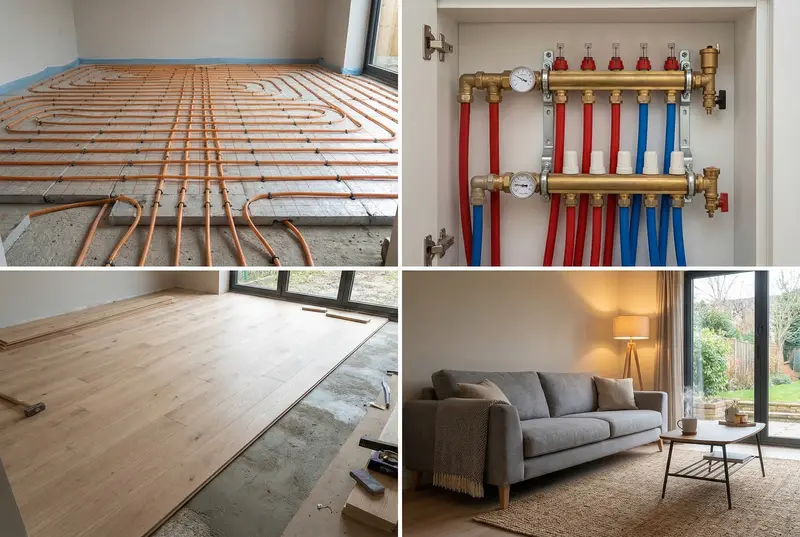
A wet underfloor heating installation starts with a survey of your property — a good installer will assess your floor construction, existing heat source, insulation levels, and room layout before quoting. In Plymouth homes with solid concrete floors, the process typically involves laying insulation boards first (essential — without them you're heating the ground, not the room), then fixing the UFH pipework in a snake or spiral pattern before screeding over the top. The screed needs to cure for several weeks before the system is commissioned, so timing matters if you're coordinating with other trades. For suspended timber floors, a different approach is used — either routing pipes into purpose-cut channels in the joists, or using low-profile aluminium spreader plates that sit between the boards. This method suits many Plymouth Victorian properties where raising floor height isn't an option. Once installed, the system connects to your existing boiler or heat pump via a manifold, which controls flow to each room independently. Commissioning involves a slow heat-up process over several days to cure the screed properly and balance the system. A competent installer will walk you through the controls — usually a smart thermostat setup — and leave you with system documentation for future reference.
Why Choose a Local Plymouth Specialist
Choosing a Plymouth-based installer rather than a national firm genuinely makes a difference here. Local tradespeople understand the quirks of Plymouth's housing — they'll have worked on Edwardian terraces in Greenbank, post-war builds in Honicknowle, and new estates out toward Wembury. They know which local suppliers stock the materials they need, can revisit quickly if there's a commissioning issue, and tend to rely heavily on local reputation for repeat work and referrals. For a high-value installation like underfloor heating, that accountability matters. Ask specifically for examples of similar Plymouth properties they've worked on.
Frequently Asked Questions
Can underfloor heating be installed in an older Plymouth Victorian terrace?
Yes, but it requires careful planning. Suspended timber floors need a different installation method to solid floors, and raising floor height can be a concern in period properties. An experienced Plymouth installer will assess whether low-profile systems or joisted channel routing works best for your specific house, and whether your boiler has enough capacity to run the system efficiently.
How does Plymouth's moderately hard water affect a wet UFH system?
Hard water causes limescale build-up inside pipework and boiler components over time. For a wet underfloor heating system in Plymouth, your installer should add a corrosion and scale inhibitor to the system water, and ideally fit a magnetic filter on the return pipe. This is standard good practice locally and protects your investment for the long term.
How long does underfloor heating installation take in a typical Plymouth home?
For a whole ground floor in an average Plymouth semi, the physical installation usually takes three to five days. However, if a sand and cement screed is laid, you'll need to allow four to six weeks for it to cure before floor coverings go down. Anhydrite (liquid) screeds cure faster. Your installer should give you a realistic programme before work starts.
Is underfloor heating compatible with the heat pumps being installed under government schemes?
Absolutely — underfloor heating and heat pumps are an ideal pairing. Heat pumps work most efficiently at lower flow temperatures, and UFH systems are designed to operate exactly at those temperatures. If you're thinking about a future heat pump installation in your Plymouth home, installing UFH now is a smart preparatory step that will make the switch much more cost-effective later.
Other Plumbing Services in Plymouth
What do you need?
Select your service and urgency level