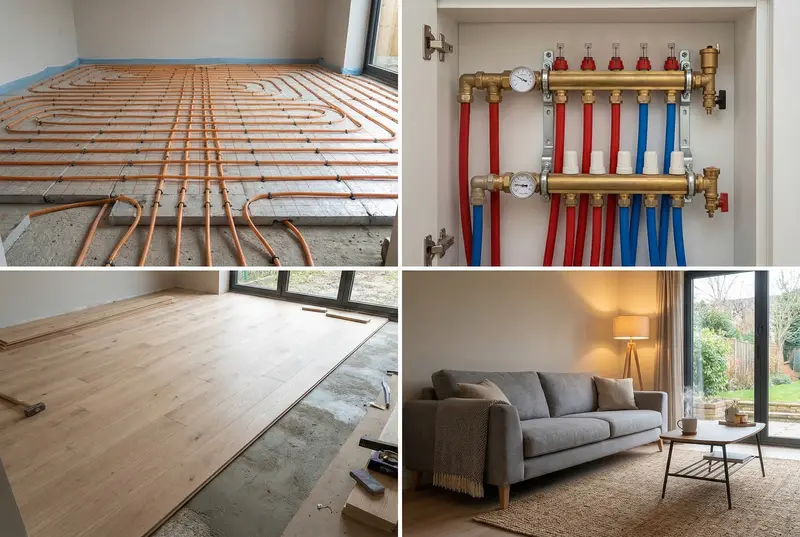
Underfloor Heating in Bristol
You've finally decided to do something about those cold stone floors in your Bristol Victorian terrace — the ones that make you wince every morning between October and March. Underfloor heating is increasingly popular in Bristol homes, and it's easy to see why. It delivers even, comfortable warmth across the whole room without radiators eating into your wall space, and it works beautifully with the high-ceilinged, open-plan layouts that many Bristol homeowners are creating by knocking through original Victorian rooms. Whether you're renovating a period property in Clifton or extending a semi in Bishopston, underfloor heating is well worth serious consideration as part of the project.
Plumbing Conditions in Bristol
Moderately Hard water
Mixed housing stock across different eras. With 22% of properties built before 1919, older pipework and drainage systems are common — specialist knowledge of period properties matters.
Underfloor Heating in Bristol — Local Expertise
Bristol's housing stock creates a genuinely interesting backdrop for underfloor heating work. The city is dominated by Victorian terraces and Edwardian semis — properties built with solid ground floors, often suspended timber upper floors, and original floor coverings that have been replaced multiple times over 120 years. This matters practically: wet underfloor heating systems (water-fed pipes connected to your boiler or heat pump) suit ground-floor extensions and new concrete screed floors very well, while electric mat systems are often the smarter choice for upstairs bathrooms or rooms where lifting an original suspended timber floor isn't desirable. Bristol is also a moderately hard water area, which means that inhibitor treatment and proper system flushing are essential when connecting wet UFH to an existing central heating circuit — limescale buildup in underfloor pipework is a genuine long-term risk if the installation isn't done carefully. A good local installer will pressure-test thoroughly and use appropriate inhibitor concentrations suited to Bristol's water supply.
How We Work
A typical underfloor heating installation in Bristol begins with a proper site assessment. The installer will look at your floor construction, insulation levels beneath the floor (critical for efficiency — heat needs to go upward, not into your subfloor), your boiler or heat pump output, and the room dimensions. For wet systems, the next stage is laying insulation board, then running the pipe loops in a serpentine or spiral pattern before the screed is poured over the top. The screed then needs a curing period — usually around three to four weeks — before the system is gradually commissioned, starting at low temperatures and slowly ramping up to avoid cracking. For electric mat systems, the process is quicker: mats are rolled out on the subfloor, the thermostat and sensor are wired in, and the floor covering goes straight over the top, often within a day. In both cases, your installer should provide a full pressure test certificate for wet systems, a wiring certificate for electric installations, and a walkthrough of the thermostat controls. Zoning — splitting different rooms onto separate circuits with individual thermostats — is worth doing properly from the start, and a good Bristol installer will plan this carefully rather than wiring everything to a single stat.
Why Choose a Local Bristol Specialist
Choosing a Bristol-based installer rather than a national firm genuinely makes a difference with underfloor heating. Local tradespeople understand the specific challenges of the city's Victorian and Edwardian housing stock — they've dealt with the quirks of suspended timber ground floors in Southville terraces and the deep screed requirements of Bedminster extensions. They also know which Bristol building inspectors require notification for wet system installations connected to existing heating circuits, and they're available for follow-up visits when you need your system re-balancing in the first heating season — something that's harder to arrange with a company based hours away.
Frequently Asked Questions
Can underfloor heating be fitted in an older Bristol Victorian terrace with original floorboards?
Yes, but the approach depends on which floor you're working on. For ground floors with suspended timber, specialist low-profile wet systems can be fitted between or beneath the joists without losing floor height. For upper floors, an electric mat system is often more practical and less disruptive. A proper survey of your Bristol property will determine which system suits the construction.
How long does underfloor heating take to warm up compared to radiators?
Wet underfloor heating has a slower response time than radiators — typically 30 to 60 minutes to reach comfortable temperature — which is why programmable thermostats are important. Electric systems respond faster. In Bristol's climate, most homeowners run their UFH on a schedule rather than on demand, which suits the longer warm-up time and keeps running costs manageable through the winter months.
Does Bristol's moderately hard water affect underfloor heating systems?
It's worth taking seriously. Limescale can accumulate inside underfloor pipe loops over time, reducing efficiency. A good installer will flush your system thoroughly, add the correct concentration of inhibitor, and fit a magnetic filter. Annual inhibitor checks — which any Bristol heating engineer can carry out — will protect your system and keep your manufacturer's warranty valid for the long term.
Do I need building regulations approval for underfloor heating in my Bristol home?
For wet underfloor heating connected to a boiler or heat pump, the work needs to comply with Part L and Part P of the Building Regulations. In most cases your installer will handle notification through a competent persons scheme. If you're also doing structural work — like an extension — your Bristol building control officer will inspect the UFH installation as part of the wider project sign-off.
Other Plumbing Services in Bristol
What do you need?
Select your service and urgency level