Underfloor Heating in Bath
Bath is a city that takes its architecture seriously, and rightly so. Underfloor heating has become one of the most sought-after upgrades for homeowners here, precisely because it solves a problem that radiators never quite could — delivering comfortable, even warmth without cluttering the walls of rooms where original features and period proportions genuinely matter. Whether you're in a Georgian townhouse near the Circus or a Victorian terrace in Oldfield Park, underfloor heating offers a cleaner, more efficient alternative that works with your home rather than against it.
Plumbing Conditions in Bath
Moderately Hard water
Mixed housing stock across different eras. With 22% of properties built before 1919, older pipework and drainage systems are common — specialist knowledge of period properties matters.
Underfloor Heating in Bath — Local Expertise
Bath's housing stock is unlike almost anywhere else in the UK. The city is dominated by Georgian townhouses and period properties, many of which sit within a UNESCO World Heritage Site, meaning any significant work needs to be approached with care and a genuine understanding of older building fabric. These properties typically have solid stone floors, suspended timber floors, or a mixture of both — each of which changes the type of underfloor heating system that's appropriate and how it's installed. Wet (hydronic) systems are generally preferred in Bath for full-floor retrofits because they operate at lower water temperatures, which suits both the building fabric and the energy efficiency goals most homeowners have. Bath sits in a moderately hard water area, which is worth factoring in when specifying your underfloor heating system — a good installer will recommend appropriate inhibitor treatments and possibly a scale reducer to protect the pipework and manifold over the long term, keeping maintenance costs down.
How We Work
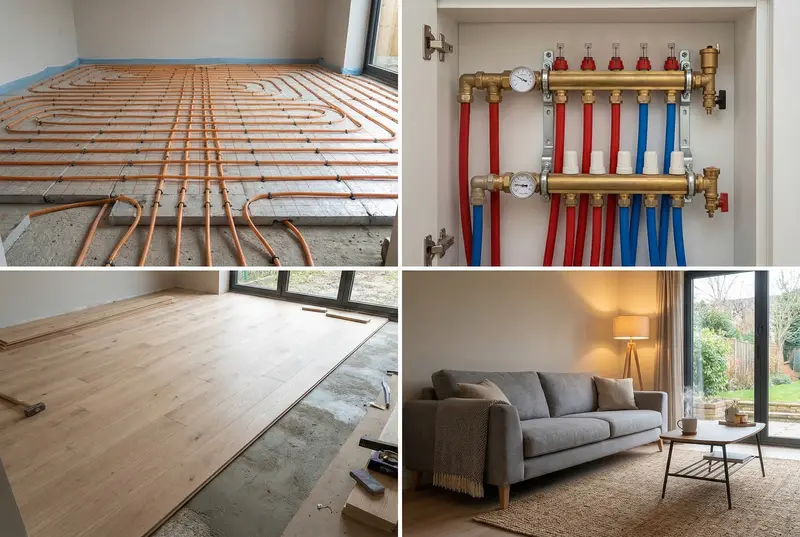
A professional underfloor heating installation in Bath follows a clear process, though the details vary considerably between property types. The first step is always a site survey, where an engineer assesses your floor construction, existing heating system, room dimensions, and insulation levels. In Georgian townhouses, this survey often turns up surprises — uneven subfloors, buried services, or particularly thick stone flags — so a thorough assessment upfront saves significant disruption later. For wet systems, pipe loops are laid across the floor in a serpentine or spiral pattern, connected back to a manifold that controls flow to each zone independently. In solid floor situations, this typically means laying insulation board, then the pipework, then a screed layer on top — a process that adds around 100–150mm to floor height, which needs planning in rooms with low ceilings or existing fitted joinery. In properties with suspended timber floors, the pipes are fitted between or beneath the joists using heat-diffusion plates, which is less invasive but requires careful access planning. Electric mat systems are also available and are often a practical choice for single rooms, bathrooms, or where raising floor height isn't possible. Once installed, your engineer will commission the system, balance the zones, and connect it to your existing boiler or heat pump. Most installations in Bath take between two and five days depending on the number of rooms and floor type.
Why Choose a Local Bath Specialist
Choosing a tradesperson who knows Bath well genuinely matters for a project like this. Local engineers will have hands-on experience with the particular quirks of Georgian and Victorian floor construction in this city — the way stone floors behave, the common layouts of period properties, and how to work sensitively around original features. They'll also be familiar with local building control requirements and, where relevant, the considerations that come with listed building consent. An installer who has worked extensively across Bath's housing stock will anticipate problems before they become costly ones, and that experience is worth paying for.
Frequently Asked Questions
Can underfloor heating be installed in a listed Georgian property in Bath?
Yes, but it requires careful planning. Listed building consent may be needed depending on the works involved, and the system design must avoid damage to original fabric. Many Bath properties have had underfloor heating successfully installed using low-profile electric mats or carefully designed wet systems with minimal screed depth. Always use an installer experienced with heritage properties.
Will underfloor heating work with my existing boiler?
It depends on the boiler's age and condition. Underfloor heating runs most efficiently at lower flow temperatures — around 45–55°C — which modern condensing boilers handle well. Older boilers may struggle to run efficiently at these temperatures. Your installer will assess compatibility during the survey and advise whether an upgrade or heat pump would make the system more cost-effective long term.
How does Bath's hard water affect an underfloor heating system?
Bath's moderately hard water can cause limescale buildup inside pipework and at the manifold if the system isn't properly treated. A good installer will add a suitable inhibitor to the system fluid and may recommend a scale reducer or filter. This is straightforward to manage but important to address at installation — it protects your investment and keeps the system running efficiently for years.
How long does underfloor heating take to heat up in a period property?
Wet underfloor systems in stone or screed floors have a longer warm-up time than radiators — typically two to four hours to reach comfortable temperature. This is normal and easily managed with a programmable thermostat set to come on ahead of when you need it. The upside is that stone floors retain heat well, so the system runs less frequently overall, which can lower energy bills.
Other Plumbing Services in Bath
What do you need?
Select your service and urgency level