Underfloor Heating in Exeter
Most Exeter homeowners who contact us are either renovating a kitchen, extending their home, or finally tackling a cold ground floor that's been uncomfortable for years. It's a significant investment, but it genuinely transforms how a room feels to live in — and when it's properly designed and installed, it's one of the most efficient ways to heat a home in this part of Devon.
Plumbing Conditions in Exeter
Moderately Hard water
Mixed housing stock across different eras. With 22% of properties built before 1919, older pipework and drainage systems are common — specialist knowledge of period properties matters.
Underfloor Heating in Exeter — Local Expertise
Exeter's housing stock is varied, and that variety matters a great deal when planning underfloor heating. Victorian and Edwardian semis — particularly in areas like St Leonard's and Heavitree — tend to have solid ground floors or original suspended timber, which affects which system is viable and how much prep work is involved. Lifting and insulating beneath a solid concrete floor in an Edwardian terrace is very different from laying a thin electric mat under tiles in a modern St Thomas new-build. Post-war estates across Exeter, many built between the 1950s and 1970s, often have low floor-to-ceiling heights, making floor depth a real constraint. Exeter sits in a moderately hard water area, which is worth noting for wet underfloor heating systems — limescale build-up inside the pipework can reduce efficiency over time if the system isn't properly commissioned and the water chemistry isn't managed. A good installer will discuss inhibitor treatment and ongoing maintenance from the outset.
How We Work
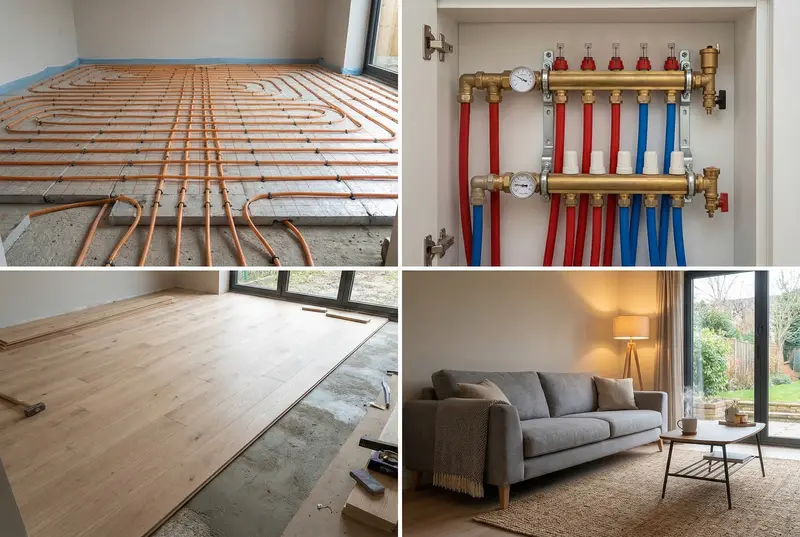
The installation process for wet underfloor heating begins with a proper heat loss calculation for each room — this isn't optional, it's how your installer works out pipe spacing, flow rates, and whether your existing boiler can handle the load. Skipping this step leads to systems that don't perform. Once the design is agreed, the groundwork starts: existing flooring comes up, the subfloor is inspected, and insulation boards are laid. Insulation is critical — without it, you're heating the ground, not the room. The pipe circuits are then laid in a pattern calculated during the design stage and connected to a manifold, usually positioned in a cupboard or utility area. The system is pressure tested before any screed or floor covering goes down. If you're using liquid screed — common in Exeter new-build and renovation projects — there's a curing period of several weeks before the system can be fully commissioned. Electric systems are quicker: the heating element is laid directly on the subfloor, a thermostat is wired in, and the floor covering goes straight over the top. Both types require a final commissioning visit where flow rates are balanced, thermostats are programmed, and the homeowner is walked through how everything works. Expect the full installation on a typical Exeter semi to take three to five days for wet systems, and one to two days for electric.
Why Choose a Local Exeter Specialist
Choosing an installer who works regularly in Exeter makes a practical difference. They'll know the typical construction quirks of Heavitree terraces and post-war estates on the outskirts of the city — things like original quarry tile floors sitting directly on earth, or low-grade concrete subfloors that need more preparation than expected. A local tradesperson also has established relationships with Exeter-based merchants for materials and can usually respond quickly if a follow-up visit is needed during commissioning. Local knowledge of building control requirements in Devon is useful too, particularly if your project involves structural changes or a new heat source.
Frequently Asked Questions
Is underfloor heating suitable for an older Exeter property with suspended timber floors?
Yes, but it needs careful planning. Suspended timber floors in Exeter's Edwardian and Victorian homes can accommodate underfloor heating using a low-profile electric system or specially designed wet pipe clips fitted between the joists from below. Your installer will assess joist depth, current floor height, and insulation options before recommending the right approach.
How does Exeter's moderately hard water affect a wet underfloor heating system?
Hard water can cause limescale to build up inside the pipework over time, reducing flow and efficiency. In Exeter, it's standard practice for installers to add a scale inhibitor to the system at commissioning and recommend annual checks of water chemistry. It's a straightforward precaution that significantly extends the system's working life.
Can I add underfloor heating to just one room, or does it have to be the whole ground floor?
You can absolutely install it in a single room — many Exeter homeowners start with a kitchen extension or bathroom. A standalone electric system is ideal for this and doesn't require changes to your boiler. Wet systems can also be zoned to cover one area, though they're more cost-effective when covering a larger combined floor area.
How long does underfloor heating take to warm up, and will it work well with my existing Exeter home's insulation levels?
Wet underfloor heating typically takes one to two hours to reach temperature — it's designed to run at lower temperatures for longer periods rather than blasting heat quickly. In older Exeter properties with limited wall insulation, a heat loss survey is essential to make sure the system is sized correctly and won't struggle to maintain comfortable temperatures on cold Devon days.
Other Plumbing Services in Exeter
What do you need?
Select your service and urgency level