Underfloor Heating in Nottingham
It's a significant investment, but one that pays dividends in comfort and efficiency — especially in older homes where radiators struggle to heat large, draughty rooms evenly. Nottingham homeowners are increasingly choosing underfloor heating as part of broader renovation projects, pairing it with heat pumps or upgraded boilers to future-proof their homes. Get the spec right from the start and it's a genuinely transformative upgrade.
Plumbing Conditions in Nottingham
Moderately Hard water — Trent Valley
Mixed housing stock across different eras. With 22% of properties built before 1919, older pipework and drainage systems are common — specialist knowledge of period properties matters.
Underfloor Heating in Nottingham — Local Expertise
Nottingham's housing stock presents some specific challenges for underfloor heating installers. The city is dominated by Victorian terraces and Edwardian semis — properties built with solid ground floors, low ceiling heights, and floor-to-ceiling dimensions that leave little room for adding depth. Retrofitting a wet underfloor heating system into a solid concrete or suspended timber floor requires careful planning: you may need to lower the floor level slightly or use a low-profile system to avoid affecting door clearances and skirting heights. Nottingham also sits in a moderately hard water area, which means a properly dosed inhibitor and a quality manifold with corrosion protection are important considerations for wet systems — scale build-up in the pipework is a real long-term risk if this is overlooked. A good installer will account for all of this in the survey, not as an afterthought.
How We Work
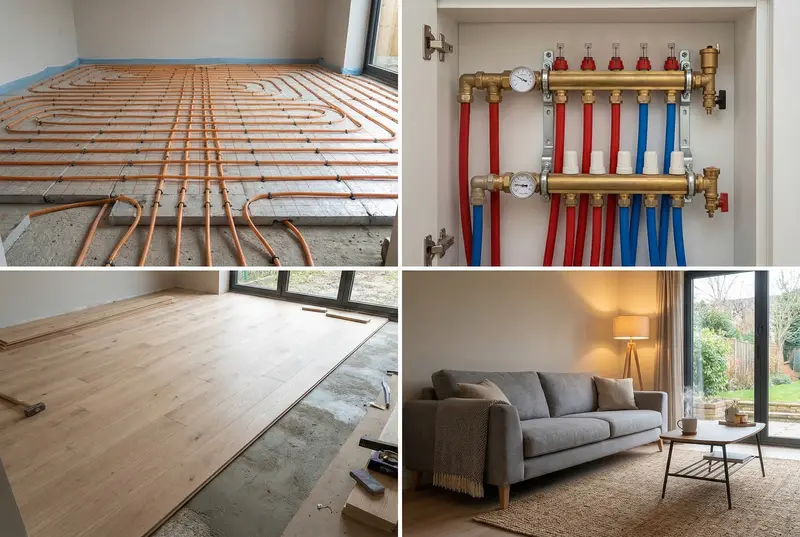
A professional underfloor heating installation in Nottingham begins with a proper heat loss survey of your home. This isn't optional — it determines whether the system will actually keep the rooms warm, and it shapes the pipe spacing, flow temperatures, and manifold design. For wet systems (the most common choice for whole-room or whole-house installations), the installer will lay cross-linked polyethylene pipework in a structured pattern across the floor before screed or a low-profile panel system is installed on top. The manifold, which controls flow to each zone, is typically fitted in a cupboard or utility area and connected back to your boiler or heat pump. Electric mat systems are simpler to install and suit smaller areas like bathrooms or single rooms, but they're more expensive to run day-to-day. Once the pipework is laid, the system is pressure-tested before any screed is poured. With a sand-and-cement screed, you'll need to allow a curing period — usually two to four weeks — before the heating is commissioned. Your installer should walk you through the controls, set up the thermostat zones, and explain how to run the system efficiently. In Nottingham's older properties, floor preparation often takes as long as the installation itself, so build that time into your project plan.
Why Choose a Local Nottingham Specialist
Choosing a Nottingham-based installer matters more than people realise. Someone who works regularly across the city's Victorian terraces and Edwardian semis will understand the quirks — awkward joist directions, varying floor depths, the constraints of back-to-back terraces in areas like Sherwood, Mapperley, or West Bridgford. A local tradesperson can also revisit easily if a zone needs balancing or a thermostat needs attention after commissioning. Lead generation sites connect you with vetted local specialists who know Nottingham's housing stock and can give you an accurate quote based on what they've actually seen in similar properties nearby.
Frequently Asked Questions
Can underfloor heating be installed in a Victorian terrace in Nottingham?
Yes, but it requires careful planning. Many Nottingham Victorian terraces have solid concrete or suspended timber ground floors, both of which can accommodate underfloor heating with the right system specification. Low-profile wet systems or electric mats are often used where floor depth is limited. A proper survey before any work starts is essential.
How long does underfloor heating installation take in a typical Nottingham home?
For a full ground floor wet system in a Nottingham terrace or semi, the physical installation usually takes two to four days. If sand-and-cement screed is used, add another two to four weeks for curing before the heating can be commissioned. Electric systems are quicker — typically one to two days per room with no curing time needed.
Does Nottingham's hard water affect underfloor heating systems?
Nottingham is a moderately hard water area, which means mineral scale can build up inside wet underfloor heating pipework over time if the system isn't properly treated. A quality installer will dose the system with an appropriate inhibitor at commissioning and may recommend a scale reducer depending on your water hardness. This is a simple step that significantly extends system life.
Is underfloor heating compatible with a combi boiler in a Nottingham property?
Most modern combi boilers can run underfloor heating, but they need to be capable of delivering lower flow temperatures — ideally 35–45°C rather than the 70°C typical for radiators. Some older combis may not modulate low enough to run the system efficiently. An installer familiar with Nottingham's typical boiler setups can assess compatibility during the initial survey.
Other Plumbing Services in Nottingham
What do you need?
Select your service and urgency level