Underfloor Heating in Leicester
Most homeowners in Leicester start thinking seriously about underfloor heating when they're already mid-renovation — typically when they're pulling up old floorboards or retiling a kitchen and realise it's the ideal moment to lay pipework underneath. It's one of those upgrades that's significantly easier and cheaper to install during other building work than as a standalone project. Underfloor heating delivers warmth more evenly than traditional radiators, reduces dust circulation, and frees up wall space — all genuine benefits in a city where terrace and semi properties often have compact, characterful rooms that radiators tend to dominate.
Plumbing Conditions in Leicester
Moderately Hard water — mixed Midlands geology
Mixed housing stock across different eras. With 22% of properties built before 1919, older pipework and drainage systems are common — specialist knowledge of period properties matters.
Underfloor Heating in Leicester — Local Expertise
Leicester's housing stock is dominated by Victorian terraces and Edwardian semis, particularly across areas like Clarendon Park, Stoneygate, Aylestone, and Evington. These properties present specific challenges for underfloor heating installation. Original suspended timber floors require either an overboarded system using low-profile insulated panels, or lifting the boards entirely to install between the joists — both viable approaches, but each with cost and disruption implications. Solid Victorian-era floor slabs, where they haven't been replaced, often need a screed overlay or a specialist low-build system to keep floor heights manageable. Leicester is also a moderately hard water area, which means any wet underfloor heating system should include appropriate corrosion inhibitor and ideally a magnetic filter to protect the manifold and pipework from limescale buildup over time — something a good local installer will factor in as standard rather than an afterthought.
How We Work
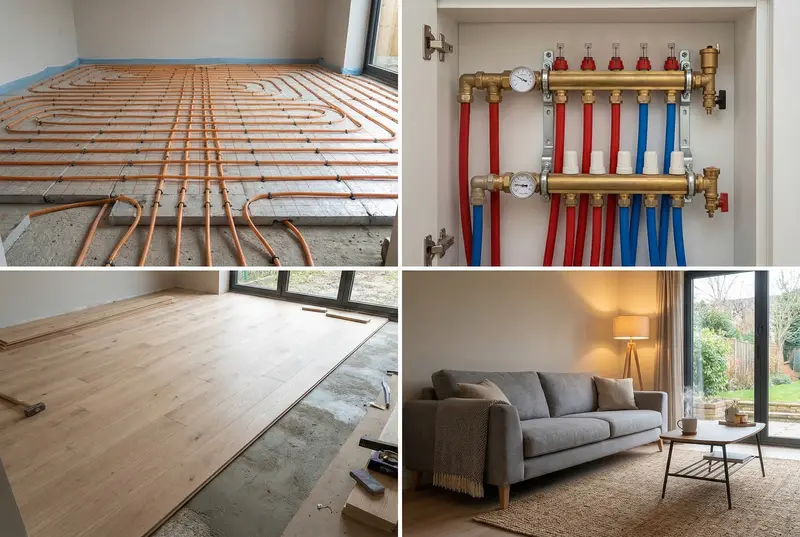
A wet underfloor heating installation — the type connected to your boiler or heat pump — follows a reasonably predictable process once a surveyor has assessed your floor construction and heat loss requirements. The first stage is a site survey, where the installer checks floor depths, existing pipework runs, boiler output, and room-by-room heat demand. This informs the system design, including pipe spacing and manifold placement. In a typical Leicester terrace, the manifold is usually located in a utility area, kitchen, or understairs cupboard. Pipework is then laid in loops across the floor area, either within a screed (for solid floors), clipped to insulation boards, or pushed through between joists on timber floors. Insulation beneath the pipework is critical — without it, you're heating the ground rather than the room. Once pipework is pressure-tested and the floor finished, the manifold is connected to the heating circuit and the system is commissioned, balanced, and tested across all zones. Electric underfloor heating — typically used in bathrooms or single rooms — is simpler to install, using a heating mat laid under tiles, but it costs more to run and is less suitable as a whole-house solution. Your installer should leave you with a clear explanation of the thermostat controls and a commissioning certificate.
Why Choose a Local Leicester Specialist
Underfloor heating installation is detailed work that really benefits from local knowledge. An installer who regularly works across Leicester understands the quirks of Victorian and Edwardian floor construction in this area, knows which systems perform best in the local climate, and can make sensible recommendations about boiler compatibility and water treatment given Leicester's moderately hard water supply. They're also easier to reach if anything needs adjusting after commissioning — and with a system embedded under your floor, you want someone who'll actually pick up the phone six months later.
Frequently Asked Questions
Can underfloor heating be installed in a Victorian terrace in Leicester without raising the floor height significantly?
Yes, though it requires the right system. Low-profile overlay boards designed for retrofit can add as little as 15–18mm to floor height, which is manageable in most Leicester terraces. Alternatively, lifting floorboards and fitting pipework between joists keeps height unchanged entirely. Your installer should assess which approach suits your specific floor construction and doorframe clearances before committing.
Does underfloor heating work with my existing boiler?
Most modern combi and system boilers in Leicester homes are compatible with underfloor heating, though the boiler needs to be capable of running at lower flow temperatures — ideally 45–55°C rather than the 70–80°C used for traditional radiators. Older boilers may struggle with efficiency at those temperatures. A heat pump is actually the ideal pairing, but a good combi boiler can absolutely work well with the right setup.
How long does underfloor heating take to install in a typical Leicester semi?
For a ground floor installation in a Leicester Edwardian semi, expect around three to five days of active installation work, plus curing time if a screed is poured — wet screed typically needs four to six weeks before the system is fully commissioned. Dry overlay or between-joist timber systems can be commissioned much sooner, sometimes within the same week the installation completes.
Do I need to add anything to the water in a wet underfloor heating system in Leicester?
Yes. Because Leicester has moderately hard water, it's important that your installer adds a quality corrosion inhibitor to the system fluid at commissioning. A magnetic filter on the return pipe is also strongly recommended — it catches magnetite and limescale particles before they can damage the manifold or pipework. These are relatively low-cost additions that significantly extend the system's lifespan.
Other Plumbing Services in Leicester
What do you need?
Select your service and urgency level