Underfloor Heating in Sheffield
Most Sheffield homeowners looking into underfloor heating are doing so because they're renovating a kitchen or extension and want to ditch the radiators for something cleaner and more efficient. It's a sensible instinct. Underfloor heating delivers warmth evenly across the whole floor surface rather than blasting heat from a single point on the wall, which makes a real difference in comfort — especially in larger open-plan spaces. Sheffield's older housing stock means there's often more to think about than in a newer build, but with the right installer and a bit of planning, it's absolutely achievable and increasingly popular across the city.
Plumbing Conditions in Sheffield
Moderately Soft water — mixed Pennine/limestone
Mixed housing stock across different eras. With 22% of properties built before 1919, older pipework and drainage systems are common — specialist knowledge of period properties matters.
Underfloor Heating in Sheffield — Local Expertise
Sheffield is a city of Victorian terraces and Edwardian semis, particularly in areas like Nether Edge, Crookes, Walkley, and Hillsborough. These properties were built for coal fires and cast-iron radiators, so retrofitting underfloor heating takes some careful thought. Solid ground floors — common in older terraces — typically need insulation board laid before the heating pipes or mats go down, adding to the overall job complexity. Suspended timber floors require a different approach again, with pipes clipped between joists rather than buried in screed. On the plus side, Sheffield's soft water supply from Pennine reservoirs is genuinely good news for wet underfloor heating systems. Soft water causes far less limescale build-up inside pipework and manifolds compared to hard water areas, meaning your system should stay cleaner and more efficient for longer without needing chemical inhibitors topped up as frequently.
How We Work
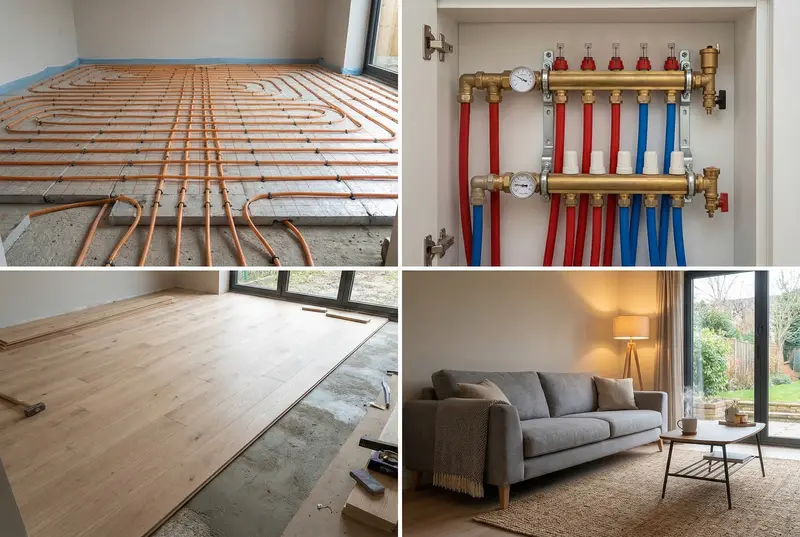
There are two main types of underfloor heating: wet (hydronic) systems that connect to your boiler or heat pump, and electric mat systems that run off your mains supply. Wet systems are the more common choice for whole-room or whole-house installations in Sheffield, while electric systems suit smaller areas like a single bathroom where running pipework isn't practical. For a wet system installation, the process typically starts with a site survey to assess your floor construction and check your boiler can handle the additional load — older combi boilers in Sheffield terraces sometimes need upgrading. Insulation is then laid to prevent heat escaping downwards, followed by the pipe loops fixed to the insulation or clipped into spreader plates. A manifold is fitted to distribute flow across different zones, and the system is connected back to your heat source. If you're going with a screed finish, the floor is then poured and needs several weeks to cure before it can be used. Your installer should commission the system properly, pressure-test the pipework, and walk you through the controls — typically a smart thermostat set up per zone. Electric mat installations are quicker, usually completable in a day per room, with the mat laid under tiles and connected to a thermostat.
Why Choose a Local Sheffield Specialist
Choosing a Sheffield-based installer matters more than people realise. Someone who works regularly in the city will know the quirks of local property types — the varying floor depths in Edwardian semis, the common layouts in terraced streets off Ecclesall Road, or the challenges of period properties in areas like Broomhill. They'll also have established relationships with local merchants for materials and can often get to site faster for any follow-up work. A locally based engineer is also much easier to hold to account if something needs attention after installation — and with underfloor heating, having that ongoing relationship is genuinely useful.
Frequently Asked Questions
Is underfloor heating suitable for my Victorian terrace in Sheffield?
Yes, but it needs careful planning. Most Victorian terraces have solid concrete or flagstone ground floors, which means adding insulation and possibly a new screed layer. This does raise floor height slightly, so you'll need to account for door clearances and step heights. A good installer will assess this during the survey and advise on the best approach for your specific property.
Will my existing boiler cope with underfloor heating?
It depends on the boiler's age and output rating. Many older combi boilers in Sheffield homes can handle a ground floor UFH system, but they need to be assessed properly. Underfloor heating runs at lower flow temperatures than radiators, which actually suits modern condensing boilers well. If your boiler is over 15 years old, replacement may be recommended alongside the UFH installation.
Does Sheffield's soft water make a difference to underfloor heating systems?
It genuinely does. Soft water from Sheffield's Pennine reservoir supply is much less likely to cause limescale deposits inside your UFH pipework and manifold compared to hard water areas. You'll still want a quality inhibitor added to the system, but you're at lower risk of the internal scaling issues that can reduce efficiency and cause problems in hard water parts of the country.
How long does underfloor heating installation take in a typical Sheffield home?
A single room electric mat system can usually be done in one day. A wet system for a full ground floor, including screed, typically takes three to five days of active work — but then you need to wait four to six weeks for the screed to cure fully before laying floor finishes. Your installer should give you a clear programme before work starts.
Other Plumbing Services in Sheffield
What do you need?
Select your service and urgency level