Underfloor Heating in Barnet
You've just had new flooring quoted for the ground floor of your Barnet home, and the fitter has mentioned now would be the perfect time to think about underfloor heating before the boards go down. It's a thought that occurs to a lot of homeowners across Barnet, particularly when they're already mid-renovation. Underfloor heating transforms how a room feels — no more cold tile shock in the bathroom, no radiators eating into kitchen wall space, just gentle, even warmth rising from the floor. It's increasingly popular across north London, and in Barnet specifically, where homes range from large Edwardian semis to post-war estates and modern builds, there's rarely a property type that can't benefit from a properly installed system.
Plumbing Conditions in Barnet
Very Hard water — significant limescale buildup, annual boiler servicing essential
Mixed housing stock across different eras. With 22% of properties built before 1919, older pipework and drainage systems are common — specialist knowledge of period properties matters.
Underfloor Heating in Barnet — Local Expertise
Barnet's housing stock is genuinely varied, and that variety matters when it comes to underfloor heating. Victorian and Edwardian terraces — common in areas like New Barnet, East Barnet, and around Hadley Wood — often have suspended timber floors on the ground level, which calls for a different approach than a solid concrete slab. Post-war properties across Barnet tend to have solid ground floors and can be well-suited to a wet underfloor heating system, though ceiling heights occasionally limit how much screed depth is practical. Newer builds and modern extensions are typically designed with underfloor heating in mind from the outset, making installation more straightforward. Barnet is also a moderately hard water area, which is worth flagging — hard water can cause scale build-up inside the pipework of a wet underfloor heating system over time. A reputable installer will advise fitting an inhibitor and possibly a scale reducer at the manifold to protect the system and keep it running efficiently for years.
How We Work
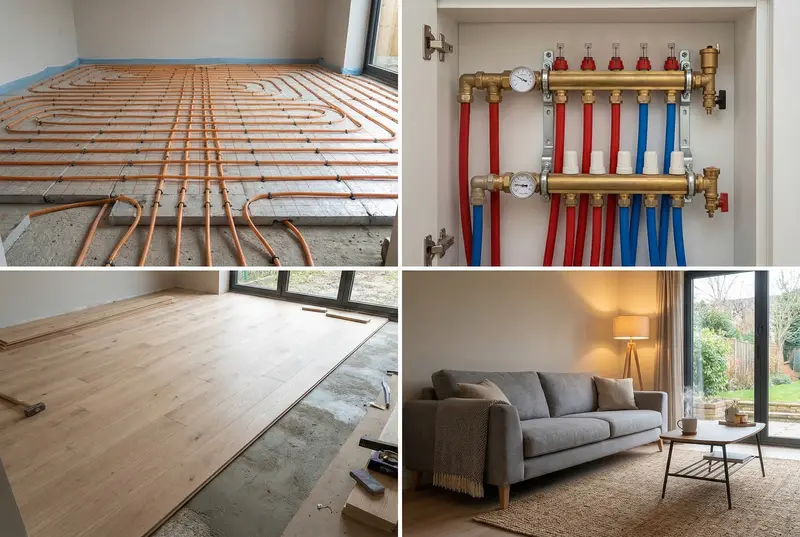
Underfloor heating installation broadly falls into two categories: wet systems (hydronic), where warm water circulates through pipes connected to your boiler or heat pump, and electric mat systems, which are simpler and better suited to single rooms or retrofits. For most Barnet homeowners undertaking a full ground floor renovation, a wet system delivers better long-term efficiency and running costs, though it requires more involved installation. The process starts with a survey — a good installer will assess your floor construction, existing boiler output, room dimensions, and insulation levels before recommending anything. Once the approach is agreed, insulation boards are laid first to stop heat escaping downward. Pipework is then fixed in a loop pattern across the floor, connected to a manifold that controls flow to each zone independently. In a solid floor installation, self-levelling screed is poured over the pipework and left to cure — typically 21 to 28 days before flooring is laid on top. For timber floors, a specialist dry system using aluminium heat spreader plates between joists is used instead. Commissioning involves pressure-testing the system, connecting it to the boiler or heat pump, and a careful warm-up process where temperature is raised gradually to avoid cracking the screed. The whole installation in a typical Barnet semi-detached property takes two to five days depending on scope.
Why Choose a Local Barnet Specialist
Choosing an installer who knows Barnet well genuinely makes a difference. Local tradespeople understand the typical floor constructions found in the borough's mix of period and post-war housing, they're familiar with the moderately hard water supply and the importance of system protection measures, and they're accountable to the local community they work in. A Barnet-based installer is also easier to reach if you need the system checked or adjusted after completion. Word of mouth still travels fast in areas like Whetstone, Cockfosters, and Chipping Barnet — a good local reputation matters, and that keeps standards high.
Frequently Asked Questions
Can underfloor heating be installed in an older Victorian property in Barnet?
Yes, though it requires careful planning. Many Victorian homes in Barnet have suspended timber ground floors, which means a wet screed system isn't suitable. Instead, a dry underfloor heating system using aluminium spreader plates between the joists is used. It's a well-established approach and works well, though output is slightly lower than a screed-based system. A survey will confirm what's viable for your specific property.
How does hard water in Barnet affect an underfloor heating system?
Barnet's moderately hard water supply means limescale can gradually build up inside the closed pipework of a wet underfloor heating system, reducing efficiency over time. A reputable installer will add a corrosion inhibitor to the system fluid and may recommend a scale reducer or water softener at the manifold. Annual checks on inhibitor levels will keep the system protected and running well long-term.
How long does the screed need to cure before I can lay flooring?
Standard sand and cement screed typically needs around 21 to 28 days to cure fully before flooring is laid. During that time, the underfloor heating system should be run through a gradual warm-up programme to condition the screed and prevent cracking. Some fast-drying screeds can be ready sooner — your installer will specify which product they're using and give you a realistic timeline for your Barnet project.
Is underfloor heating compatible with my existing boiler in Barnet?
Most modern combi and system boilers in Barnet homes are compatible with underfloor heating, though the boiler needs to be able to run at lower flow temperatures — ideally 35 to 45°C — for the system to work efficiently. Older boilers running at high temperatures may need adjustment or eventual replacement. An installer will assess your current setup during the survey and let you know if any upgrades are needed before work begins.
Other Plumbing Services in Barnet
What do you need?
Select your service and urgency level