Underfloor Heating in Brent
It's one of the more involved home improvement jobs, but for Brent homeowners who get it right, the payoff is real — more even heat distribution, lower running costs compared to traditional radiators, and freed-up wall space. Whether you're retrofitting a Victorian terrace in Willesden or fitting out a new-build flat in Wembley, the planning and groundwork matter just as much as the installation itself.
Plumbing Conditions in Brent
Very Hard water — significant limescale buildup, annual boiler servicing essential
Mixed housing stock across different eras. With 22% of properties built before 1919, older pipework and drainage systems are common — specialist knowledge of period properties matters.
Underfloor Heating in Brent — Local Expertise
Brent's housing stock is genuinely varied, and that variety has a direct impact on how underfloor heating gets installed. Victorian terraces — common across areas like Kilburn, Brondesbury, and Harlesden — typically have solid or suspended timber floors, both of which need different approaches. Solid floors can usually accommodate a wet system by screeding over new pipework, but suspended timber floors often need a low-profile overlay system to avoid excessive floor height gain. Post-war properties, particularly the semi-detached and terraced housing around Kingsbury and Kenton, often have concrete ground floors, which are well-suited to wet underfloor systems. Modern flats and new-builds in regeneration areas like Wembley Park and South Kilburn may already have underfloor heating provisions built in. Brent is also a moderately hard water area, which means inhibitors and system protectors are particularly important in wet underfloor systems — limescale buildup in the manifold and pipework can reduce efficiency and cause premature damage if the water isn't properly treated from day one.
How We Work
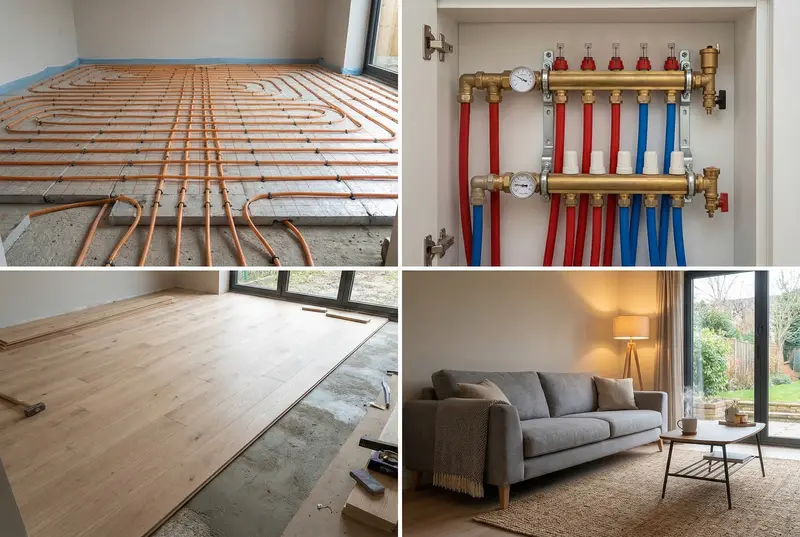
A professional underfloor heating installation in Brent begins with a proper site survey. A good installer won't quote blind — they'll assess your existing floor construction, check whether your boiler has the capacity to run an additional zone or full system, and identify any structural considerations, particularly relevant in older Brent properties where floor depths and joist positions vary. From there, you'll agree on the system type: wet (hydronic) systems are the most popular for whole-home installations and connect to your existing boiler or heat pump, while electric mat systems suit smaller areas or single rooms where pipework isn't practical. Installation itself involves lifting or preparing the floor surface, laying the pipe loops or heating mats in a specific pattern to ensure even coverage, connecting to a manifold, and either screeding over the system or using a specialist board overlay. The screed then needs a curing and commissioning period — typically two to three weeks — before it can be used at full temperature. Throughout this time, the system is gradually brought up to temperature to prevent cracking. Once commissioned, your installer should set up the smart thermostat controls, zone the system properly, and test every circuit before signing off. Brent installers familiar with the local housing mix will also know how to handle quirks like uneven Victorian subfloors or original tiling that needs careful removal.
Why Choose a Local Brent Specialist
Hiring a tradesperson who knows Brent well genuinely saves headaches. Local installers are already familiar with the mix of property types across the borough — they've worked in Willesden Victorians, Wembley new-builds, and everything in between. They understand the quirks that come with Brent's housing stock, from original suspended floors to the post-war concrete constructions in the north of the borough. They're also more likely to have established relationships with local building control teams, which matters when underfloor heating work requires a Part P or Part L notification. A locally based installer is easier to get back if something needs attention after the job is done.
Frequently Asked Questions
Can I install underfloor heating under my existing wooden floors in my Brent Victorian terrace?
Yes, but it requires careful planning. Suspended timber floors need either a low-profile staple-up system fitted between joists or a thin overlay board system on top. Both work, but they have trade-offs around heat output and floor height. A survey of your specific floor is essential before committing to a system type.
How does Brent's hard water affect an underfloor heating system?
Brent's moderately hard water supply means mineral deposits can gradually build up inside your pipework and manifold. A good installer will treat your system with a corrosion inhibitor and scale reducer at commissioning. Annual checks and periodic flushing will keep the system running efficiently and prevent premature wear to the pump and valves.
How long does underfloor heating installation take in a typical Brent home?
For a full ground-floor wet system in a three-bedroom Brent semi, allow around three to five days for installation, plus two to three weeks for the screed to cure before full commissioning. Electric mat systems are faster — a single room can often be completed in a day — but the curing period still applies if new tile adhesive is involved.
Do I need planning permission or building regulations approval for underfloor heating in Brent?
Generally, no planning permission is required. However, wet underfloor heating systems connected to a boiler or heat pump fall under Part L of Building Regulations, and the work should be carried out and certified by a competent installer. If electrical connections are involved, Part P may also apply. Your installer should handle the necessary notifications with Brent's building control department.
Other Plumbing Services in Brent
What do you need?
Select your service and urgency level