Underfloor Heating in Aberdeen
Underfloor heating is one of those upgrades that transforms how a home feels, not just how it looks on a brochure. Aberdeen homeowners are increasingly turning to it as a practical alternative to radiators, particularly as energy costs stay high and people want more efficient, even heat across their homes. Whether you're extending a granite-built Victorian terrace in the West End, renovating a post-war semi in Kincorth, or fitting out a new-build in Westhill, underfloor heating is a viable option — but getting it right depends heavily on your property type, floor construction, and which heating system you're pairing it with.
Plumbing Conditions in Aberdeen
Soft water — Grampian supply
Victorian stone tenements in cities, traditional stone cottages in rural areas. With 35% of properties built before 1919, older pipework and drainage systems are common — specialist knowledge of period properties matters.
Underfloor Heating in Aberdeen — Local Expertise
Aberdeen's housing stock is genuinely varied, and that variety matters enormously when planning underfloor heating. Victorian and Edwardian properties — common in areas like Mannofield, Ferryhill, and the West End — typically have suspended timber floors, which means wet underfloor heating requires careful assessment of joist depth and insulation strategy. Post-war housing in areas like Mastrick, Northfield, and Torry often features solid concrete ground floors, which are actually well-suited to wet UFH systems, though older slabs may need insulation added beneath the pipework to avoid heat loss downward. Modern new-builds across Aberdeen and the surrounding Aberdeenshire commuter belt are frequently built with underfloor heating in mind from the outset, making installation more straightforward. Aberdeen sits in a moderately hard water area, which is worth noting if you're installing a wet underfloor heating system — a quality inhibitor and, in some cases, a scale reducer or system filter is advisable to protect pipework and the manifold from long-term mineral build-up.
How We Work
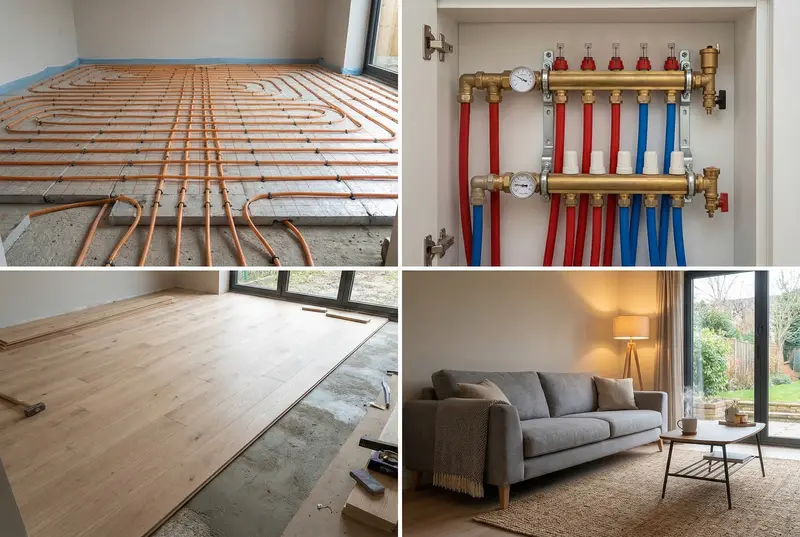
Underfloor heating installation broadly falls into two categories: wet systems, which circulate warm water through pipework connected to your boiler or heat pump, and electric systems, which use heating mats or cables beneath the floor. In Aberdeen, wet systems are the more popular choice for whole-home or multi-room installations given the running cost advantage, while electric systems suit smaller areas like bathrooms or single rooms where retrofitting pipework would be disruptive. The installation process for a wet system starts with a site survey to assess floor construction, existing heating, and insulation levels. Pipework is then laid in a serpentine or spiral pattern across insulation boards, and a manifold is installed — usually in a cupboard or utility area — to control flow to each zone independently. The system is pressure tested before screed or floor boards go back down. For electric systems, the process is quicker: heating mats are rolled out beneath tiles or other flooring, a thermostat is wired in, and the system is tested before tiling proceeds. Most installers will also advise on thermostat options — smart thermostats are increasingly popular in Aberdeen homes and allow zone-by-zone scheduling from a phone app, which helps manage running costs. From survey to signed-off installation, a typical whole-ground-floor wet system in an average Aberdeen semi-detached takes three to five days.
Why Choose a Local Aberdeen Specialist
Choosing a heating engineer based in or around Aberdeen makes a real practical difference. They'll know the quirks of local property construction — the thick granite walls, the older slab types common in post-war estates, the timber floor depths in tenement conversions. They'll have worked with the local building control requirements and understand what's needed for compliance sign-off. Turnaround on parts and follow-up visits is quicker when your installer isn't travelling from another region. And for a job of this scale and cost, being able to meet face-to-face, get references from nearby completed jobs, and have someone accountable locally is genuinely valuable.
Frequently Asked Questions
Can underfloor heating be installed in an older Aberdeen granite or Victorian property?
Yes, though it requires more planning than a modern build. Suspended timber floors need joist assessment and appropriate insulation. Solid-floor rooms are more straightforward. Many Victorian properties in Aberdeen's West End and Ferryhill have been successfully fitted with UFH — the key is a thorough survey before committing to a system type.
Is underfloor heating compatible with a combi boiler?
It can be, but combi boilers aren't always the ideal pairing for whole-home wet UFH systems, as they're designed for high-temperature output and UFH runs most efficiently at lower flow temperatures. A heating engineer can assess your current setup and advise whether your existing boiler is suitable or if a system or heat pump upgrade would give better long-term results.
How long does underfloor heating take to heat a room compared to radiators?
UFH heats up more slowly than radiators — typically 30 to 60 minutes to reach comfortable temperature — but holds heat more evenly and for longer. In Aberdeen's colder months, most homeowners set it on a timer to warm up ahead of when rooms are needed. Smart thermostats make this easy to manage and help keep running costs in check.
Does Aberdeen's moderately hard water affect underfloor heating systems?
It's worth taking seriously. Hard water can cause scale build-up inside UFH pipework and manifold components over time, reducing efficiency and potentially causing blockages. A good installer will add a quality corrosion inhibitor to the system at commissioning and may recommend a magnetic system filter or scale reducer depending on your water hardness readings — standard practice for Aberdeen installations.
Other Plumbing Services in Aberdeen
What do you need?
Select your service and urgency level