Underfloor Heating in Kirkcaldy
It's one of the more significant home improvements you can make, but for many Kirkcaldy homeowners it pays off quickly — both in comfort and in reduced heating bills over time. Wet underfloor heating systems, which connect to your boiler or heat pump, tend to deliver the best long-term efficiency, while electric mat systems suit smaller areas or renovation projects where lifting floors isn't practical. Either way, getting the right advice upfront makes a real difference to how well the system performs.
Plumbing Conditions in Kirkcaldy
Moderately Soft water — mixed Fife supply
Victorian stone tenements in cities, traditional stone cottages in rural areas. With 35% of properties built before 1919, older pipework and drainage systems are common — specialist knowledge of period properties matters.
Underfloor Heating in Kirkcaldy — Local Expertise
Kirkcaldy's housing stock is genuinely varied, and that variety matters when it comes to underfloor heating. The older stone-built properties and period cottages you'll find across much of the town — particularly in areas like Pathhead and the older residential streets near the High Street — present specific challenges. Solid stone floors need careful preparation, and older buildings often require additional insulation beneath the heating layer to stop warmth disappearing downward rather than rising into the room. Without that insulation, you're essentially heating the ground, and efficiency suffers badly. Modern estates on the outskirts of Kirkcaldy are generally easier to work with — concrete sub-floors and better existing insulation mean faster installation and quicker payback. Kirkcaldy sits in a moderately hard water area, which is worth knowing for wet underfloor heating systems. Limescale can build up in pipework over time, so using a quality inhibitor and scheduling periodic system flushes helps protect your investment and keeps flow rates consistent across the manifold.
How We Work
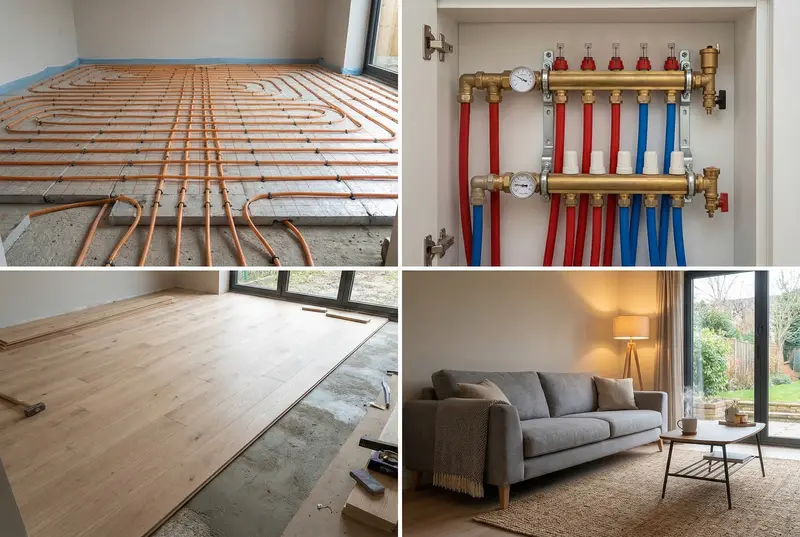
A professional underfloor heating installation in Kirkcaldy follows a logical sequence, and a good installer will walk you through each stage before work begins. The process starts with a proper heat loss calculation for your home — this determines how much output you actually need room by room, and it's the foundation of a well-designed system. Skipping this step is one of the most common reasons underfloor heating underperforms. Once the design is confirmed, the installer will assess your sub-floor. For a wet system, this usually means either screeding over pipework laid on insulation boards, or using a low-profile overlay system that clips directly onto insulation panels without the need for deep screed. The low-profile approach has become popular in Kirkcaldy's period properties because it adds minimal floor height — critical in rooms with original skirting, doors, and period joinery. Pipework is pressure-tested before any floor covering goes down, so any issues are caught early. The manifold — which controls flow to each room — is typically installed in a cupboard or utility space, and your existing boiler or a new heat pump connects into it. Commissioning involves balancing each circuit to ensure even heat distribution, setting up controls and thermostats room by room, and running the system through a slow curing process if screed has been used. The whole job in an average Kirkcaldy home takes between three and seven days depending on the number of rooms.
Why Choose a Local Kirkcaldy Specialist
Choosing a tradesperson who knows Kirkcaldy well genuinely matters for a job like this. Local installers understand the quirks of the town's older housing stock — the varying floor constructions, the uneven sub-floors common in period cottages, and the particular challenges of working in stone-built properties where damp can complicate insulation choices. They're also familiar with building warrant requirements through Fife Council, which apply to certain types of underfloor heating work. A local expert can recommend suppliers, visit the site quickly if anything needs adjusting after installation, and offer the kind of ongoing relationship that makes maintaining your system straightforward for years to come.
Frequently Asked Questions
Is underfloor heating suitable for the older stone-built houses common in Kirkcaldy?
Yes, but it requires careful planning. Older properties often need additional sub-floor insulation to make the system efficient, and low-profile overlay systems are frequently the best option where floor height is restricted by original joinery or doorways. A thorough site survey before quoting is essential — any installer worth using will insist on one.
Will underfloor heating work with my existing boiler in Kirkcaldy?
In most cases, yes. Wet underfloor heating runs at lower flow temperatures than radiators, which actually makes modern condensing boilers more efficient when paired with it. If your boiler is older or undersized, an installer may recommend upgrading it at the same time — but many Kirkcaldy homes can connect a new underfloor system to their existing setup without replacing the boiler.
How does the moderately hard water in Kirkcaldy affect an underfloor heating system?
Hard water causes limescale to build up inside pipework and at the manifold over time, reducing efficiency and potentially causing blockages. Using a quality corrosion inhibitor from day one, and having the system flushed every few years, keeps everything running cleanly. Your installer should add inhibitor as part of the commissioning process — if they don't mention it, ask them directly.
Do I need a building warrant for underfloor heating installation in Kirkcaldy?
It depends on the scope of work. Installing underfloor heating as part of a larger renovation that alters the floor structure typically requires a building warrant through Fife Council. A straight replacement or addition to an existing wet system usually doesn't. Your installer should be able to advise on this clearly before work starts, and handle any necessary paperwork on your behalf.
Other Plumbing Services in Kirkcaldy
What do you need?
Select your service and urgency level