Underfloor Heating in Wolverhampton
You've just had new flooring laid in your Wolverhampton home and you're wondering whether now is the right time to finally sort out underfloor heating — the answer is almost certainly yes. Whether you're renovating a Victorian terrace in Whitmore Reans, extending a 1960s semi in Wednesfield, or fitting out a new-build in the Canalside quarter, underfloor heating transforms how a room feels to live in. No more cold tiles on a January morning, no radiators eating up wall space, and noticeably lower running costs when paired with a modern heat pump or condensing boiler. Getting it right from the start means choosing a properly qualified installer who understands Wolverhampton's varied housing stock.
Plumbing Conditions in Wolverhampton
Moderately Soft water — Severn Trent supply
Mixed housing stock across different eras. With 22% of properties built before 1919, older pipework and drainage systems are common — specialist knowledge of period properties matters.
Underfloor Heating in Wolverhampton — Local Expertise
Wolverhampton's housing mix creates genuinely different challenges depending on where you live. Victorian and Edwardian properties — common across Penn, Tettenhall, and the older inner suburbs — often have suspended timber floors, which suit electric underfloor heating mats or low-profile hydronic systems rather than a thick screed pour. Post-war semis and terraces, which make up a huge share of Wolverhampton's residential stock, usually have solid concrete ground floors that are well-suited to a full wet system embedded in screed. Modern new-builds typically already have the insulation and floor construction that makes hydronic underfloor heating the obvious choice. Wolverhampton sits in a moderately hard water area, which is worth flagging to your installer — hard water increases limescale build-up in pipework and manifolds over time, so fitting an appropriate inhibitor and a suitable filter from day one protects your investment and keeps the system running efficiently for decades.
How We Work
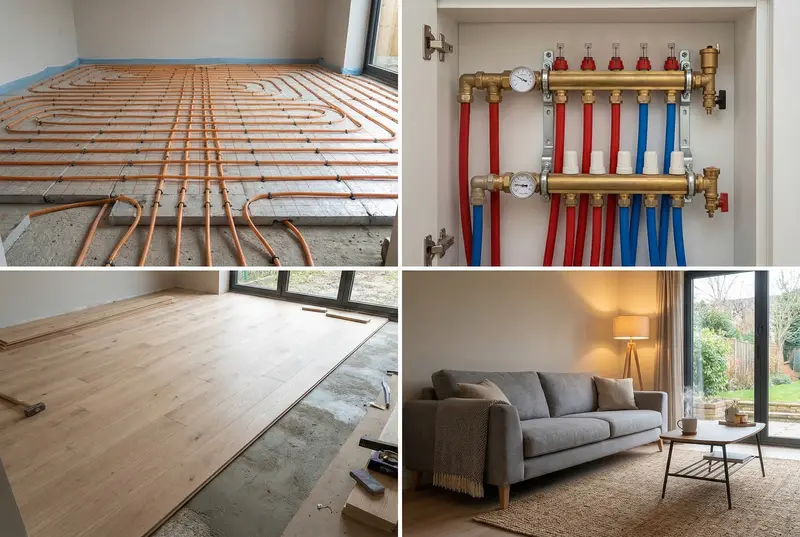
A professional underfloor heating installation in Wolverhampton follows a clear process, though the exact steps depend on your floor type and whether you're going electric or wet (hydronic). For a wet system, the installer begins with a heat loss calculation for each room — this determines pipe spacing and flow temperatures, and it's a step that should never be skipped. Insulation boards are laid first to stop heat disappearing downward; in older Wolverhampton properties with uninsulated ground floors this stage alone makes a significant difference to efficiency. The pipework is then clipped or stapled to the insulation in a carefully planned pattern, connected to a manifold which controls flow to each zone independently. A screed layer — typically 65–75mm — is poured over the pipes and must cure fully before the floor covering goes down, which usually takes four to six weeks in a Wolverhampton winter. For electric systems, heating mats or cables are laid directly beneath tiles or a suitable floor covering, making them quicker to install and ideal for single rooms or upper floors. Either way, the system is pressure-tested and commissioned before handover, and your installer should walk you through the thermostat controls. Expect the installation itself to take two to four days for a typical ground floor, longer for whole-house projects.
Why Choose a Local Wolverhampton Specialist
Choosing a local Wolverhampton installer rather than a national firm makes a practical difference. Someone who works regularly across Penn, Bilston, Tettenhall, and Blakenhall understands the specific floor constructions common in this city's housing stock — they've seen the compressed hardcore under 1950s Wolverhampton slabs, and they know what to expect when lifting boards in an Edwardian terrace. Local tradespeople also carry a reputation worth protecting and are far easier to contact if you need a return visit for commissioning adjustments or any follow-up work. Availability tends to be quicker too, which matters when you're mid-renovation.
Frequently Asked Questions
Is underfloor heating suitable for a Victorian terrace in Wolverhampton?
Yes, but it requires more planning. Most Victorian terraces in Wolverhampton have suspended timber floors, which means a wet screed system isn't practical without significant structural work. Electric heating mats or a low-profile hydronic system designed for timber floors are usually the better route, and insulation beneath the boards is essential to make it efficient.
How does Wolverhampton's hard water affect an underfloor heating system?
Moderately hard water means limescale can gradually build up inside the pipework and manifold, reducing efficiency and potentially causing blockages over time. A qualified installer should add a quality inhibitor to the system fluid and fit a scale or magnetic filter at the manifold. Annual checks to top up inhibitor levels keep the system protected and running well.
Can I install underfloor heating upstairs in my Wolverhampton home?
Electric systems are commonly fitted on upper floors since they sit directly beneath the floor covering and don't require a screed pour. Wet systems can work upstairs but need careful structural assessment, particularly in older Wolverhampton properties where joists may need reinforcing. Your installer should assess load-bearing capacity and floor depth before recommending an approach.
How long does it take before a new underfloor heating system is ready to use in Wolverhampton?
For electric systems, you can often use the heating within a day or two of installation. Wet systems embedded in screed require a curing period of four to six weeks before the floor covering is laid and the system runs at full temperature. In Wolverhampton's colder months, allow extra time — rushing the screed cure causes cracking and uneven heat distribution.
Other Plumbing Services in Wolverhampton
What do you need?
Select your service and urgency level