Underfloor Heating in Worcester
It's a significant investment, but one that pays back in comfort, energy efficiency, and added property value — particularly in a city where home improvements hold their price well. Whether you're renovating a period property near the city centre or fitting out a new build on the outskirts, getting the specification right from the start is what separates a system that works brilliantly for decades from one that causes headaches within a few years.
Plumbing Conditions in Worcester
Moderately Soft water — mixed Severn Valley
Mixed housing stock across different eras. With 22% of properties built before 1919, older pipework and drainage systems are common — specialist knowledge of period properties matters.
Underfloor Heating in Worcester — Local Expertise
Worcester's housing stock is genuinely varied, and that variety has a real bearing on how underfloor heating is installed and specified. Edwardian semis — particularly common in areas like St John's, Rainbow Hill, and Barbourne — often have solid or suspended timber ground floors, which affects whether a wet (hydronic) or electric system is more practical. Wet systems are generally more cost-effective to run long-term, but retrofitting them into a suspended timber floor adds cost and complexity. Post-war estates across Warndon and Dines Green tend to have solid concrete floors, which makes wet UFH installation more straightforward, as the pipe work sits in a screed layer without requiring major structural work. Newer developments in areas like Kempsey or Droitwich Road corridors are increasingly built with UFH already roughed in. Worcester is also a moderately hard water area, which matters for wet hydronic systems — a properly dosed inhibitor and scale prevention from the outset will protect your manifold and pipework from the gradual build-up that shortens system life.
How We Work
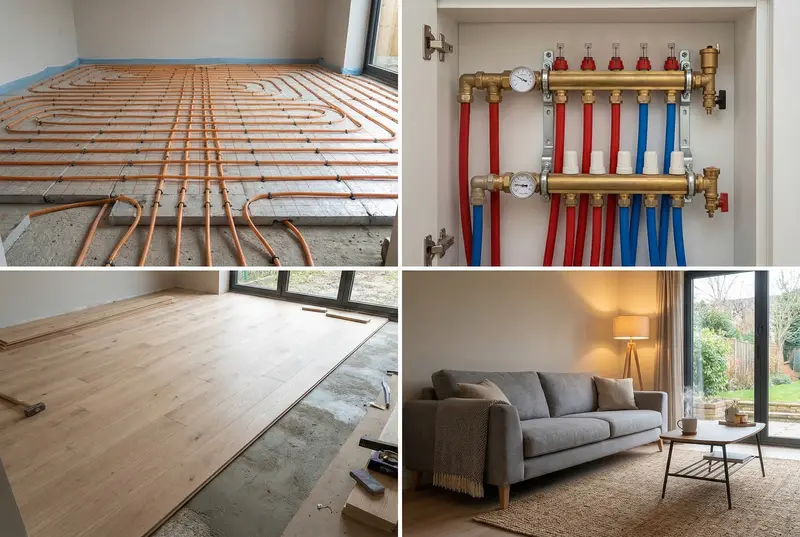
A professional underfloor heating installation in Worcester follows a clear sequence, and understanding it helps you plan around any disruption to your home. The process starts with a heat loss calculation — this is not optional, it's the technical foundation that determines pipe spacing, flow temperatures, and whether your boiler or heat pump can handle the load. A good installer will carry this out before quoting a final price. Once the design is agreed, the floor preparation begins. For a solid floor, this means laying rigid insulation boards to prevent downward heat loss into the subfloor — skipping this step is a common false economy. For a suspended timber floor, specialist low-profile panels or aluminium spreader plates are fitted between joists. The pipework or heating elements are then laid to the agreed design, the manifold is installed (usually in a cupboard or utility space), and the system is connected to your heat source. For solid floors, a liquid screed or sand-and-cement screed is then poured and must be allowed to cure — typically two to four weeks before flooring can be laid. The system is then commissioned and pressure-tested, with flow rates balanced across each zone. Most Worcester installations covering a full ground floor take three to five days for the physical work, though the screed curing adds to the overall timeline. You'll need to factor in flooring installation as a separate trade after that point.
Why Choose a Local Worcester Specialist
Choosing a Worcester-based installer rather than a national firm or someone travelling in from outside the area makes a practical difference. Local tradespeople are familiar with the specific property types found across Worcester's neighbourhoods — they've worked in the Edwardian terraces around Claines, the post-war builds in Warndon Villages, and the newer estates on the city's fringes. They'll know the common floor construction quirks, understand local building control requirements, and are easier to reach if anything needs attention after commissioning. A local installer also has a reputation to maintain in a relatively close-knit city, which tends to keep standards high.
Frequently Asked Questions
Is underfloor heating a good fit for an Edwardian semi in Worcester?
It can work very well, but it depends on the floor construction. Solid floors are straightforward to retrofit with a wet system. Suspended timber floors are more involved — you'd typically use low-profile aluminium spreader plates or consider an electric mat system, which is easier to install but costs more to run. A heat loss survey will tell you what's genuinely viable for your specific property.
Will Worcester's hard water cause problems for my underfloor heating system?
Worcester sits in a moderately hard water area, so scale build-up is a real consideration for wet hydronic systems. The solution is straightforward: use a quality inhibitor dosed into the system at commissioning, and consider a scale reducer on the fill point. An installer who doesn't mention this is worth questioning — it's a basic step that significantly extends system lifespan.
How long does the installation take and how disruptive is it?
For a full ground floor wet system in a typical Worcester three-bedroom semi, expect three to five days of active work. The bigger constraint is screed curing — you'll be without full use of the ground floor for two to four weeks while it dries before flooring can go down. It's a significant project, and most homeowners plan it alongside other renovation work to minimise disruption.
Can underfloor heating work with my existing boiler?
Possibly, but it needs checking. UFH runs at lower flow temperatures than radiators — typically 35–45°C rather than 60–70°C — which is more efficient but requires the boiler to modulate down effectively. Many modern condensing boilers handle this well. Older or oversized boilers may struggle or run inefficiently. Your installer should assess this during the design stage, not as an afterthought.
Other Plumbing Services in Worcester
What do you need?
Select your service and urgency level