Underfloor Heating in Birmingham
Underfloor heating is one of those upgrades that completely transforms how a home feels — and demand for it across Birmingham has grown steadily as homeowners look for more efficient, comfortable ways to heat their properties. Whether you're renovating a kitchen in Harborne, extending a family home in Moseley, or doing a full refurb in the Jewellery Quarter, underfloor heating is increasingly the heating system of choice for people who want to move away from bulky radiators and uneven warmth. It's a premium installation, but done properly it pays back in comfort and running costs for decades.
Plumbing Conditions in Birmingham
Moderately Soft water — Severn Trent supply
Mixed housing stock across different eras. With 22% of properties built before 1919, older pipework and drainage systems are common — specialist knowledge of period properties matters.
Underfloor Heating in Birmingham — Local Expertise
Birmingham's housing stock creates some specific considerations when it comes to underfloor heating. The city is dominated by Victorian terraces and Edwardian semis — the kind of solid, characterful properties you'll find throughout Balsall Heath, Erdington, Kings Heath and beyond. These homes were built with solid ground floors and relatively low ceiling heights, which means the choice between wet (hydronic) and electric underfloor heating systems matters enormously. Wet systems require a screed layer that can raise floor levels by 80–100mm, which may create issues with door frames and skirting boards in period homes. Electric mat systems are thinner and easier to retrofit, but better suited to smaller areas like bathrooms rather than whole-floor coverage. Birmingham is also a moderately hard water area, which is worth factoring into a wet underfloor system — limescale build-up inside the pipework can reduce efficiency over time, so a good installer will recommend appropriate inhibitors and possibly a scale filter as part of the setup.
How We Work
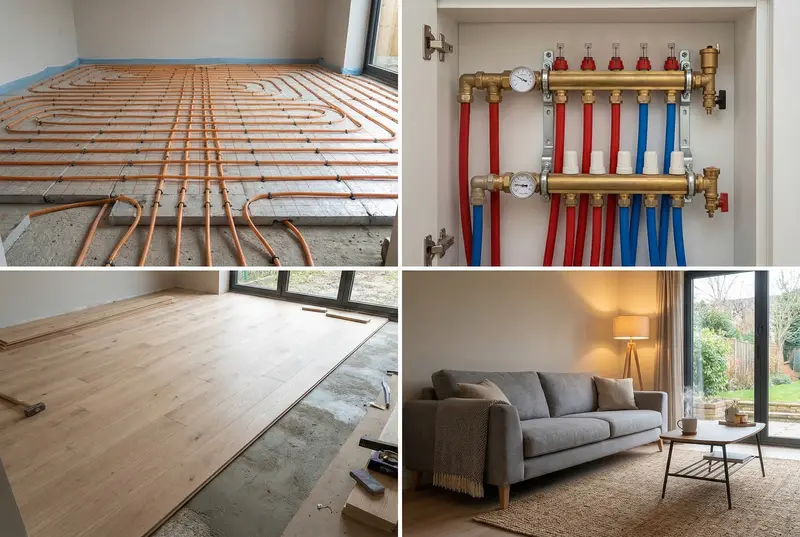
A professional underfloor heating installation in Birmingham typically follows a clear process, and knowing what to expect helps you plan properly. It starts with a site survey — an experienced installer will assess your floor construction, check for damp-proofing, review your existing boiler capacity (for wet systems), and discuss which areas of the home you want to heat. Victorian terraces often have suspended timber floors on upper levels and solid concrete or flagstone at ground level, so the installer needs to plan accordingly for each zone. Once agreed, the installation begins with preparing the subfloor. For wet systems, insulation board is laid first to stop heat escaping downward, then the pipework is clipped into place in a serpentine or spiral pattern. Screed is then poured over the pipes, which needs to cure for several weeks before the system is commissioned — patience is key here. For electric systems, the heating mat is rolled out over insulation, connected to a thermostat, and can often be tiled or floored over within 24 hours. Commissioning involves slowly bringing the system up to temperature over a number of days to prevent screed cracking, then balancing the system across zones. A good installer will walk you through your thermostat controls and leave you with documentation, especially important if your home is in a conservation area in central Birmingham where any future work may need to account for the system.
Why Choose a Local Birmingham Specialist
Choosing a Birmingham-based installer rather than a national firm makes a real practical difference. Local tradespeople know the housing stock here inside out — they've worked on hundreds of Victorian terraces and Edwardian semis and understand the quirks that come with period properties, from wonky floor levels to buried pipework. They also have existing relationships with local suppliers, which can keep material costs down and lead times shorter. When something needs revisiting after installation — and occasionally it does — a local Birmingham business is far more likely to be on hand quickly than someone based elsewhere.
Frequently Asked Questions
Can underfloor heating work in a Victorian terrace in Birmingham?
Yes, but it needs careful planning. The main challenge in Birmingham's Victorian terraces is floor height — wet systems add significant depth which can cause issues with doors and thresholds. Electric mat systems are often the better fit for retrofitting into period rooms, particularly bathrooms and kitchens. A good installer will assess your specific floor construction before recommending anything.
Will I need a new boiler to run underfloor heating in my Birmingham home?
Not always, but it depends on your existing setup. Underfloor heating runs at lower flow temperatures than radiators, which actually makes modern condensing boilers more efficient when paired with it. If your boiler is older or undersized, an upgrade may be recommended — your installer should calculate the heat load during the survey stage and advise you honestly rather than just selling you a replacement.
How does Birmingham's hard water affect underfloor heating systems?
Birmingham sits in a moderately hard water zone, which means limescale can gradually accumulate inside wet underfloor pipework and reduce efficiency. A reputable installer will add a corrosion and scale inhibitor to the system and may recommend a scale filter, particularly on older systems or properties with higher mineral content in the supply. Annual system checks help catch any issues early.
How long does underfloor heating installation take in a typical Birmingham home?
For a wet system covering a ground floor, expect the physical installation to take two to four days, followed by four to six weeks of screed curing before the floor finish can go down. Electric systems are much faster — often completable in a day for a single room. Your installer should give you a clear timeline upfront, especially if you're coordinating with other trades on a larger renovation.
Other Plumbing Services in Birmingham
What do you need?
Select your service and urgency level