Underfloor Heating in Stoke-on-Trent
Underfloor heating is one of the most popular heating upgrades in Stoke-on-Trent right now, and it's easy to see why. Done properly, it delivers even, comfortable warmth across your entire floor — no cold spots, no radiators eating into your living space, and better energy efficiency when paired with a modern heat pump or condensing boiler. It's a significant investment, but one that adds real value to your home and noticeably reduces your heating bills over time.
Plumbing Conditions in Stoke-on-Trent
Moderately Soft water — Pennine fringe
Mixed housing stock across different eras. With 22% of properties built before 1919, older pipework and drainage systems are common — specialist knowledge of period properties matters.
Underfloor Heating in Stoke-on-Trent — Local Expertise
Stoke-on-Trent has an unusually varied housing stock, and that variety makes a real difference when it comes to underfloor heating. Victorian terraces — common across Fenton, Longton, and Burslem — typically have solid concrete or suspended timber ground floors, both of which require different approaches. Solid floors need a screed overlay or a low-profile system, while suspended timber floors often suit a dry-system installation fitted between the joists. Post-war council-built semis, which make up a large chunk of housing in areas like Bentilee and Meir, tend to have solid concrete slabs that are relatively straightforward to work with. Newer builds and modern extensions across the city usually make the most cost-effective candidates, since the floors are already designed with lower heating profiles in mind. Stoke-on-Trent sits in a moderately hard water area, which is worth factoring in — limescale buildup in pipework over time can reduce efficiency, so fitting an inline inhibitor and keeping on top of system servicing is advisable.
How We Work
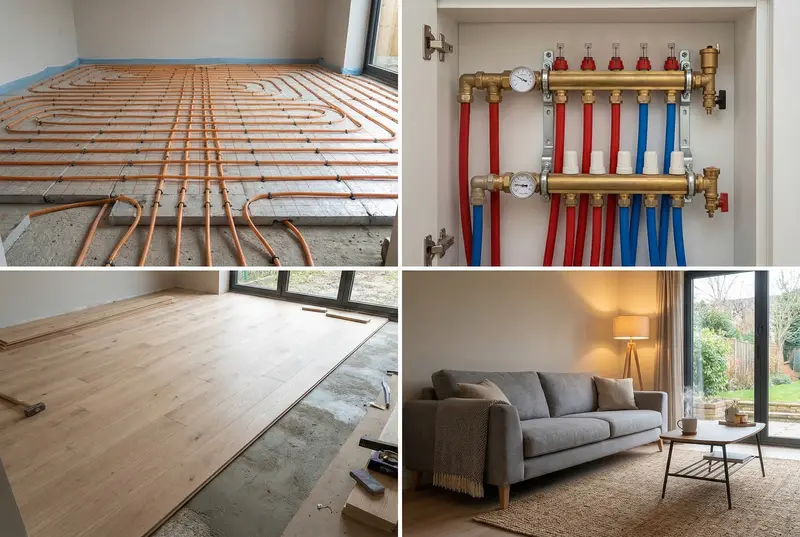
A wet underfloor heating installation in Stoke-on-Trent typically starts with a proper survey of your property. A qualified heating engineer will assess your floor construction, insulation levels, existing boiler or heat source, and room dimensions before recommending the right system. Skipping this step is how people end up with underperforming systems, so it matters. Once the spec is agreed, the installer will prepare the subfloor — this might mean laying insulation boards to prevent heat loss downward, which is especially important in Stoke-on-Trent's older properties where ground floors can be quite cold. The pipework is then laid out in a continuous loop pattern, either embedded in a wet screed or clipped into a dry panel system, depending on your floor type. The manifold — the central control point that regulates flow to each zone — is fitted, usually in an airing cupboard or utility area, and connected to your boiler or heat pump. Thermostats are installed room by room, giving you independent control over each zone. A pressure test is carried out before any screed is poured, and if you're having a wet screed installed, you'll need to allow around four to six weeks for it to fully cure before the floor covering goes down. Your installer should commission the system and walk you through the controls before leaving.
Why Choose a Local Stoke-on-Trent Specialist
Choosing a local Stoke-on-Trent heating engineer rather than a national firm makes a genuine difference on a job like this. Local tradespeople know the housing stock — they've worked in the Victorian terraces of Tunstall, the post-war estates of Abbey Hulton, and the newer developments around Trentham. That experience means fewer surprises when they open up your floors. They're also easier to get back if anything needs adjusting after installation, and their reputation in the city depends on getting it right first time. For a job costing several thousand pounds, that local accountability is worth having.
Frequently Asked Questions
Is my Stoke-on-Trent Victorian terrace suitable for underfloor heating?
Yes, but it depends on your floor construction. Many Victorian terraces in Stoke-on-Trent have solid floors that can take a screed-based system, while suspended timber floors suit a dry panel installation between joists. The key is getting a proper survey first — an experienced local installer will tell you exactly what's involved and whether any insulation work is needed beforehand.
Will underfloor heating work with my existing boiler?
In most cases, yes. Wet underfloor heating works well with modern condensing boilers, which are common across Stoke-on-Trent properties. It's even more efficient when paired with a heat pump. Your installer will check whether your boiler has sufficient output for the additional load, and may recommend a system upgrade if it's older or underpowered for the floor area you're heating.
How long does a full underfloor heating installation take in Stoke-on-Trent?
A typical ground-floor installation in a Stoke-on-Trent semi-detached home takes two to four days for the pipework, manifold, and thermostat fitting. If a wet screed is being poured, add four to six weeks curing time before floor coverings go down. Dry system installations are faster and can sometimes have floor coverings back within a day or two of the pipework being laid.
Does hard water affect underfloor heating systems in Stoke-on-Trent?
Stoke-on-Trent has moderately hard water, which can cause limescale to build up inside the pipework over time, gradually reducing efficiency. A good installer will add a corrosion inhibitor to the system at commissioning, and you should have the inhibitor levels checked annually during your boiler service. Magnetic filters are also worth considering to keep the system running cleanly for longer.
Other Plumbing Services in Stoke-on-Trent
What do you need?
Select your service and urgency level