Underfloor Heating in Preston
You've been putting up with cold kitchen tiles and a sluggish radiator system for years, and now you're finally looking at underfloor heating as a proper long-term fix. It's a smart move — especially in Preston, where the older housing stock and damp winters make conventional heating feel increasingly inadequate. Underfloor heating, whether wet (hydronic) or electric, delivers warmth evenly across the floor rather than blasting hot air from one wall. It works particularly well in open-plan extensions and ground-floor renovations, which are increasingly common across Preston's residential neighbourhoods. This page will walk you through what's actually involved, what it costs locally, and what questions you should be asking before you commit.
Plumbing Conditions in Preston
Soft water — Pennine catchments
Mixed housing stock across different eras. With 22% of properties built before 1919, older pipework and drainage systems are common — specialist knowledge of period properties matters.
Underfloor Heating in Preston — Local Expertise
Preston's housing mix creates some genuinely varied installation challenges. The Edwardian semis found across Fulwood, Ribbleton, and Ashton are typically solid-floored or have shallow suspended timber floors — both of which require different approaches to underfloor heating. A solid concrete floor can often accept a wet system screed overlay, but you'll need to check ceiling heights carefully if you want to avoid losing too much room height. The post-war estates that spread across much of outer Preston tend to have more straightforward slab-on-ground construction, making them somewhat easier to retrofit. Newer modern developments, meanwhile, are often already designed with UFH in mind. On the water quality side, Preston is supplied from Pennine reservoirs, making it a soft water area. This is actually good news for wet underfloor heating systems — soft water causes far less limescale buildup in pipework and manifolds compared to hard water areas, meaning your system should require less maintenance over time and the pipework lifespan is generally better.
How We Work
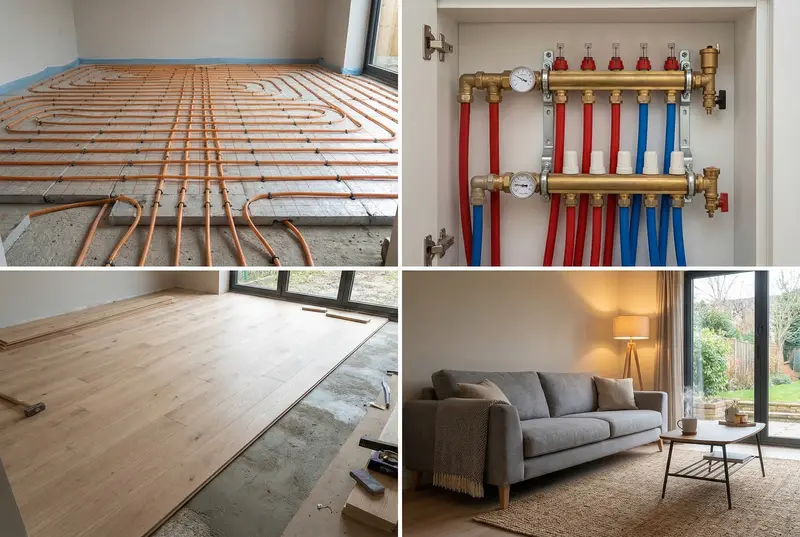
A typical underfloor heating installation in Preston starts with a proper survey of your property — floor construction, existing boiler capacity, room dimensions, and insulation levels all need to be assessed before any work begins. For a wet system, the installer will design a manifold layout and pipe loop configuration suited to each zone. Insulation boards go down first to ensure heat travels upward rather than being lost into the subfloor. The pipework — usually 16mm PEX or similar — is then laid in a serpentine or spiral pattern across the insulation and clipped into place before being connected to the manifold. In a new build or extension, a liquid screed is poured over the top. In a retrofit on an existing solid floor, either a low-profile screed or an overlay system using router-cut boards is used to keep the floor height manageable. The system is then connected to your boiler or heat pump, pressure-tested, and commissioned — which includes a slow heat-up process over several days to cure the screed properly. Electric systems follow a broadly similar process but without the pipework and manifold; instead, a heating mat or cable is embedded beneath the floor finish. Your installer should provide a full set of as-built drawings showing exactly where pipes are laid — essential if any future floor work is needed.
Why Choose a Local Preston Specialist
Choosing a tradesperson who regularly works across Preston makes a genuine difference. They'll have hands-on experience with the floor construction typical of Edwardian semis in Fulwood, the slab types found on post-war estates around Ingol and Lea, and the requirements of modern developments closer to the city centre. A local installer will also have established relationships with local merchants and will know realistic lead times for materials. When something needs checking after the job — and occasionally it does — you're dealing with someone who's ten miles away, not ten counties.
Frequently Asked Questions
Can underfloor heating be installed under an existing floor in a Preston Edwardian semi without losing too much ceiling height?
Yes, though it requires careful planning. Low-profile overlay systems can add as little as 15–20mm to floor height, making them viable in most Edwardian properties. Your installer will assess door clearances and existing floor levels as part of the survey. In rooms with high Victorian-era ceilings, the reduction is rarely noticeable.
Will my existing boiler cope with underfloor heating in a Preston property?
Many combi and system boilers in Preston homes can be adapted to run a wet UFH system, but older units may need replacing or supplementing with a blending valve to deliver the lower flow temperatures UFH requires. A proper assessment of your boiler's output relative to the floor area is an essential first step before installation begins.
Does the soft water supply in Preston affect how an underfloor heating system performs?
It works in your favour. The Pennine reservoir water supplying Preston is naturally soft, which means far less limescale accumulation inside the UFH pipework and manifold. Hard water areas often see reduced efficiency over time due to scale buildup. In Preston, your system should maintain better long-term performance with less need for chemical inhibitor top-ups.
How long does an underfloor heating installation typically take in a Preston home?
For a single room, installation usually takes one to two days, plus curing time if a screed is poured. A full ground-floor installation across a larger Preston property — particularly in a post-war or Edwardian semi — typically takes three to five days for installation, followed by a two to four week gradual heat-up period before the floor is fully ready for use.
Other Plumbing Services in Preston
What do you need?
Select your service and urgency level