Underfloor Heating in Oldham
Underfloor heating has become one of the most sought-after home upgrades in Oldham, and it's easy to see why. Replacing rattling radiators with invisible, even warmth beneath your feet transforms how a home feels — and in a town where winters roll in off the Pennines with some determination, that matters. Whether you're renovating a terraced house in Glodwick, extending a semi in Royton, or fitting out a new build near Chadderton, a properly installed underfloor heating system can cut energy bills, free up wall space, and add genuine value to your property. This guide covers everything you need to know before committing.
Plumbing Conditions in Oldham
Soft water — Pennine reservoir supply
Mixed housing stock across different eras. With 22% of properties built before 1919, older pipework and drainage systems are common — specialist knowledge of period properties matters.
Underfloor Heating in Oldham — Local Expertise
Oldham's housing stock is genuinely varied, and that variety has a direct impact on how underfloor heating is installed and what it costs. The town has a significant number of Victorian and Edwardian terraces — particularly around Shaw, Failsworth, and the older residential streets closer to the town centre — where solid stone or timber suspended floors present specific challenges. These properties often need insulation boards laid first to prevent heat loss downward, adding time and cost but making the system far more effective. Post-war semis and council-built properties from the 1950s through to the 1980s tend to have concrete ground floors that are well suited to wet underfloor systems. Newer developments around the Oldham edges are increasingly built with underfloor heating pre-designed into the slab. One bonus for Oldham homeowners: the area sits in a soft water zone, fed by Pennine reservoir supply. Soft water is kinder to pipe systems over time — limescale buildup is far less of a concern here than in hard water areas, which means your manifold and pipework should have a longer, lower-maintenance life.
How We Work
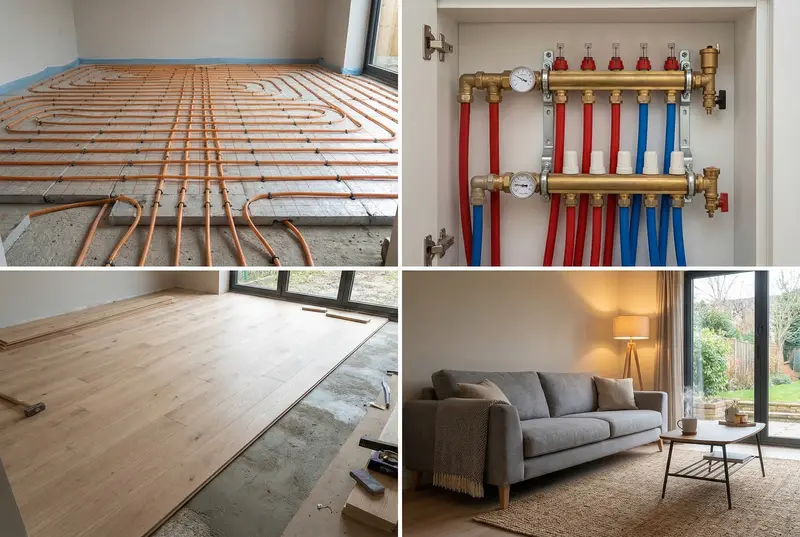
A professional underfloor heating installation in Oldham typically follows a clear sequence of stages, though the specifics depend heavily on your floor type and whether you're going wet (hydronic, connected to your boiler) or dry (electric mat systems). For most family homes, a wet system is more cost-effective to run long-term, so that's what most installers recommend for whole-floor projects. The process begins with a proper site survey — an engineer will assess your existing boiler capacity, floor construction, room dimensions, and insulation levels. In older Oldham terraces, this survey stage is particularly important because suspended timber floors may need reinforcing or replacing before pipework goes in. Once the floor is prepared and insulation is laid, flexible polyethylene pipe is fixed in loops across the floor area according to a calculated circuit plan. A screed is then poured over the top (or low-profile panels used in retrofit situations), encasing the pipes. The system is then connected to a manifold, pressure tested, and commissioned — a process that involves slowly raising the temperature over several days to cure the screed properly. Smart thermostats are fitted room by room, giving you precise control. The whole installation on a typical Oldham three-bedroom semi, covering ground floor rooms, usually takes three to five days for the floor work plus a curing period before you can use the heating properly.
Why Choose a Local Oldham Specialist
Choosing an installer who knows Oldham's housing stock well genuinely makes a difference. A local tradesperson will have seen the full range of floor constructions common to the area — from the solid flagstone ground floors in some of the older Shaw Road terraces to the thin concrete slabs in 1970s builds around Fitton Hill. They'll understand which local suppliers stock the right screed mixes, how to work around the terraced layouts common in this part of Greater Manchester, and they'll be on hand quickly if any commissioning issues arise. For a job of this size and permanence, local knowledge and easy follow-up access are worth paying for.
Frequently Asked Questions
Is underfloor heating suitable for my Victorian terrace in Oldham?
Yes, but it requires more preparation. Victorian terraces typically have suspended timber floors or solid stone, both of which need insulation boards laid before pipework. This adds cost but is absolutely doable. Many Oldham homeowners with period terraces have successfully installed wet systems during full kitchen or ground floor renovations. A survey will confirm what your specific floor needs.
Will my existing boiler handle underfloor heating in an Oldham home?
It depends on the boiler's output and age. Underfloor heating runs at lower flow temperatures than radiators, which actually suits modern condensing boilers very well and can improve efficiency. However, if your boiler is older or undersized for the floor area you're heating, an upgrade may be recommended alongside the installation. Your installer should assess this at the survey stage.
How long does the screed take to dry before I can use the heating in Oldham winters?
Standard sand and cement screed needs around 21 to 28 days to cure fully, though liquid screeds can be ready for cautious use sooner. During colder Oldham winters, drying times can extend slightly. Your installer will manage a commissioning programme — gradually raising temperatures over the first few weeks — to prevent cracking and ensure the system beds in properly.
Does soft water in Oldham affect underfloor heating maintenance?
Positively, actually. Oldham's Pennine reservoir supply is notably soft, meaning very low mineral content. This significantly reduces the risk of limescale forming inside your underfloor pipes and manifold compared to hard water areas. You'll still want inhibitor fluid added to the system at installation to prevent internal corrosion, but overall, soft water means less maintenance hassle over the system's lifetime.
Other Plumbing Services in Oldham
What do you need?
Select your service and urgency level