Underfloor Heating in St Albans
Underfloor heating is one of the most popular home upgrades in St Albans right now, and it's easy to see why. It delivers even, comfortable warmth across a room without the clutter of radiators, and when it's properly installed and controlled, it can genuinely reduce your heating bills over time. It's a significant investment, but for a well-maintained St Albans home it adds real value — both in daily comfort and in resale appeal.
Plumbing Conditions in St Albans
Very Hard water — Chiltern chalk hills
Mixed housing stock across different eras. With 22% of properties built before 1919, older pipework and drainage systems are common — specialist knowledge of period properties matters.
Underfloor Heating in St Albans — Local Expertise
St Albans has a genuinely varied housing stock, and the type of property you own makes a big difference to how underfloor heating gets installed and what it costs. Edwardian semis — common in areas like Clarence Park and around the city centre — typically have suspended timber floors and solid walls, which means the installer needs to work carefully to accommodate pipe runs without compromising floor height or structural integrity. Post-war estates, found throughout the outer parts of St Albans and into villages like Bricket Wood and Chiswell Green, often have solid concrete ground floors that are actually ideal for wet underfloor heating systems. Modern developments are increasingly built with UFH already in mind. It's also worth knowing that St Albans sits in a moderately hard water area. This means lime scale can build up in pipework and heat exchangers over time, so a good installer should be fitting a scale reducer or recommending inhibitor treatment as part of the system setup — not leaving it as an afterthought.
How We Work
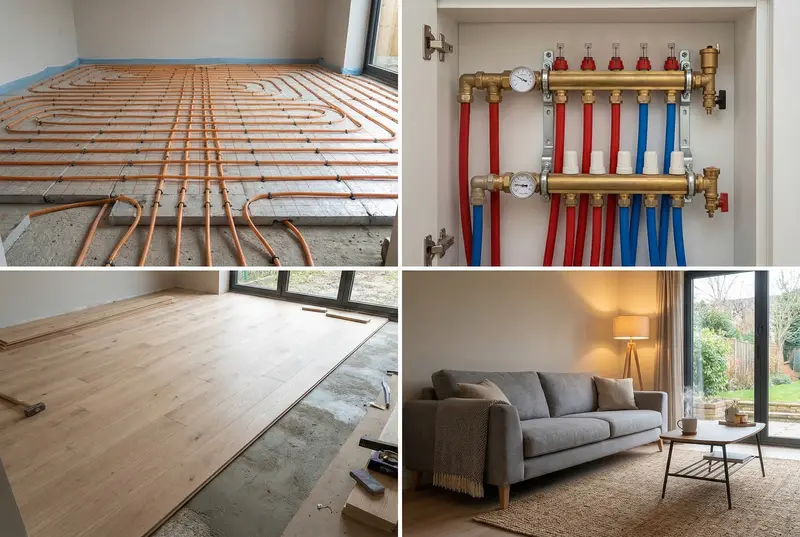
A wet underfloor heating installation involves laying a network of water-carrying pipes beneath your floor, connected to your boiler or heat pump, which circulate warm water to heat the floor surface from below. Here's what to expect from start to finish. The process begins with a site survey, where an installer assesses your floor construction, room dimensions, existing heating system, and insulation levels. This is essential — without proper insulation beneath the pipes, heat escapes downward and the system performs poorly. For Edwardian properties in St Albans, the surveyor may recommend lifting floorboards to install between joists, which is more involved but avoids raising the floor level. For solid concrete floors, a screed layer is typically poured over the pipework, which does add some height — usually 60 to 100mm — so door clearances and skirting boards need to be factored in. Once the pipes are laid and pressure tested, they're connected to a manifold, which controls flow to each zone. A thermostat is fitted per room or zone, allowing precise temperature control. The system is then commissioned and balanced, which is a step that's often rushed but critical to efficiency. The whole installation typically takes two to five days depending on the scale of the project, and floors usually need a curing period before full use.
Why Choose a Local St Albans Specialist
Underfloor heating isn't a job to hand to someone who's never worked in St Albans before. A local installer will know the difference between the joist spacing in an Edwardian terrace off Hatfield Road and a 1970s semi in Marshalswick. They'll understand what the building control team in St Albans expects for notifiable work, and they'll have local suppliers they can turn to quickly if something unexpected comes up mid-job. They're also far easier to get back if something needs adjusting after the job is done — which matters a lot on a premium installation like this.
Frequently Asked Questions
Is underfloor heating suitable for my Edwardian semi in St Albans?
Yes, but it requires more planning than a modern property. Edwardian homes typically have suspended timber floors, which means pipes are usually fitted between the joists from below rather than on top. It's more involved, but an experienced installer will handle it cleanly. Insulation beneath the pipes is especially important in older St Albans properties to prevent heat loss downward.
Can I run underfloor heating from my existing boiler?
In many cases, yes. Most modern condensing boilers can run a wet underfloor heating system, though your installer will need to check the output capacity and may recommend fitting a low-loss header or mixing valve to manage the lower flow temperatures UFH requires. Older or undersized boilers may need replacing, which adds to overall cost but often improves whole-home efficiency.
How does hard water in St Albans affect underfloor heating systems?
St Albans has moderately hard water, which means lime scale can accumulate inside pipes and at the heat exchanger over time. A reputable installer should add a scale inhibitor or fit a water softener as part of the installation. Using the correct system inhibitor fluid and having it checked annually during a service visit will protect your investment and keep the system running efficiently for years.
How long does underfloor heating take to heat a room, and is it expensive to run?
Wet underfloor heating is slower to respond than radiators — typically 30 to 60 minutes to reach target temperature — so it works best when controlled by smart thermostats with scheduled programming rather than switching on and off reactively. Running costs depend heavily on insulation quality and your heat source, but a well-installed system in a properly insulated St Albans home can be cheaper to run than conventional radiators over a full heating season.
Other Plumbing Services in St Albans
What do you need?
Select your service and urgency level