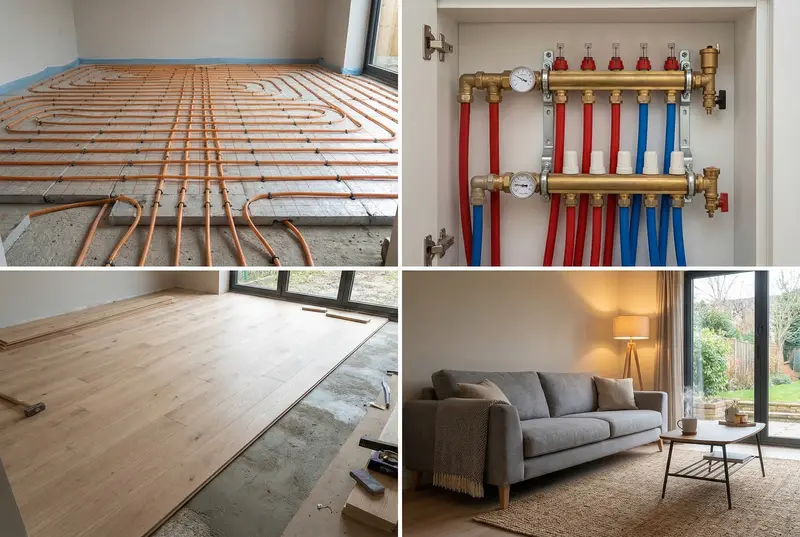
Underfloor Heating in Haringey
Underfloor heating has become one of the most sought-after home upgrades across Haringey, and it's easy to understand why. Whether you're tired of cold kitchen tiles first thing in the morning or you want a more efficient, even heat throughout your home, underfloor heating delivers comfort that radiators simply can't match. Haringey's dense, varied housing stock — ranging from grand Victorian terraces to compact post-war semis and contemporary new-builds — means there's rarely a one-size-fits-all approach here. Getting the installation right from the start matters enormously, both for your comfort and your long-term running costs.
Plumbing Conditions in Haringey
Very Hard water — significant limescale buildup, annual boiler servicing essential
Mixed housing stock across different eras. With 22% of properties built before 1919, older pipework and drainage systems are common — specialist knowledge of period properties matters.
Underfloor Heating in Haringey — Local Expertise
Haringey presents a genuinely interesting challenge for underfloor heating installers because the borough covers such a wide range of property types and ages. Victorian terraces — common across Crouch End, Stroud Green, and Hornsey — often have solid concrete or suspended timber ground floors, and each requires a completely different installation approach. Post-war housing in areas like Tottenham and Wood Green tends to have solid floors that suit wet underfloor systems well, but may need insulation upgrades to perform efficiently. Modern developments and conversions across the borough are generally better suited straight off, with thinner floor builds already in mind. Haringey also sits in a moderately hard water area, which is worth factoring in for wet (hydronic) underfloor heating systems. Hard water can accelerate limescale build-up inside the pipework and manifold over time, so fitting a good inhibitor and a suitable filter at installation is important — not an optional extra. A local installer who understands this will set your system up correctly from day one.
How We Work
Underfloor heating installation in Haringey typically begins with a proper survey of your home — the floor construction, existing heating system, insulation levels, and room layout all need to be assessed before any work starts. There are two main system types: electric (dry) systems, which use heating cables or mats beneath the floor finish and are well-suited to single rooms or renovations; and wet (hydronic) systems, which circulate warm water through pipework connected to your boiler or heat pump, and are better suited to whole-home installations. For most Haringey properties looking to heat multiple rooms, a wet system connected to a condensing boiler or heat pump will offer the best running costs over time. Once the system type is agreed, installers will lay insulation boards first — this is critical and often skipped by less experienced tradespeople, but without it, you're heating the subfloor rather than the room above. Pipework or heating mats are then laid in a specific pattern to ensure even heat distribution, before the floor is screeded or boarded over. The system is then connected to the manifold, pressure-tested, and commissioned carefully before any floor finish goes down. The whole process for a ground floor installation typically takes three to five days, with screed needing up to four weeks to cure fully before the floor covering is laid.
Why Choose a Local Haringey Specialist
Choosing an installer who works regularly in Haringey genuinely makes a difference. They'll know the common floor constructions found in Victorian and post-war properties across the borough, they'll understand the local water supply characteristics and spec the system accordingly, and they'll be familiar with building control requirements for this part of Greater London. A local tradesperson is also easier to get back if anything needs adjusting after commissioning — and with underfloor heating, small tweaks to zone settings or thermostat positioning are common in the first heating season. Reputation matters in a borough like Haringey, and local tradespeople depend on word-of-mouth.
Frequently Asked Questions
Is underfloor heating suitable for a Victorian terrace in Haringey?
Yes, but it takes more planning than a modern property. Many Haringey Victorian terraces have suspended timber ground floors, which can accommodate electric or low-profile wet systems with the right insulation fitted beneath. Solid floors can be dug out and insulated for a full wet system. A proper survey will tell you what's realistic for your specific home.
Will hard water in Haringey damage my underfloor heating system?
It can cause problems over time if the system isn't set up correctly. Haringey's moderately hard water means limescale can build up inside the pipework and manifold. A reputable installer will add a quality corrosion inhibitor and fit a suitable filter at the manifold to protect the system. Annual checks of inhibitor levels are recommended to keep everything running efficiently.
How long does underfloor heating installation take in a typical Haringey home?
For a wet system covering the ground floor of a standard Haringey terrace or semi, expect three to five days of installation work. If a new screed is laid, you'll then need to wait approximately four weeks for it to cure before the floor covering goes down. Electric mat systems in a single room can be completed in a day or two.
Can underfloor heating work with my existing boiler, or will I need a new one?
Many existing condensing boilers in Haringey homes are compatible with underfloor heating, particularly if the boiler is relatively modern. Underfloor systems run at lower flow temperatures than radiators, which actually suits condensing boilers well and can improve efficiency. However, if your boiler is older or undersized for the additional load, an upgrade may be recommended at the survey stage.
Other Plumbing Services in Haringey
What do you need?
Select your service and urgency level