Underfloor Heating in Barking and Dagenham
Underfloor heating is one of those upgrades that completely changes how a home feels — and demand for it across Barking and Dagenham has grown steadily as homeowners look for more efficient, comfortable alternatives to traditional radiator systems. Whether you're renovating a Victorian terrace in Barking, extending a post-war semi in Dagenham, or fitting out a new-build flat, underfloor heating can work brilliantly — but only when it's been properly designed and installed for your specific property. Get it wrong and you're looking at cold spots, inefficiency, or costly remedial work. Get it right and you'll wonder how you managed without it.
Plumbing Conditions in Barking and Dagenham
Very Hard water — significant limescale buildup, annual boiler servicing essential
Mixed housing stock across different eras. With 22% of properties built before 1919, older pipework and drainage systems are common — specialist knowledge of period properties matters.
Underfloor Heating in Barking and Dagenham — Local Expertise
Barking and Dagenham has a genuinely mixed housing stock, and that variety matters enormously when it comes to underfloor heating. The older Victorian terraces found closer to Barking town centre typically have solid or suspended timber ground floors, which affects whether wet or electric systems are more practical. Post-war housing — which makes up a large proportion of the borough's residential stock — often has concrete slab floors that are well-suited to wet underfloor heating, though insulation beneath the slab needs careful consideration to avoid heat loss downward. Newer builds and modern extensions tend to be the easiest to work with, as they're often already built with UFH in mind. It's also worth noting that Barking and Dagenham sits in a moderately hard water area, which means the water flowing through a wet underfloor heating system carries a degree of mineral content. Fitting a good quality inhibitor and, where appropriate, an inline scale reducer is genuinely important here — it protects the manifold and pipework from furring up over time and keeps the system running efficiently.
How We Work
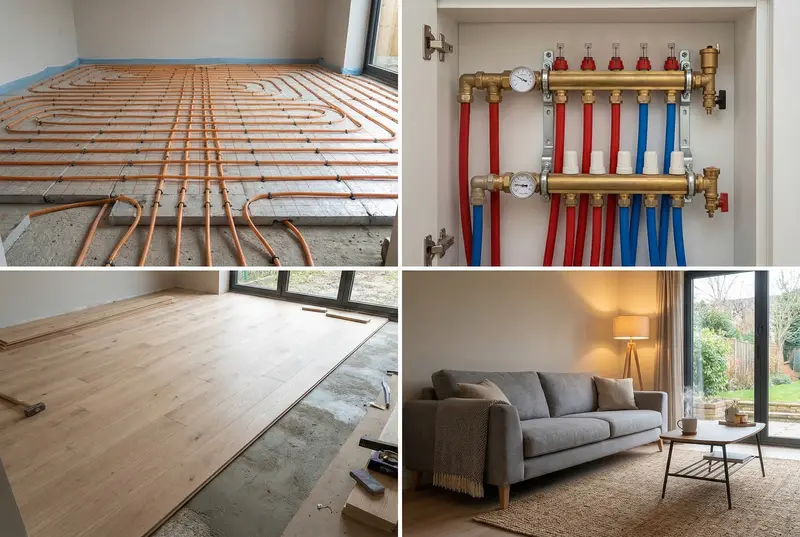
A proper underfloor heating installation in Barking and Dagenham starts well before anyone lifts a floorboard. The first step is a heat loss calculation for each room — this determines whether UFH alone can heat the space or whether supplementary heating will be needed. A surveyor will assess your floor construction, existing boiler capacity (for wet systems), insulation levels, and room usage. From there, a system design is drawn up covering pipe spacing, manifold location, and zone controls. For wet systems, installation involves laying insulation boards first, then looping flexible pipe in a serpentine or spiral pattern across the floor before screeding or boarding over. This process typically takes two to five days depending on the area covered. For electric mat systems — often better suited to Barking and Dagenham's older properties where floor height is a concern — the mats are laid directly onto the subfloor and tiled or boarded over, making it a faster job. Once installed, wet systems need a commissioning period where the screed is gradually brought up to temperature over several weeks — this is not optional and skipping it causes cracking. A final pressure test and thermostat setup rounds off the job, and a good installer will walk you through the controls before they leave.
Why Choose a Local Barking and Dagenham Specialist
Choosing a tradesperson who knows Barking and Dagenham well genuinely pays off with a job like this. Local installers will have worked in the borough's range of property types — from the older terraced streets near Barking station to the post-war estates in Dagenham — and they'll understand the practical challenges each throws up. They're also likely to know local building control requirements and can advise on whether your planned installation needs to be notified under Part L of the Building Regulations. A local installer is also easier to call back if a zone stops responding or the manifold needs adjustment down the line.
Frequently Asked Questions
Can underfloor heating be installed under an existing tiled or wooden floor in a Barking and Dagenham home?
It depends on the floor type and construction. In many cases, yes — electric mat systems can be installed beneath new tiles with minimal floor height change. Wet systems usually require lifting the existing floor. A surveyor will assess your specific setup and tell you honestly what's involved before any work begins.
Will my existing boiler cope with underfloor heating in my Dagenham semi?
Many modern combi and system boilers can run wet UFH, but older or undersized boilers may struggle — particularly if you're adding UFH to a larger area. An installer will check your boiler's output against the heat demand of the new system. Sometimes a low-temperature buffer cylinder or boiler upgrade is recommended, which affects overall cost.
How does hard water in Barking and Dagenham affect an underfloor heating system?
Moderately hard water can cause limescale to build up inside the pipework and manifold over time, reducing efficiency and potentially causing blockages. Adding a quality inhibitor to the system fluid is essential, and some installers recommend a scale reducer on the feed. Annual system checks help catch any buildup early before it becomes a problem.
How long does underfloor heating take to heat a room compared to radiators?
UFH is slower to respond than radiators — it can take 30–60 minutes to reach working temperature, sometimes longer in colder weather. This is why smart thermostats with scheduling are important. Once up to temperature, UFH holds heat well and feels very even throughout the room, with no cold spots near windows or exterior walls.
Other Plumbing Services in Barking and Dagenham
What do you need?
Select your service and urgency level