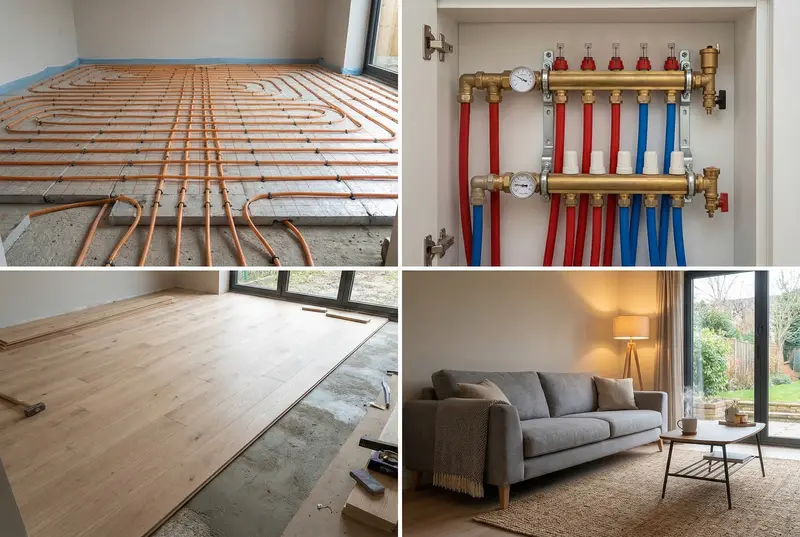
Underfloor Heating in Southampton
Most Southampton homeowners looking into underfloor heating are driven by the same frustration: cold floors in winter, radiators taking up wall space, and energy bills that don't seem to reflect the comfort they're getting. Underfloor heating solves all three. Whether you're renovating a period terrace in Shirley, extending a post-war semi in Hedge End, or fitting out a new-build apartment near the waterfront, a well-installed wet or electric UFH system delivers even, efficient warmth from the ground up. It's a significant investment, but one that adds real value to a Southampton home and pays back in comfort and running costs over time.
Plumbing Conditions in Southampton
Hard water — Hampshire chalk
Mixed housing stock across different eras. With 22% of properties built before 1919, older pipework and drainage systems are common — specialist knowledge of period properties matters.
Underfloor Heating in Southampton — Local Expertise
Southampton's housing stock is genuinely varied, and that variety matters enormously when planning underfloor heating. Victorian terraces — common across Freemantle, Portswood, and St Denys — typically have solid ground floors and limited floor-to-ceiling height, which means a low-profile electric mat system or a slim-screed wet system is often the more practical route. Post-war semis and bungalows across Lordshill and Millbrook tend to have suspended timber floors, which suit specialist underfloor heating panels designed for joist bays. Modern developments closer to Southampton's city centre or in areas like Hedge End are generally the easiest to retrofit, with concrete slab construction that accepts a standard wet system without compromise. Southampton sits in a hard water area supplied by Thames Water and Affinity Water, which means the pipework and manifold in a wet UFH system should be specified with scale inhibition in mind — either through system inhibitor dosing or a suitable filter — to protect your investment long-term.
How We Work
A proper underfloor heating installation in Southampton starts well before anyone lifts a floorboard. A good installer will visit your property to assess the floor construction, room dimensions, heat loss, and your existing boiler's output — because UFH runs at lower flow temperatures than radiators, your boiler needs to be compatible, and heat pumps are increasingly popular pairings. From there, you'll receive a system design showing pipe or mat layouts, manifold positions, and zone controls. For a wet system, installation involves laying insulation boards first to prevent heat loss downward, then fixing pipe loops at set spacings before the screed is poured over the top. Screeded floors then need a curing period — typically two to four weeks — before commissioning. Electric mat systems are quicker to install and suit bathrooms or single-room installations particularly well. Once the system is laid, a manifold is connected to your heating circuit, smart thermostats are fitted per zone, and the whole system is pressure-tested and balanced before handover. A competent installer will walk you through the controls, explain the warm-up times to expect, and provide documentation for your records. Throughout Southampton, quality installers will also ensure Building Regulations compliance — Part L and Part P where electrical work is involved.
Why Choose a Local Southampton Specialist
Choosing a Southampton-based installer rather than a national contractor makes a practical difference. A local tradesperson will be familiar with the city's mix of property types, understand which approaches work in period terraces versus post-war builds, and can often visit for a survey quickly. They'll also know local building control requirements and have working relationships with local suppliers, which can speed up material lead times. When something needs attention after installation — a zone not responding, a thermostat query — a local business is far more accountable and accessible than a distant call centre. Reputation in a city like Southampton travels fast.
Frequently Asked Questions
Can underfloor heating be installed under an existing tiled floor in a Southampton Victorian terrace?
It depends on the floor construction. Most Victorian terraces in Southampton have solid floors, which can accept an electric mat system beneath new tiles without major upheaval. If you want a wet system, the existing floor level needs careful assessment — there's often limited headroom in period properties, but low-profile systems with slim-screed overlays can work well.
Will my existing boiler work with underfloor heating in a Southampton home?
Many modern combi and system boilers are compatible, but they need to achieve low flow temperatures — around 35–45°C — to run UFH efficiently. Older boilers may struggle with this. An installer should assess your boiler output and age before designing the system. In Southampton, many homeowners are also pairing new UFH with air source heat pumps, which are a natural fit.
How long does a full ground-floor UFH installation take in a typical Southampton property?
For a wet screed system in a three-bedroom Southampton home, expect around three to five days of installation work, followed by a screed curing period of two to four weeks before the system can be commissioned and flooring laid on top. Electric systems are faster — a single room can often be done in a day. Your installer should give you a clear programme upfront.
Does Southampton's hard water affect underfloor heating systems?
Yes, it's worth taking seriously. Hard water areas like Southampton can cause limescale build-up inside UFH pipework and at the manifold over time, reducing efficiency and potentially causing blockages. A good installer will add a suitable system inhibitor and possibly a magnetic filter to the circuit. This is standard practice and should be included in any quality installation, not treated as an optional extra.
Other Plumbing Services in Southampton
What do you need?
Select your service and urgency level