Underfloor Heating in Rochester
Underfloor heating has become one of the most sought-after home upgrades in Rochester, and it's easy to see why. Instead of relying on radiators that heat unevenly and take up wall space, a properly installed underfloor system spreads warmth across the entire floor surface, making every room feel genuinely comfortable rather than just warm near the edges. Whether you're renovating a period property in the older parts of town or upgrading a newer build closer to the riverside developments, underfloor heating is a realistic, long-term investment that adds both comfort and value to your home.
Plumbing Conditions in Rochester
Very Hard water — Thames and Medway chalk aquifers
Mixed housing stock across different eras. With 22% of properties built before 1919, older pipework and drainage systems are common — specialist knowledge of period properties matters.
Underfloor Heating in Rochester — Local Expertise
Rochester's housing stock is wonderfully varied, and that variety matters a great deal when it comes to underfloor heating. The Edwardian semis that line many of Rochester's established streets present a particular challenge — solid ground floors, lower ceiling heights, and original timber joisted upper floors all require careful planning before any installation begins. Lifting original floorboards or breaking up solid concrete screeds in these older homes is perfectly achievable, but it does add time and cost compared to newer builds. Post-war estates, common across the outskirts of Rochester, often have suspended timber or early concrete floors that need assessment before deciding on a wet or electric system. Modern developments, particularly those built in the last decade, are generally the most straightforward — insulation is usually already adequate and floor voids are designed with services in mind. Rochester also sits in a moderately hard water area, which is worth noting for wet (hydronic) underfloor heating systems. Hard water can cause scale build-up inside pipework over time, so using an inhibitor and fitting a system filter is strongly recommended to protect your investment.
How We Work
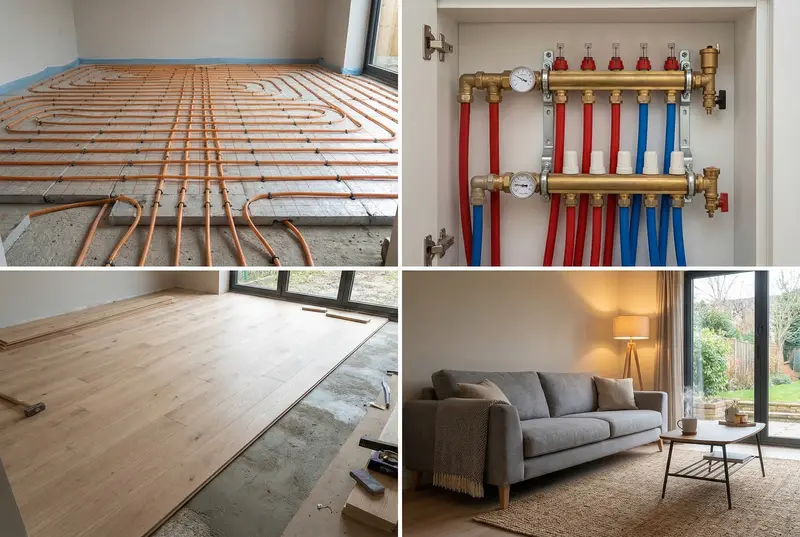
Underfloor heating installation broadly falls into two categories: wet systems, which circulate warm water through pipes laid beneath the floor, and electric systems, which use heating cables or mats. Wet systems are more efficient for whole-house heating and are the better long-term choice for most Rochester properties, while electric systems are ideal for single rooms or smaller areas where you want supplementary warmth without the disruption of connecting to your boiler. The installation process starts with a proper survey of your home — a good installer will assess your existing boiler capacity, floor construction, insulation levels, and room layout before recommending anything. For a wet system, insulation board is laid first, followed by the pipe runs, which are then covered with a screed or specialist overlay board. The system is connected to a manifold, which in turn links to your boiler or heat pump. Commissioning and pressure testing follow before any floor covering goes down. For Edwardian semis in Rochester, this stage often reveals the need for additional insulation work beneath the pipes to prevent heat loss downward. The whole process for a typical mid-terrace or semi-detached home takes three to five days for groundwork floors, though properties with suspended timber floors may take slightly longer due to the additional structural care required. You'll also need zone controls and thermostats fitted — these allow you to heat different rooms independently, which makes a genuine difference to running costs.
Why Choose a Local Rochester Specialist
Choosing a Rochester-based installer rather than a national firm makes a practical difference. Local tradespeople understand the specific property types here — they've worked in the Edwardian semis off the High Street, the post-war estates around Borstal and Strood, and the newer developments near the waterfront. They know what surprises tend to come up under Rochester floors and can price accordingly rather than adding large contingency fees. They're also easier to get back if something needs attention after the job is done, and their reputation depends on word of mouth within the local community, which tends to sharpen the quality of their work considerably.
Frequently Asked Questions
Can underfloor heating be installed in an Edwardian semi in Rochester without replacing the whole floor?
In many cases, yes. Overlay systems use thin boards placed directly on top of an existing floor, adding only 15–20mm of height. This avoids the disruption of a full screed but does require careful attention to door clearances and transitions between rooms. It's worth having a surveyor assess the floor condition first, as some older Rochester properties have uneven or damaged subfloors that need attention beforehand.
Will my existing boiler cope with underfloor heating in my Rochester home?
It depends on your boiler's age and output. Underfloor heating runs at lower flow temperatures than radiators, which is actually more efficient, but your boiler still needs sufficient capacity to heat the added volume of water in the system. A qualified installer will calculate this during the survey. Many Rochester homes with boilers over ten years old do need an upgrade, though this isn't always the case.
Does the hard water in Rochester cause problems for underfloor heating pipework?
It can if the system isn't properly protected. Scale build-up inside the pipes is a genuine risk in moderately hard water areas like Rochester. A reputable installer will add a corrosion inhibitor to the system fluid and should fit an inline filter on the manifold. Having your system professionally serviced every two to three years and checking inhibitor levels annually will significantly extend the life of the pipework.
How long does underfloor heating take to heat up, and is it suitable as the main heat source in a Rochester home?
Wet underfloor systems are slower to respond than radiators — typically 30 to 60 minutes to reach full temperature — so they work best left on a timed programme rather than switched on and off. For well-insulated homes they work excellently as a primary heat source. Older Rochester properties with less insulation may benefit from combining underfloor heating on the ground floor with radiators upstairs for the most comfortable and cost-effective result.
Other Plumbing Services in Rochester
What do you need?
Select your service and urgency level