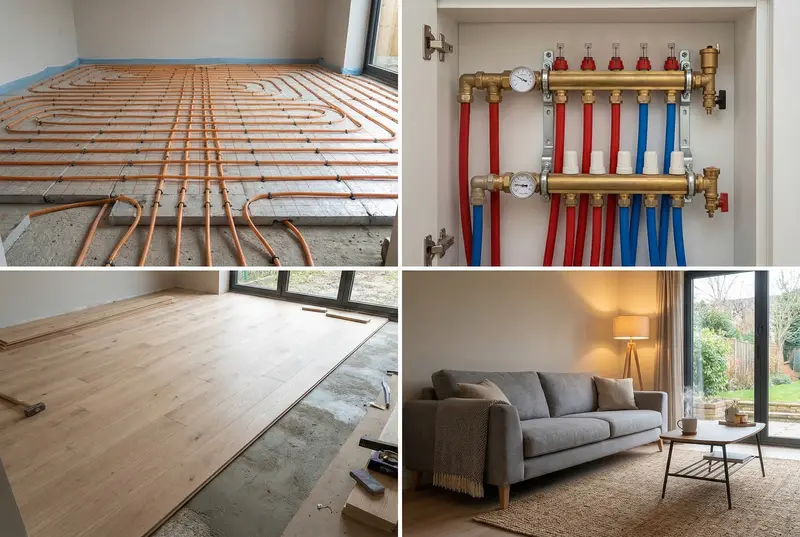
Underfloor Heating in Peterborough
Underfloor heating is one of the most popular home improvements in Peterborough right now, and it's easy to see why. It delivers even, comfortable warmth across a room without radiators taking up wall space, and when paired with a modern heat pump or condensing boiler, it can genuinely reduce your heating bills over time. That's a significant investment, but for most households it adds real value to the home and improves day-to-day comfort considerably.
Plumbing Conditions in Peterborough
Very Hard water — some of the hardest in England
Mixed housing stock across different eras. With 22% of properties built before 1919, older pipework and drainage systems are common — specialist knowledge of period properties matters.
Underfloor Heating in Peterborough — Local Expertise
Peterborough's housing stock is unusually varied, and that variety matters a great deal when it comes to underfloor heating. The city has a substantial number of Victorian and Edwardian terraces, particularly in areas like Millfield and New England, where solid floors, low ceiling heights, and older joisted timber floors all affect what's feasible and how much it costs. Post-war housing — think the council-built semis and bungalows across Ravensthorpe and Paston — often has suspended timber ground floors that suit a dry screed or low-profile electric mat system rather than a full wet pour. Newer builds in areas like Hampton and Hampton Vale, on the other hand, are frequently pre-plumbed for wet underfloor heating systems already. Peterborough sits in a moderately hard water area, which is worth noting for wet hydronic systems — a good installer should include a suitable inhibitor and, where appropriate, a scale reducer to protect the pipework and manifold from limescale build-up over time.
How We Work
A professional underfloor heating installation in Peterborough starts with a proper survey of the property. The installer needs to assess the floor construction, the existing heat source, insulation levels, and room-by-room heat loss before recommending a wet (hydronic) or electric system. Wet systems circulate warm water through pipework beneath the floor and are connected to your boiler or heat pump — these are the most cost-effective to run long-term but involve more disruption during installation. Electric systems use heating mats or cables and are quicker to install, making them popular for bathroom and kitchen retrofits in Peterborough's older homes where lifting floors extensively isn't practical. For a wet system, the process typically involves laying insulation board, fixing the pipework in a serpentine or spiral pattern, connecting zones to a manifold, pressure testing the circuit, and then either screeding over with a self-levelling compound or, in timber floor situations, using a low-profile plate system that sits between joists. The whole job on a ground floor of an average three-bedroom Peterborough home usually takes between three and five days. After installation, the system needs a slow commissioning process — the floor temperature is raised gradually over several days to allow the screed to cure properly before the system is handed over to you.
Why Choose a Local Peterborough Specialist
Choosing a locally based installer in Peterborough makes a real difference on a job like this. Someone who works regularly across the city will understand the common floor constructions in different neighbourhoods, know how to handle the quirks of older Victorian terraces versus newer Hampton builds, and be on hand easily if you need any adjustments after handover. Underfloor heating isn't a fit-and-forget installation — the commissioning stage and the first heating season often throw up small tweaks — and having an installer who is genuinely local means you're not waiting weeks for a callback.
Frequently Asked Questions
Is underfloor heating suitable for older Victorian houses in Peterborough?
Yes, but it requires more planning. Many Victorian homes in Peterborough have suspended timber floors or solid floors with limited headroom, which affects which system is suitable. A dry plate system or low-profile electric mat is often the most practical option. A good installer will survey the floor construction properly before recommending anything.
How does Peterborough's hard water affect an underfloor heating system?
Peterborough is a moderately hard water area, so limescale can be an issue in wet hydronic systems over time. A reputable installer should add a quality inhibitor to the system fluid and may recommend a scale reducer or magnetic filter on the feed. This is straightforward to include during installation and protects the manifold and pipework long-term.
How long does underfloor heating take to install in an average Peterborough home?
For a wet system covering the ground floor of a typical three-bedroom semi, expect around three to five working days for the physical installation. After that, you need to allow time for the screed to cure before gradually commissioning the system — this process can take a couple of weeks before the heating is fully operational.
Can I add underfloor heating to just one room rather than the whole house?
Absolutely. Single-room installations are very common in Peterborough, particularly in bathrooms and open-plan kitchen extensions. Electric mat systems are the usual choice for a single room retrofit as they're less disruptive and quicker to install. They're more expensive to run than a wet system but ideal where you want the comfort in one specific area.
Other Plumbing Services in Peterborough
What do you need?
Select your service and urgency level