Underfloor Heating in Norwich
Underfloor heating has become one of the most sought-after home upgrades across Norwich, and it's easy to see why. Radiators take up wall space, create uneven heat, and can leave cold spots in larger rooms. A well-installed underfloor heating system turns your entire floor into a gentle, consistent heat source — warming the room from the ground up. Whether you're renovating a period property in the Golden Triangle or fitting out a new-build on the outskirts of the city, the right system can transform your home's comfort levels and actually reduce your heating bills over time. This guide covers what's involved, what it costs in Norwich, and what to look out for.
Plumbing Conditions in Norwich
Hard water — Norfolk chalk and limestone
Mixed housing stock across different eras. With 22% of properties built before 1919, older pipework and drainage systems are common — specialist knowledge of period properties matters.
Underfloor Heating in Norwich — Local Expertise
Norwich is a city of genuinely varied housing stock, and that variety matters enormously when it comes to underfloor heating. Edwardian semis — common in areas like Eaton, Unthank Road, and Thorpe Hamlet — typically have suspended timber floors with original joists, which makes wet underfloor heating more complex but far from impossible. Insulation boards or low-profile systems between the joists can work well, though these properties do require careful heat-loss calculations. Post-war estates across Heartsease, Bowthorpe, and Mile Cross tend to have solid concrete ground floors that are actually ideal for wet systems, as the screed holds and radiates heat efficiently. Modern developments, particularly around Broadland Business Park and the Norwich Research Park fringe, often come pre-wired for electric underfloor heating mats under tiled or stone floors. Norwich sits in a moderately hard water area, which is worth knowing if you're installing a wet system — a scale inhibitor or water treatment should be included in any reputable installation to protect the pipework and manifold from mineral build-up over time.
How We Work
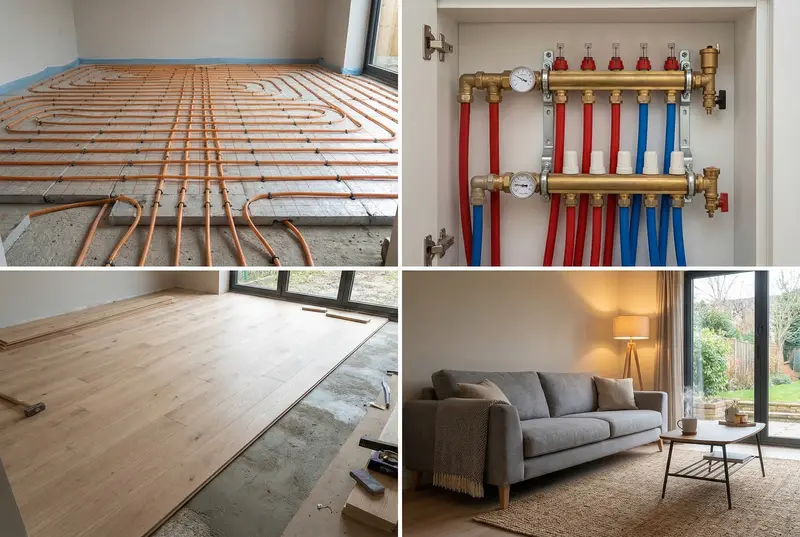
A professional underfloor heating installation in Norwich typically follows a clear process that starts well before anyone lifts a floorboard. The installer will begin with a site survey, assessing your floor construction, the room dimensions, your existing boiler capacity, and where the manifold will sit. This stage is crucial — undersized systems are one of the most common causes of disappointing results. For wet systems, flexible polyethylene pipes are laid in a continuous loop across the floor in a specific pattern, usually a snail or serpentine configuration, which ensures even heat distribution. These pipes connect back to a manifold — a central control unit typically installed in a utility cupboard or hallway — which regulates flow to each zone separately. The floor is then screeded over (for solid floors) or covered with specialist boards, and a curing period of several weeks is needed before full temperature is reached. For electric systems, heating mats or cables are laid directly onto the subfloor before tiles or flooring is fitted on top — these are quicker to install and suit single rooms or bathrooms well. Throughout the process, a competent installer will also assess your boiler. Underfloor heating runs at lower flow temperatures than radiators, so a condensing combi or system boiler is usually a good match, though older boilers may need attention. The final stage involves testing, commissioning, and walking you through the room-by-room controls.
Why Choose a Local Norwich Specialist
Choosing a Norwich-based installer rather than a national firm makes a real practical difference. A local tradesperson will know the housing stock — they'll have worked in Edwardian semis with awkward joist layouts, fitted systems around period features in the city centre conservation areas, and dealt with the specific floor constructions common on post-war estates. They're also easier to reach if something needs attention after commissioning. Word of mouth matters in a city the size of Norwich, and tradespeople who rely on local reputation tend to take more care. Ask for references from nearby properties if you can — it's a reasonable request and a confident installer won't hesitate.
Frequently Asked Questions
Can underfloor heating work with my older Edwardian semi in Norwich?
Yes, though it takes more planning than a solid floor. Many Norwich Edwardian properties have suspended timber floors, which can accommodate low-profile wet systems using insulated panels between joists, or electric mat systems under new flooring. A proper survey is essential to check joist depth and insulation options before any work begins.
How long does an underfloor heating installation take in a typical Norwich home?
A single-room electric system can be completed in a day or two. A full ground-floor wet system typically takes three to five days for the pipework and manifold, plus a screed curing period of four to six weeks before the system reaches full operating temperature. Planning ahead — especially for kitchen or extension projects — is strongly advised.
Does Norwich's hard water affect underfloor heating systems?
Norwich is a moderately hard water area, so mineral deposits can gradually affect pipework and manifold components in wet systems. A reputable installer should include a scale and corrosion inhibitor in the system fluid and may recommend a magnetic filter. It's a straightforward precaution that significantly extends the life of the installation.
Is underfloor heating compatible with a combi boiler in a Norwich terraced house?
In most cases, yes. Underfloor heating runs at lower flow temperatures (typically 35–45°C) than radiators, which actually suits modern condensing combis very well. However, if your boiler is older or undersized for the property, your installer may recommend an upgrade or a buffer tank. This should be assessed during the initial survey.
Other Plumbing Services in Norwich
What do you need?
Select your service and urgency level