Underfloor Heating in Lambeth
Underfloor heating has become one of the most sought-after home upgrades across Lambeth, and it's easy to understand why. Whether you're renovating a Victorian terrace in Stockwell, extending a post-war flat in Brixton, or fitting out a new-build apartment near Vauxhall, underfloor heating offers a level of comfort and efficiency that traditional radiators simply can't match. Space is at a premium in this part of south London, and freeing up wall space while achieving even, draught-free warmth makes real practical sense. If you're considering having a system installed, here's everything you need to know about what's involved, what it costs in Lambeth, and how to get it right first time.
Plumbing Conditions in Lambeth
Very Hard water — significant limescale buildup, annual boiler servicing essential
Mixed housing stock across different eras. With 22% of properties built before 1919, older pipework and drainage systems are common — specialist knowledge of period properties matters.
Underfloor Heating in Lambeth — Local Expertise
Lambeth's housing stock is genuinely varied, and that variation matters enormously when it comes to underfloor heating. Victorian terraces — common throughout Brixton, Clapham, and Kennington — typically have solid ground floors and suspended timber upper floors, both of which require quite different installation approaches. Solid floors can usually accommodate a screeded wet system without too much disruption, but suspended timber floors often suit electric mat systems or low-profile wet systems designed specifically to avoid the weight and depth of traditional screed. Post-war council housing, still prominent in parts of Lambeth like Stockwell and Tulse Hill, frequently has concrete slab construction which can actually make wet underfloor heating more straightforward on the ground floor. More modern apartments near the South Bank and Nine Elms are increasingly built with underfloor heating already in mind. It's also worth noting that Lambeth sits in a moderately hard water area, meaning that proper system flushing, inhibitor dosing, and the use of a magnetic filter are particularly important to prevent scale and debris buildup inside underfloor pipework over time.
How We Work
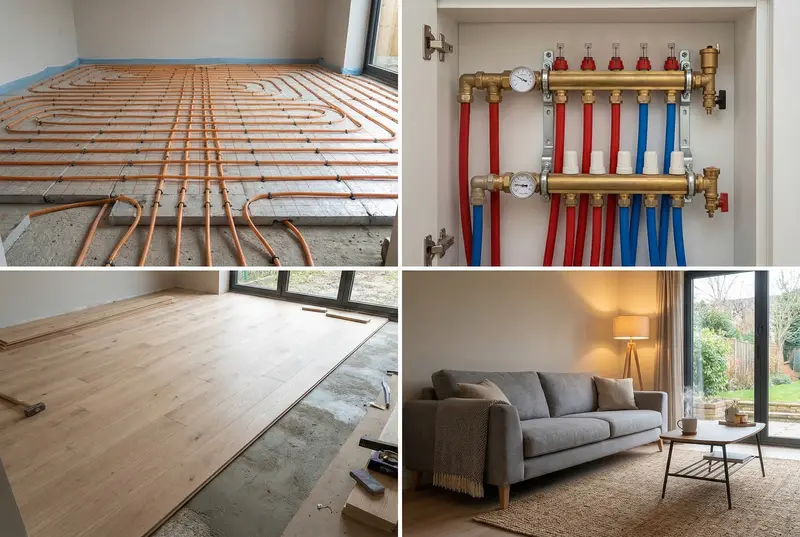
A professional underfloor heating installation in Lambeth typically follows a structured process, beginning with a proper heat loss calculation for each room. This isn't a step to skip — getting the pipe or mat layout wrong from the start means you'll either have cold spots or an inefficient system that costs more to run. Once the design is agreed, the type of system is confirmed: wet (hydronic) systems are generally preferred for whole-house or ground-floor installations where the boiler or heat pump will feed warm water through pipework embedded in the floor; electric systems are better suited to single rooms, bathrooms, or retrofits where screeding isn't practical. For a wet system installation, the floor is prepared, insulation boards are laid to prevent heat loss downwards, and the pipework is clipped into position in a serpentine or spiral pattern before the screed is poured. The screed then needs adequate curing time — typically at least three to four weeks — before the system is commissioned and the floor covering is laid. A competent installer will also connect the system to a manifold, set up individual room thermostats, and carry out a pressure test before handing over. For electric systems the process is faster, with heating mats or cables laid over the existing floor and a new thermostat wired in. Throughout Lambeth, access and parking logistics for materials delivery can add some complexity, particularly in terraced streets with permit zones, so it's worth factoring that into your planning from the outset.
Why Choose a Local Lambeth Specialist
Choosing a tradesperson who works regularly in Lambeth makes a genuine difference on a job like this. They'll be familiar with the borough's building regulations and planning considerations, understand the quirks of local property types — from Victorian conversions in Herne Hill to newer developments near Vauxhall — and know how to navigate the practicalities of working in a dense urban area. A local installer is also easier to hold accountable if anything needs attention after the job is done. Word of mouth matters in tight-knit areas like Brixton and Clapham, and established local tradespeople have a real incentive to get it right.
Frequently Asked Questions
Can underfloor heating be installed in a Victorian terraced house in Lambeth?
Yes, though it requires careful planning. Ground floors are often solid concrete or can be built up with insulation and screed, which suits a wet system well. Suspended timber floors on upper levels are better suited to electric mats or slim-profile wet systems. A good installer will assess each floor independently and recommend the right approach rather than a one-size-fits-all solution.
How does Lambeth's hard water affect an underfloor heating system?
Lambeth's moderately hard water supply means limescale can build up inside pipework over time, reducing efficiency and potentially causing blockages. A reputable installer should flush the system thoroughly, add a quality inhibitor, and fit a magnetic filter to catch debris and scale particles. Annual servicing that includes checking inhibitor levels is particularly important in this area to protect your investment.
How long does underfloor heating installation take in a typical Lambeth property?
For a wet system covering a ground floor, allow around three to five days for the installation itself, plus three to four weeks for the screed to cure before floor coverings can be laid. Electric systems are considerably quicker — often one to two days per room. The overall timeline from start to a fully usable floor is typically four to six weeks for a wet system installation.
Is underfloor heating compatible with a combi boiler in a Lambeth flat or house?
In most cases, yes. Many Lambeth homes use combi boilers, and underfloor heating can be connected to them, though the system needs to run at lower flow temperatures than standard radiators. Your installer may recommend fitting a blending valve to reduce the flow temperature appropriately. If you're also planning to replace your boiler, it's worth considering a heat pump, which is highly compatible with underfloor heating's lower temperature requirements.
Other Plumbing Services in Lambeth
What do you need?
Select your service and urgency level