Underfloor Heating in Burnley
Most homeowners in Burnley start thinking seriously about underfloor heating when they're already committed to a renovation — ripping up old carpets, replacing a tired boiler, or extending the back of a 1930s semi. It's one of those upgrades that makes complete sense when the floor is already up, but feels like a big commitment if you're starting from scratch. Done properly, underfloor heating transforms how a home feels: no radiators eating into wall space, no cold tiles underfoot in the morning, and a noticeably more even warmth throughout the room. In Burnley, where winters are reliably damp and chilly, it's becoming an increasingly popular choice for homeowners who want long-term comfort rather than a quick fix.
Plumbing Conditions in Burnley
Soft water — Pennine catchments
Mixed housing stock across different eras. With 22% of properties built before 1919, older pipework and drainage systems are common — specialist knowledge of period properties matters.
Underfloor Heating in Burnley — Local Expertise
Burnley's housing stock is genuinely varied, and that variation matters a lot when you're planning underfloor heating. Edwardian semis — common across areas like Habergham and parts of Rosehill — tend to have solid ground floors with limited void space underneath, which typically means a wet system laid within a screed is the most practical route. Post-war council-built estates and semi-detached properties often have suspended timber floors, where electric or low-profile wet systems can work well without major structural changes. Newer developments on the edge of town are usually already plumbed for underfloor heating or have the floor construction to support it straightforwardly. It's also worth knowing that Burnley sits in a moderately hard water area — not severe, but enough that fitting a good-quality inhibitor and possibly an inline scale filter on a wet underfloor system is a sensible precaution to protect your manifold and pipework from gradual mineral build-up over the years.
How We Work
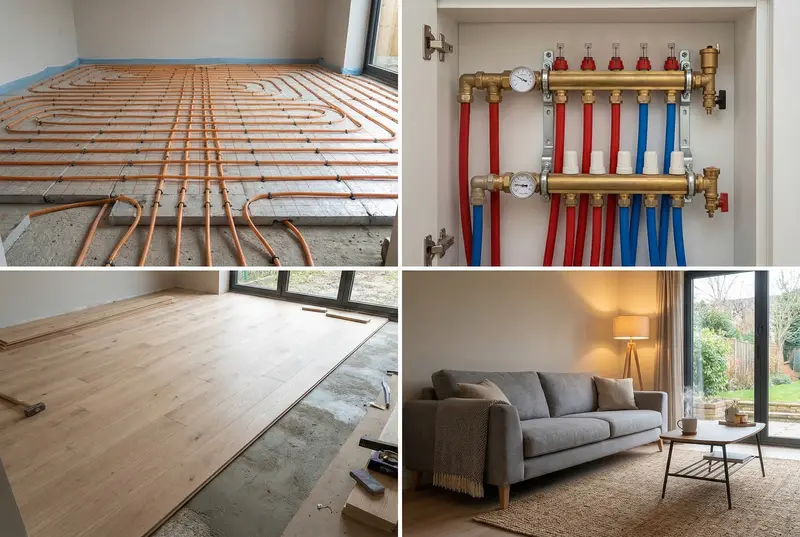
A wet (hydronic) underfloor heating installation in Burnley starts with a proper heat loss calculation for each room — a decent installer won't skip this step, because it determines pipe spacing and flow temperatures. Once the design is agreed, the existing floor is prepared: in most cases this means removing the old floor finish and, for solid floors, grinding back or building up to accommodate the screed depth needed. Pipework — typically 16mm PEX or PE-RT — is laid in a continuous loop pattern across the floor and connected back to a manifold, usually housed in a utility room or cupboard. For a whole-ground-floor installation in a typical Burnley semi, this stage takes one to two days. The screed is then poured and needs to cure for around four to six weeks before the final floor finish goes down. Your installer should also commission the system once everything is set: pressure-testing the pipework before screeding, running the system through a controlled warm-up sequence, and balancing each zone. Electric underfloor heating follows a simpler process — heating mats or cables are laid directly under tiles or a floating floor — and suits smaller rooms like bathrooms or kitchens where a full wet system wouldn't be cost-effective.
Why Choose a Local Burnley Specialist
Underfloor heating isn't a job where the cheapest online quote usually works out well. A local Burnley installer who knows the area's housing stock understands, for example, that many Edwardian properties here have unusual floor depths or original quarry tiles that need careful handling. They're also easier to get back if something needs adjusting after commissioning — and with a system that's embedded in your floor, you want someone who'll still be around in five years. Look for an installer who's Gas Safe registered (if they're connecting to your boiler), carries public liability insurance, and can show you completed local jobs.
Frequently Asked Questions
Can underfloor heating be fitted in an Edwardian semi in Burnley without major disruption?
It depends on the floor construction. Many Edwardian semis in Burnley have solid concrete or stone ground floors, which can take a wet screed system without too much extra work. If the floor needs significant build-up, door thresholds and skirting boards may need adjusting. A good installer will survey the property first and flag any complications before you commit.
How long does the installation take from start to finish?
The physical installation — pipe laying, manifold fitting, and screeding — usually takes two to four days for a typical Burnley semi ground floor. The screed then needs four to six weeks to cure before your floor finish goes down. Budget eight to ten weeks from installation start to a fully usable, finished floor, especially if tiling is involved.
Will underfloor heating work with my existing boiler?
Possibly, but it depends on the boiler's age, output, and condition. Underfloor heating runs at lower flow temperatures than traditional radiators, which actually suits modern condensing boilers well. Older or undersized boilers may struggle. Any reputable Burnley installer should assess your current boiler as part of the survey and tell you upfront if an upgrade is needed.
Does hard water in Burnley cause problems for underfloor heating systems?
Burnley's water is moderately hard, which can cause gradual limescale build-up inside underfloor pipework and manifolds over time if the system isn't properly protected. A quality corrosion inhibitor added to the system fluid, and potentially a scale reducer on the fill point, keeps this in check. Ask your installer specifically what water treatment they include — it's a small cost that protects a significant investment.
Other Plumbing Services in Burnley
What do you need?
Select your service and urgency level