Underfloor Heating in Colchester
Underfloor heating is one of the most popular home upgrades in Colchester right now, and it's easy to see why. Whether you're renovating a period property in the older parts of town or fitting out a new build on one of the modern developments to the north and west, a properly installed underfloor heating system transforms how a home feels — and how efficiently it runs. Unlike traditional radiators, which blast heat from one point in the room, underfloor heating warms the entire floor surface evenly, working at lower flow temperatures that pair brilliantly with modern heat pumps and condensing boilers. For Colchester homeowners thinking seriously about this upgrade, here's everything you need to know.
Plumbing Conditions in Colchester
Very Hard water — East Anglian chalk geology
Mixed housing stock across different eras. With 22% of properties built before 1919, older pipework and drainage systems are common — specialist knowledge of period properties matters.
Underfloor Heating in Colchester — Local Expertise
Colchester's housing stock throws up some genuinely interesting challenges for underfloor heating installers. The Edwardian semis you'll find in areas like Old Heath and around Lexden Road typically have solid ground floors and older screed or timber suspended floors upstairs — both of which need careful assessment before any system goes in. Post-war estates, which make up a large portion of Colchester's residential housing, often have concrete slab ground floors that are actually well-suited to wet underfloor heating, though insulation upgrades beneath the slab are usually needed to prevent heat loss downward. Modern developments on the outskirts of Colchester are frequently built with underfloor heating as standard, but older systems sometimes need extending or upgrading when homeowners remodel. There's also the hard water issue to factor in. Colchester sits within the Thames Water and Affinity Water supply zone, which means the water is notably hard. Hard water accelerates limescale build-up inside underfloor heating pipework and manifests, so a good installer will recommend a suitable inhibitor and potentially a scale reducer or water softener as part of the overall system design.
How We Work
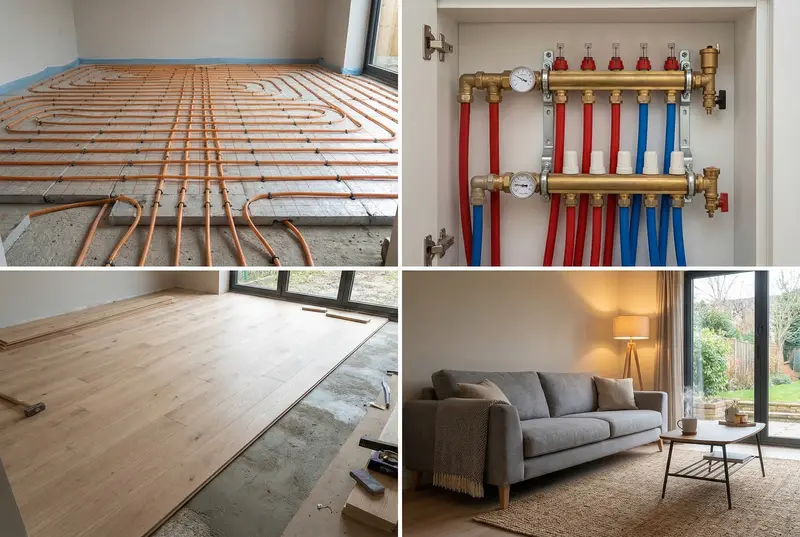
A full underfloor heating installation in Colchester typically follows a clear process, starting with a proper heat loss calculation for your property. This isn't optional — it's the step that determines how many circuits you need, what flow temperatures are required, and whether your existing boiler or heat pump can handle the additional load. Skipping this stage is how you end up with a system that never quite gets the room warm enough in January. Once the design is agreed, the installer will prepare the subfloor. For a wet system on a concrete base, this usually means laying rigid insulation boards first, then clipping or stapling the pipe in the designed serpentine or spiral pattern. The manifold — essentially the control hub that distributes hot water to each zone — is then fitted, typically inside a cabinet in a utility room, cupboard or hallway. After pressure testing the pipework, a self-levelling screed is poured over the pipes, which then needs a curing period of several weeks before the floor covering goes down. Electric systems (dry UFH) follow a different process — the heating mat or cable is laid directly beneath tiles or engineered wood — and are generally quicker to install, making them popular for Colchester bathroom and kitchen renovations where disruption needs to be minimal. Throughout the process, a good installer will coordinate with your flooring contractor, since different floor coverings have different thermal resistance ratings that directly affect how well the system performs.
Why Choose a Local Colchester Specialist
Choosing an installer who knows Colchester well genuinely makes a difference on this type of job. A local tradesperson will have worked on the full range of property types here — they'll know the quirks of solid Edwardian floors, the typical subfloor depths on post-war estates, and which screed suppliers in the area offer reliable turnaround times. They're also more likely to have established relationships with local flooring contractors and heating engineers, which matters when you're coordinating multiple trades. And if something needs adjusting after installation, having someone based in or near Colchester means you're not waiting weeks for a return visit.
Frequently Asked Questions
Is underfloor heating suitable for the older properties common in Colchester?
Yes, but it needs careful planning. Edwardian and pre-war properties in Colchester often have solid floors with limited depth or suspended timber floors that require specific system types. A surveyor will assess floor construction, ceiling heights and insulation options before recommending wet or electric UFH. Many older Colchester homes have been successfully retrofitted — it just needs the right approach from the start.
How does hard water in Colchester affect an underfloor heating system?
Colchester's hard water supply means limescale can build up inside UFH pipework over time, reducing efficiency and eventually causing blockages. A reputable installer will add a quality inhibitor to the system and may recommend a magnetic filter or scale reducer. Annual system checks should include monitoring inhibitor levels — this is straightforward maintenance that protects your investment long-term.
How long does a full underfloor heating installation take in a Colchester home?
For a ground-floor wet system in a typical Colchester semi, expect the main installation to take three to five days. However, the screed poured over the pipework needs four to six weeks to fully cure before floor coverings are laid. Electric systems are faster — usually one to two days per room — making them a practical choice for renovations where you need to minimise downtime.
Can I add underfloor heating to just one room rather than the whole ground floor?
Absolutely, and it's a common choice for Colchester homeowners extending or renovating a kitchen. A single-zone wet system can be connected to your existing boiler with its own manifold and thermostat. Electric systems are even simpler for single-room installs. Just make sure the overall boiler capacity is assessed — adding a new heating zone to an older system occasionally highlights that a boiler upgrade is also due.
Other Plumbing Services in Colchester
What do you need?
Select your service and urgency level