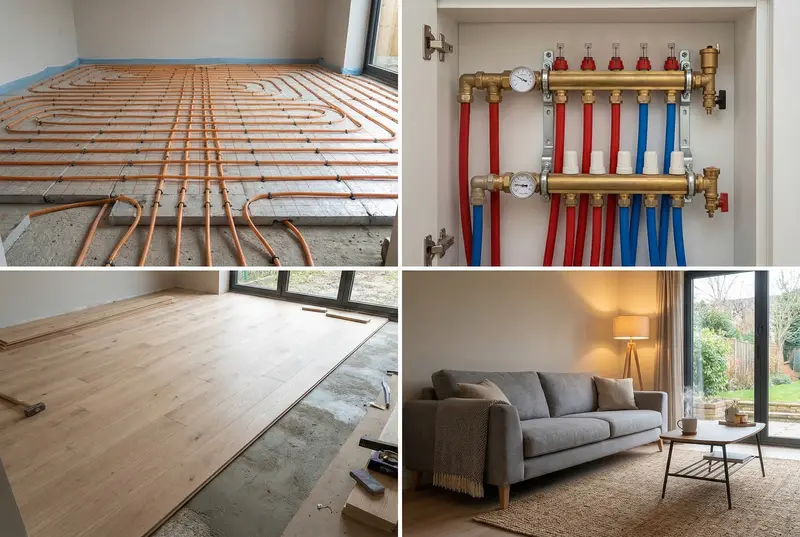
Underfloor Heating in Cambridge
Most Cambridge homeowners looking into underfloor heating are driven by the same frustration: cold stone or tiled floors in a period property that radiators simply can't warm efficiently. Whether you've just bought a Georgian townhouse near Jesus Green and want a full renovation, or you're extending a Victorian terrace in Romsey and want to future-proof the new space, underfloor heating is one of the most effective upgrades you can make. It removes bulky radiators from the walls, distributes heat more evenly across the room, and pairs especially well with the solid stone and flagged floors found in many of Cambridge's older homes.
Plumbing Conditions in Cambridge
Very Hard water — some of the hardest in England
Mixed housing stock across different eras. With 22% of properties built before 1919, older pipework and drainage systems are common — specialist knowledge of period properties matters.
Underfloor Heating in Cambridge — Local Expertise
Cambridge presents a genuinely interesting challenge for underfloor heating installers. The city has an unusually high proportion of Georgian townhouses and period properties — particularly across the historic centre, Newnham, and the streets close to the colleges — and these buildings have quirks that matter. Floor voids are often shallow or non-existent in ground-floor rooms, which can make wet underfloor systems harder to retrofit without raising floor levels. Solid stone or quarry-tiled floors are common, and while they're excellent heat conductors once warm, they need careful system design to avoid cracking. Cambridge also sits in a hard water area, supplied by Thames Water and Affinity Water, which means limescale build-up in the pipework and manifold is a real long-term concern. A good installer will recommend inhibitor treatment and an appropriate system flush at commissioning — don't skip this step or you'll shorten the life of the pipework significantly.
How We Work
A typical underfloor heating installation in Cambridge starts with a proper site survey, where the installer assesses the floor construction, existing heating system, room sizes, and insulation levels. This isn't a box-ticking exercise — in a city full of listed buildings and conservation area properties, getting this right early prevents costly surprises later. For new-build extensions or ground-up renovations, a wet (hydronic) system is usually the preferred route: flexible pipework is laid in loops across an insulation board, connected to a manifold, and then either screeded over or embedded in a low-profile liquid screed. For retrofits into existing rooms with limited floor void, an electric mat system is often more practical, particularly for bathrooms or single rooms where disruption needs to be minimised. Once the pipes or mats are laid, the system is pressure-tested before any screed goes down. After the screed cures — which can take four to six weeks depending on the product — the system is gradually commissioned, starting at low temperatures and slowly increasing over several days to prevent the screed from cracking. Finally, thermostats and zone controls are fitted and the system is balanced so every room heats evenly. The whole process for a multi-room wet system in a Cambridge property typically takes one to two weeks on site.
Why Choose a Local Cambridge Specialist
Choosing an installer who works regularly in Cambridge makes a real difference on period property jobs. Someone familiar with the city's building stock will know what to expect beneath the floors of a Georgian townhouse on Hills Road or a Victorian semi in Petersfield — and they'll have experience navigating planning queries for properties in conservation areas or under listed building consent. Local tradespeople also tend to have established relationships with Cambridge-based screed contractors and building control officers, which can speed the process up considerably. When something unexpected comes up on site (and with older Cambridge properties, it often does), a local installer can respond quickly rather than travelling in from elsewhere.
Frequently Asked Questions
Can underfloor heating be installed in a listed building in Cambridge?
Yes, but it requires listed building consent if the work affects the character of the building — which raising floor levels or disturbing original stone floors often does. A good Cambridge installer will flag this before work starts and help you understand what permissions are needed. Electric mat systems on top of existing floors are sometimes a more straightforward option in these cases.
Will hard water damage my underfloor heating system?
It can cause problems over time if the system isn't properly treated. Cambridge's hard water supply means limescale can build up inside the pipework and at the manifold. A qualified installer should flush the system thoroughly, add a quality inhibitor, and ideally fit a magnetic filter. Getting the water tested before commissioning is also worthwhile if you're connecting to an existing boiler.
How long does it take for underfloor heating to heat up in a period Cambridge property?
Wet systems embedded in screed take longer to respond than radiators — typically one to two hours to reach comfortable temperatures. In Cambridge's older properties with solid stone or flagged floors, this warm-up time can be slightly longer. The upside is that once warm, these floors retain heat well and the system runs more efficiently, especially when paired with a weather compensation controller.
Is underfloor heating compatible with the older boilers found in many Cambridge homes?
Most modern condensing boilers are compatible, but older systems may need upgrading. Underfloor heating works best with flow temperatures of around 35–45°C, which suits heat pumps and modern condensing boilers well. If your Cambridge property still has an older non-condensing boiler, your installer should assess whether it can be configured to work efficiently with the new system or whether a boiler upgrade makes sense at the same time.
Other Plumbing Services in Cambridge
What do you need?
Select your service and urgency level