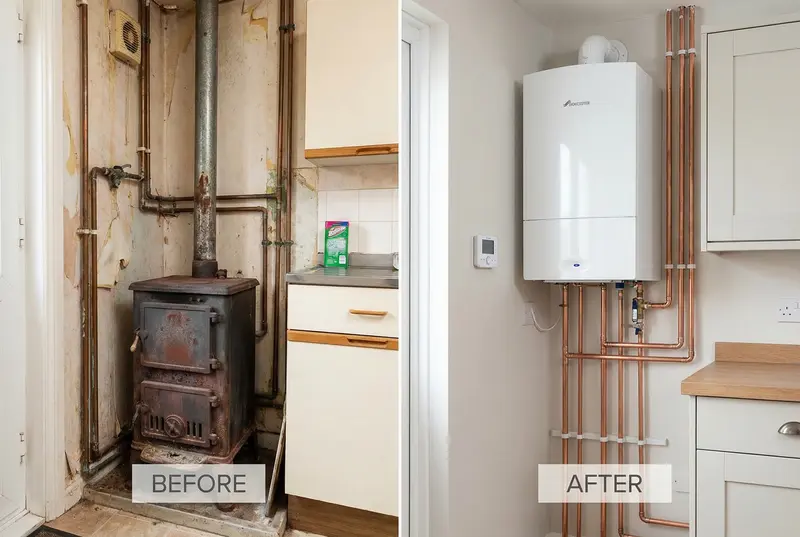
Boiler Installation in Cambridge
Most boiler installations in Cambridge come about for one of two reasons: a boiler that's finally given up after years of patchy performance, or a planned upgrade ahead of winter from a homeowner who's tired of expensive repair bills and rising energy costs. Either way, getting the installation right from the start matters enormously. Done properly by a qualified local installer, a new boiler should serve you reliably for 12 to 15 years.
Plumbing Conditions in Cambridge
Very Hard water — some of the hardest in England Regular descaling and annual servicing is particularly important in Cambridge.
Mixed housing stock across different eras. With 22% of properties built before 1919, older pipework and drainage systems are common — specialist knowledge of period properties matters.
Boiler Installation in Cambridge — Local Expertise
Cambridge presents some specific challenges that affect boiler installation work in ways that aren't always obvious. The city has a high proportion of Georgian townhouses and Victorian terraced properties, particularly across areas like Newnham, Romsey, and the streets running off Mill Road. These period properties often have older pipework, unconventional flue routes, and heating systems that haven't been touched in decades. Fitting a modern condensing boiler into a 19th-century terrace isn't always straightforward — flue positioning, pipework upgrades, and system flushing all need more careful thought than in a newer build. Cambridge also sits in a hard water area, supplied via the Thames Water and Affinity Water network. Hard water accelerates limescale build-up inside heat exchangers and pipework, which reduces efficiency and shortens boiler life. A reputable Cambridge installer should factor this in and recommend a scale reducer or inhibitor as part of the installation, not as an afterthought.
How We Work
A professional boiler installation in Cambridge typically follows a clear sequence, and knowing what to expect helps you plan and avoids surprises. It begins with a survey — either in person or, for straightforward replacements, via photos and a video call. The engineer will assess your current system, flue options, gas supply, and whether your existing pipework is compatible with the new boiler. For older Cambridge properties, this survey stage is especially important, as lead pipework or corroded radiators may need addressing before the new boiler goes in. On installation day, the old boiler is drained down and removed, and the new unit is fitted and connected. A power flush is strongly recommended for any system that's been running for several years — this clears sludge and debris that would otherwise circulate through your new boiler from day one, causing premature wear. The installer will then test all controls, check for leaks, balance the radiators, and commission the boiler according to the manufacturer's requirements. Crucially, the installation must be notified to Gas Safe and, in most cases, to your local authority under Building Regulations — a reputable installer handles this automatically. You should receive a commissioning certificate and manufacturer's warranty documentation before the engineer leaves. Budget half a day for a like-for-like swap, or a full day if pipework modifications are needed.
Why Choose a Local Cambridge Specialist
Choosing an installer based in or around Cambridge rather than a national firm makes a genuine practical difference. Local engineers know the quirks of Cambridge's housing stock — the narrow flue routes in Victorian terraces, the awkward airing cupboards in university-era properties, and the hard water conditions that affect system longevity. They're also easier to get back if something needs adjusting under warranty, and they have a local reputation to protect. Look for Gas Safe registered engineers with demonstrable experience in Cambridge, and ask specifically whether they've worked on similar period properties before committing.
Frequently Asked Questions
Does hard water in Cambridge affect which boiler I should choose?
It's worth factoring in. Cambridge's hard water causes limescale to build up inside heat exchangers faster than in soft water areas, reducing efficiency over time. Some boiler manufacturers offer built-in scale protection for hard water zones, and your installer should recommend fitting an external scale reducer or inhibitor dosing system alongside the new boiler to protect your investment.
My Cambridge terrace has a back boiler behind the gas fire — can it be replaced with a modern combi?
Yes, this is one of the most common jobs we see in Cambridge's older terraced streets. Back boilers are inefficient and parts are increasingly hard to source. Converting to a wall-mounted combi is very achievable, though it involves new flue positioning, removing the old fire surround unit, and potentially rerouting pipework. Budget for a full day's work and expect costs toward the upper end of the typical Cambridge range.
Do I need to notify anyone when a new boiler is installed in Cambridge?
Yes. All gas boiler installations must be carried out by a Gas Safe registered engineer, and the work must be notified to your local authority under Building Regulations Part J. A competent installer handles this notification on your behalf as part of the job — you shouldn't need to do anything separately. You'll receive a commissioning certificate, which you'll also need for any future property sale.
How long will a new boiler installation take in a Cambridge period property?
A straightforward like-for-like replacement in a standard Cambridge home usually takes four to six hours. In a Georgian townhouse or older terrace where pipework needs adapting, flue routes are awkward, or a power flush is required, a full day is more realistic. Your installer should give you a clear time estimate after the initial survey, not just a vague 'half a day' answer.
Other Plumbing Services in Cambridge
What do you need?
Select your service and urgency level