Underfloor Heating in Salisbury
If you've spent another winter watching your energy bills climb while the stone floors in your Salisbury home stay stubbornly cold underfoot, underfloor heating has probably crossed your mind more than once. It's one of those upgrades that genuinely transforms daily life — no more cold tiles first thing in the morning, no radiators eating into your wall space, and a more even, comfortable warmth throughout the room. Whether you're renovating a period cottage near the Cathedral Close or fitting out a new-build on one of Salisbury's modern estates, underfloor heating is a practical and increasingly popular choice that adds real value to your home.
Plumbing Conditions in Salisbury
Moderately Hard water — mixed geology
Mixed housing stock across different eras. With 22% of properties built before 1919, older pipework and drainage systems are common — specialist knowledge of period properties matters.
Underfloor Heating in Salisbury — Local Expertise
Salisbury's housing stock is wonderfully varied, and that variety matters enormously when planning an underfloor heating installation. The older stone-built properties and period cottages that give the city much of its character often come with solid floors, thick walls, and limited ceiling height — all factors that affect which system will work best and how the installation needs to be approached. Retrofitting wet underfloor heating into a Victorian terrace near Fisherton Street, for example, is a very different job to laying it under screed in a new-build on the Longhedge development. Salisbury sits in a moderately hard water area, which is worth noting for wet underfloor heating systems — limescale can gradually affect manifolds and pipework over time, so fitting an inhibitor and having the system properly commissioned from the start is important for long-term reliability. A local installer who understands these conditions will set your system up correctly rather than leaving you to deal with problems down the line.
How We Work
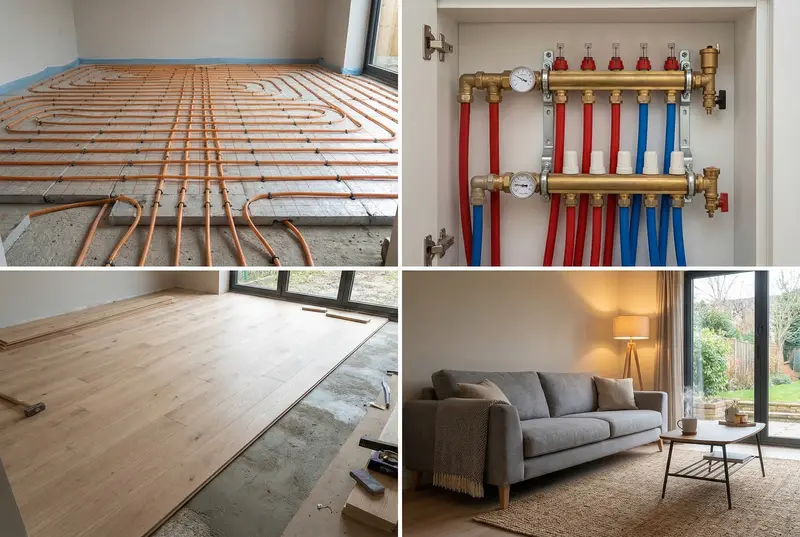
Underfloor heating installation broadly falls into two categories: wet systems (hydronic), which circulate warm water through pipes beneath the floor, and electric systems, which use heating cables or mats. For most Salisbury homeowners undertaking a full room renovation or extension, a wet system connected to their boiler or heat pump is the most cost-effective long-term solution. Electric systems suit smaller areas like bathrooms or as a retrofit under new floor coverings without major groundwork. For a wet system, the process typically starts with a site survey to assess your existing boiler capacity, floor construction, and the floor finish you're planning. If the floor needs to be built up, a layer of insulation goes down first — this is critical for efficiency, particularly in older Salisbury properties where heat loss through an uninsulated floor can be significant. Pipework is then laid in a continuous loop pattern and connected to a manifold, which is usually housed in a cupboard or utility space. The floor is then screeded over and left to cure — this curing period typically takes four to six weeks before the system is gradually commissioned. Your installer should walk you through the correct warm-up procedure, as rushing this with a new screed can cause cracking. The whole installation for a single room or open-plan space usually takes two to four days of active work.
Why Choose a Local Salisbury Specialist
Choosing a tradesperson who regularly works in Salisbury makes a genuine difference on a job like this. They'll be familiar with the quirks of local property types — the uneven floors in period cottages, the insulation challenges in older stone-built homes, and the layout constraints that come with properties that weren't designed with modern heating systems in mind. A local installer is also easier to reach if you have questions during the curing period or need the system balanced after your first full heating season. Word-of-mouth reputation matters in a market town like Salisbury, and tradespeople who work here regularly have a strong incentive to get the job right.
Frequently Asked Questions
Can underfloor heating be installed in an older stone-built Salisbury property?
Yes, though it requires more planning than a modern build. The main considerations are floor height — adding insulation and screed does raise floor level, which can be an issue near doorways or with stairs. A good installer will assess this during the survey and may recommend a low-profile system or electric matting if height is severely restricted. It's very achievable in most Salisbury period properties with the right approach.
Will my existing boiler cope with underfloor heating added to it?
It depends on your boiler's age, output, and what it's already running. Underfloor heating runs at lower flow temperatures than radiators, which is actually more efficient, but adding a new zone does increase demand. A competent installer will calculate heat loss for the rooms involved and check your boiler's capacity before committing. In some Salisbury homes, particularly larger period properties, a boiler upgrade may be recommended alongside the installation.
How long does the screed take to dry before I can use the underfloor heating?
Standard sand and cement screed typically needs around four to six weeks to cure before the heating system is commissioned — and even then, it should be warmed up very gradually over several days to prevent cracking. This is one of the most commonly rushed stages and one of the most damaging if it goes wrong. Your installer should provide a written commissioning schedule and stick to it.
Does hard water in Salisbury affect underfloor heating systems?
Moderately hard water like Salisbury's can cause limescale to build up in pipework and manifolds over time, reducing efficiency and potentially causing blockages. The solution is straightforward: ensure a quality inhibitor is added to the system at commissioning and that it's checked annually. Some installers also recommend a filter on the manifold. Done correctly, this isn't a major issue — it just needs to be factored in from the start.
Other Plumbing Services in Salisbury
What do you need?
Select your service and urgency level