Underfloor Heating in Rockwood
Underfloor heating is one of those upgrades that genuinely transforms how a home feels, not just how it looks on a spec sheet. For homeowners in Rockwood, it's an increasingly popular choice — and with good reason. Whether you're tired of cold flagstone floors in a period cottage or looking to future-proof a modern new-build, a well-installed wet underfloor heating system delivers consistent, comfortable warmth across the whole floor. It also pairs well with heat pumps and high-efficiency boilers, both of which are becoming more common across Rockwood as residents look to reduce running costs and carbon footprints. Getting the installation right matters enormously, so here's everything you need to know before you commit.
Plumbing Conditions in Rockwood
Moderately Hard water
Mixed housing stock across different eras. With 22% of properties built before 1919, older pipework and drainage systems are common — specialist knowledge of period properties matters.
Underfloor Heating in Rockwood — Local Expertise
Rockwood's housing stock is genuinely varied, and that variety has a direct bearing on how underfloor heating is specified and installed. The older stone-built properties and period cottages that make up a significant part of the town present some specific challenges. Stone floors and original suspended timber floors weren't built with underfloor heating in mind — they often require additional insulation beneath the pipework to prevent heat loss downward into the subfloor or ground. Without proper insulation boards, you can end up heating the earth rather than your living room, which is expensive and inefficient. Modern estates in Rockwood are a different story; newer concrete slab construction is far more straightforward to work with and typically requires less groundwork before pipework is laid. Rockwood sits in a moderately hard water area, which is worth flagging — hard water can cause limescale build-up inside underfloor heating pipes over time. A reputable installer should include an inhibitor and, where appropriate, a system filter to protect the pipework and manifold from scale and corrosion from day one.
How We Work
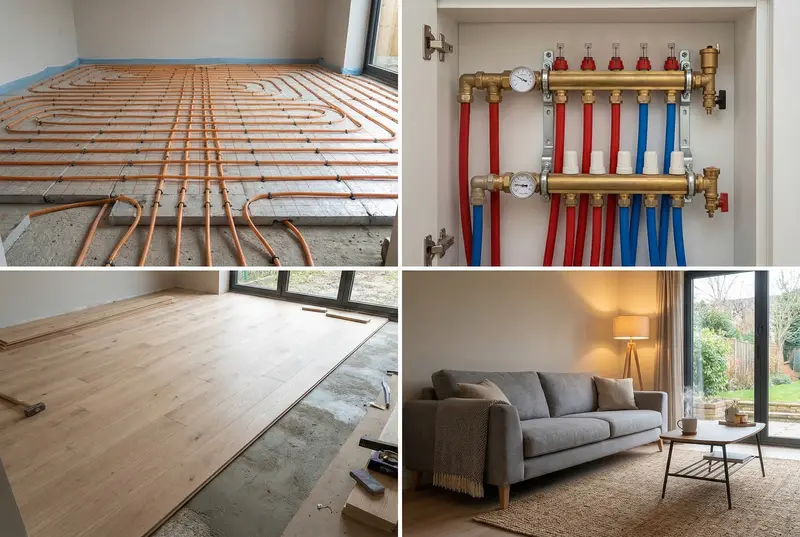
A wet underfloor heating installation in Rockwood typically follows a clear sequence of stages, and understanding what's involved helps you plan realistically. The process starts with a heat loss calculation for each room — this isn't optional, it's fundamental. Without knowing how much heat a room loses through its walls, windows, and floor, there's no way to correctly size the pipe spacing or flow temperatures. A good installer will carry this out before quoting. Once the design is signed off, the subfloor preparation begins. In older Rockwood properties, this often means lifting existing flooring, assessing the condition of the subfloor, and laying rigid insulation panels before any pipework goes down. In newer homes, self-levelling compound over a concrete slab is a common approach. The heating pipes — typically 16mm barrier pipe — are clipped to the insulation in carefully calculated loops and connected back to a central manifold, usually fitted in an airing cupboard or utility room. The manifold connects to your boiler or heat pump and allows each zone of the house to be controlled independently. Once the floor is pressure-tested (a vital step), the screed or floor finish goes back down. The system is then balanced, commissioned, and handed over with a full explanation of the controls. From start to finish on a standard Rockwood semi-detached or terrace, expect the installation phase to take between three and five days.
Why Choose a Local Rockwood Specialist
Choosing a tradesperson who knows Rockwood well makes a genuine practical difference. They'll be familiar with the construction styles common in the area — from the thick stone walls of older cottages to the timber joist floors on 1970s estates — and will know what to expect when they lift a floor. Local installers also understand the water supply conditions in this part of West Dunbartonshire, meaning they're less likely to overlook inhibitor treatment or system filtration. Beyond technical knowledge, a local business has a reputation to maintain in the community. If something goes wrong six months down the line, they're far easier to hold accountable than a national firm that sends a different engineer every time.
Frequently Asked Questions
Can underfloor heating be installed under existing floors in older Rockwood properties?
Yes, but it requires careful preparation. In stone-built houses and period cottages in Rockwood, the existing floor often needs to be lifted and insulation installed beneath the pipework. Without this, heat escapes downward rather than warming the room. It adds cost and time, but it's essential for the system to perform efficiently.
Will underfloor heating work with my existing boiler in Rockwood?
It depends on the boiler's age and type. Underfloor heating runs at lower flow temperatures than radiators, so modern condensing boilers work well. Older boilers may struggle to modulate down to the required temperatures. A local installer can assess your setup and advise whether a boiler upgrade is worthwhile alongside the underfloor heating installation.
How does hard water in Rockwood affect an underfloor heating system?
Moderately hard water can lead to limescale building up inside the pipework and manifold over time, reducing efficiency and potentially causing blockages. A quality installation should include a corrosion inhibitor added to the system water and a magnetic filter on the manifold. Annual servicing to check inhibitor levels will keep the system running cleanly for years.
How long does underfloor heating take to heat up in a Rockwood home?
Wet underfloor heating is slower to respond than radiators — typically 30 to 60 minutes to reach full output. In well-insulated Rockwood homes, this isn't a problem because you set it on a schedule rather than switching it on and off. Older stone properties retain heat well once up to temperature, which actually works in underfloor heating's favour.
Other Plumbing Services in Rockwood
What do you need?
Select your service and urgency level