Underfloor Heating in LittleMasterford
The most common reason homeowners in LittleMasterford enquire about underfloor heating is simple: cold floors. Whether it's a stone-flagged kitchen in a period cottage or a tiled bathroom in a newer build on one of the town's modern estates, radiators often struggle to heat a room evenly from the walls inward. Underfloor heating solves that by turning the entire floor into a gentle, consistent heat source.
Plumbing Conditions in LittleMasterford
Moderately Hard water
Mixed housing stock across different eras. With 22% of properties built before 1919, older pipework and drainage systems are common — specialist knowledge of period properties matters.
Underfloor Heating in LittleMasterford — Local Expertise
LittleMasterford sits in Somerset's moderately hard water zone, which is worth knowing if you're installing a wet underfloor heating system. Hard water accelerates limescale build-up inside pipework, and in a closed-loop UFH system that's running continuously through winter, that matters. A reputable installer working in LittleMasterford should fit an inline scale inhibitor or recommend a whole-system water treatment solution as part of the installation — don't accept a quote that doesn't address this. The town's housing stock also creates distinct challenges. Older stone-built properties and period cottages have thick, thermally massive floors and walls, which means wet systems take longer to warm up and respond differently to thermostats than modern construction does. Retrofitting pipes beneath existing solid floors typically requires screed or low-profile overlay systems. On LittleMasterford's modern estates, newer homes with suspended timber floors are better suited to electric mat systems or push-fit pipe between joists, which is quicker and less disruptive to install.
How We Work
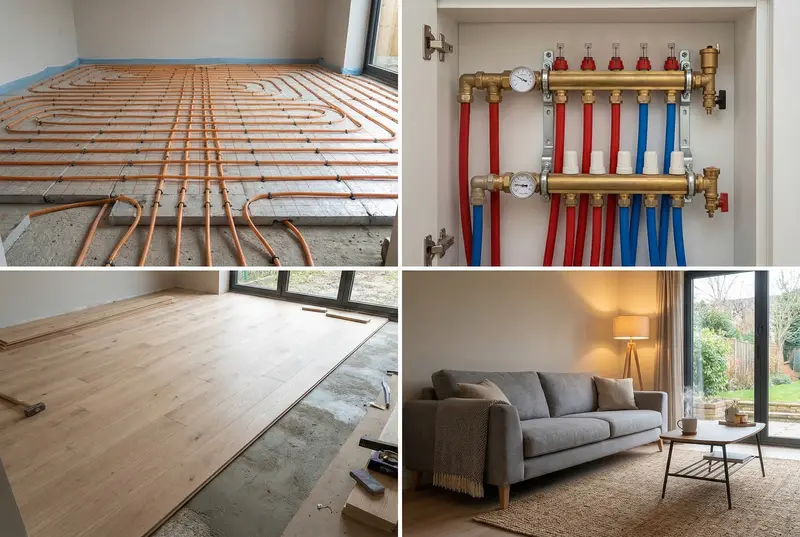
A proper underfloor heating installation in LittleMasterford begins with a site survey. A good installer will walk through your property, assess floor construction, check existing boiler capacity if you're going with a wet system, and take note of room dimensions. From this they'll produce a heat loss calculation — this determines pipe spacing and output, and any installer skipping this step is cutting corners. Once you've agreed a design and quote, installation of a wet system typically involves lifting or screding the floor, laying insulation boards (critical for pushing heat upward rather than losing it into the subfloor), then installing the pipe in a continuous loop connected to a manifold. The manifold is usually positioned in a cupboard or utility area and connects to your boiler or heat pump. Each room or zone gets its own thermostat, wired back to the manifold. On completion, the system is pressure-tested, filled, and balanced. For electric systems, installation is faster — a heating mat is rolled out under tiles or laminate and wired to a programmer — but running costs are higher, so they're better suited to smaller areas like bathrooms. Most LittleMasterford installations take between two and five days depending on the number of rooms and floor type.
Why Choose a Local LittleMasterford Specialist
Choosing a heating engineer who knows LittleMasterford well genuinely makes a difference. Someone familiar with local property types — the solid stone floors in older cottages, the varying joist depths in estate homes — will design a system that actually works, rather than applying a one-size-fits-all approach. They'll also understand the hard water conditions here and factor that into their specification. A local tradesperson is easier to hold accountable too: they have a reputation to maintain in a small town, and they're on hand if a commissioning issue crops up a few weeks after installation.
Frequently Asked Questions
Can underfloor heating be installed under an existing stone floor in a LittleMasterford cottage without removing it?
In most cases, no — the existing floor usually needs to come up to allow for insulation boards and pipe or mat installation. However, low-profile overlay systems exist that add minimal height (around 15–20mm total) and can sometimes be laid over a prepared existing subfloor. Your installer can advise after assessing the specific floor and doorway clearances.
Will my existing boiler cope with an underfloor heating system?
It depends on the boiler's age, output, and condition. Underfloor heating runs at lower flow temperatures than standard radiator systems, which actually suits modern condensing boilers well. An engineer will check your boiler's capacity against the heat load of the new system. Older boilers in some of LittleMasterford's period properties may need upgrading, which should be costed into the project from the start.
Is underfloor heating compatible with the moderately hard water in LittleMasterford?
Yes, but it needs managing. Hard water causes limescale inside pipework over time, which reduces efficiency and can cause blockages. Your installer should fit a scale inhibitor and ideally add a magnetic filter to the system. Using inhibitor fluid in the system water is also standard practice and keeps the pipework protected throughout its lifespan.
How long does it take for underfloor heating to warm up in an older LittleMasterford property?
Stone-built and period properties have high thermal mass, so expect a slower warm-up time — often two to four hours before the floor feels noticeably warm. This is normal. Most homeowners with these properties set their system on a long, lower-temperature programme rather than quick on-off cycles. Smart thermostats with weather compensation make this much easier to manage day to day.
Other Plumbing Services in LittleMasterford
What do you need?
Select your service and urgency level