Underfloor Heating in Cheltenham
Wet (hydronic) systems connected to your boiler are the most popular choice for whole-home installations, while electric mat systems suit single rooms or extensions. For homeowners in Cheltenham looking to upgrade their heating, underfloor systems offer a genuine improvement in comfort and efficiency — particularly when paired with a modern condensing boiler or heat pump. Getting accurate quotes from experienced local installers makes a real difference, especially given the variety of property types across the town.
Plumbing Conditions in Cheltenham
Moderately Hard water — Cotswold limestone
Mixed housing stock across different eras. With 22% of properties built before 1919, older pipework and drainage systems are common — specialist knowledge of period properties matters.
Underfloor Heating in Cheltenham — Local Expertise
Cheltenham's housing stock presents some of the most interesting — and occasionally tricky — underfloor heating challenges you'll find anywhere in the UK. The town's famous Georgian townhouses and Regency-era terraces were built with solid stone or timber suspended floors, which means a standard screed installation isn't always straightforward. In many of these period properties, installers need to use a low-profile electric mat system or a thin-profile wet system with insulation boards to avoid raising the finished floor height significantly, which would otherwise conflict with original skirting boards, door thresholds, and ornate cornicing. Cheltenham also sits in a moderately hard water area, which is worth factoring in for wet underfloor systems — limescale inhibitors and system filters are strongly recommended to protect the pipework and manifold from gradual furring, exactly as you'd consider for a standard boiler installation. Getting this right from the start avoids costly remediation later.
How We Work
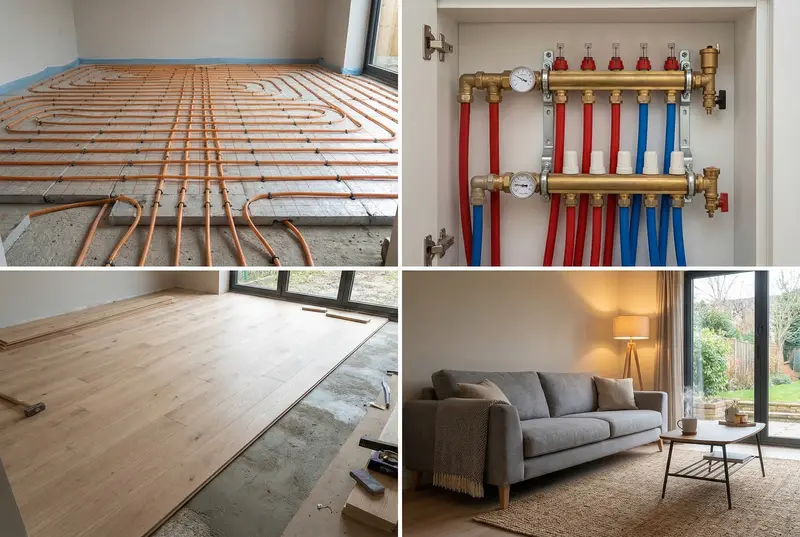
A typical wet underfloor heating installation in Cheltenham begins with a proper site survey, where the installer assesses the existing floor construction, checks the boiler output and flow rates, and identifies where the manifold will be positioned. In Georgian townhouses and period properties this survey stage is especially important — the installer needs to confirm whether the floor can take additional depth and weight, or whether a low-build system is the right route. Once the design is agreed, the floor is prepared by laying insulation boards to reflect heat upward rather than downward. The underfloor pipework is then laid in loops across the floor area and connected back to the manifold, which controls flow to each zone independently. In a wet system, the pipes are typically embedded in a self-levelling screed or sandwiched between insulation and a floating floor finish. The system is then pressure-tested before any floor covering goes down — a critical step that can't be skipped. After installation, there's a curing period for screed systems during which the floor is gradually brought up to temperature over several days. The installer should commission the system fully, balance each zone, and connect the smart thermostat controls before signing off the job. A good Cheltenham installer will also walk you through the startup procedure and optimal running temperatures for your floor finish.
Why Choose a Local Cheltenham Specialist
Choosing a locally based installer who knows Cheltenham well makes a genuine difference on this type of project. An experienced local tradesperson will have worked in Georgian townhouses and Regency properties before — they'll know the quirks of suspended timber floors in the older parts of town, they'll understand the planning sensitivities around Listed Buildings, and they're far more likely to spot a potential problem before it becomes expensive. They're also easier to reach if a question comes up during the screed curing period or once the system is running through its first winter season.
Frequently Asked Questions
Can underfloor heating be installed in an older Georgian property in Cheltenham?
Yes, but it requires careful planning. Many of Cheltenham's Georgian and Regency properties have suspended timber floors or original stone flags, which need a different approach than a modern slab. Low-profile wet systems or electric mats are often the right solution here, minimising the impact on floor height and preserving original features like skirting boards and door frames.
How does Cheltenham's hard water affect an underfloor heating system?
Cheltenham sits in a moderately hard water area, so limescale can gradually build up inside the pipework and manifold of a wet underfloor system over time. A reputable installer should fit a system filter and add a limescale inhibitor to the circuit at commissioning. This is a small cost that significantly extends the system's lifespan and keeps it running efficiently.
How long does underfloor heating installation take in a typical Cheltenham home?
For a ground floor installation in an average Cheltenham semi or townhouse, the physical installation usually takes two to four days. If liquid screed is used to embed the pipework, you then need to allow around seven to ten days curing time before laying the final floor finish. Factoring in survey, installation, and commissioning, most projects complete within two to three weeks from start to finish.
Is underfloor heating worth it in Cheltenham, or is it just a luxury?
For many Cheltenham homeowners, particularly those in larger Georgian townhouses with high ceilings and draughty floors, underfloor heating delivers real comfort improvements and can be more efficient than traditional radiators when run at lower flow temperatures with a heat pump or modern condensing boiler. It also adds value to a property. The upfront cost is significant, but it's a long-term investment rather than a pure luxury.
Other Plumbing Services in Cheltenham
What do you need?
Select your service and urgency level