Underfloor Heating in Canterbury
Underfloor heating has become one of the most sought-after home improvements in Canterbury, and it's not hard to see why. The city's damp winters, combined with older housing stock that can feel cold and draughty no matter how high you turn the thermostat, make conventional radiators feel like an uphill battle. Underfloor heating solves this by warming a room from the ground up, creating an even, comfortable heat that radiators simply can't replicate. Whether you're renovating a Victorian terrace near the city centre or fitting out a new extension on a modern development to the south of the city, it's worth understanding exactly what's involved before you commit.
Plumbing Conditions in Canterbury
Very Hard water — Thames and Medway chalk aquifers
Mixed housing stock across different eras. With 22% of properties built before 1919, older pipework and drainage systems are common — specialist knowledge of period properties matters.
Underfloor Heating in Canterbury — Local Expertise
Canterbury's housing mix creates some genuinely varied challenges when it comes to underfloor heating installation. The Edwardian semis that line streets across areas like Wincheap and St Dunstan's typically have suspended timber floors downstairs, which means a wet underfloor system requires careful assessment of floor void depth and joist spacing before anything else. These properties can absolutely accommodate underfloor heating, but the approach differs significantly from a solid concrete floor. Post-war estates — particularly the council-built homes across Herne Bay Road corridors and the Sturry Road area — often have solid ground floors that are well-suited to a screed-based wet system, though floor height gain needs consideration throughout. Canterbury's newer developments, particularly around the Kingsmead and Wincheap areas, are frequently built with underfloor heating in mind from the outset. Canterbury sits in a moderately hard water area, which is worth flagging: limescale can gradually affect manifolds and pipework over time, so fitting an in-line inhibitor and having the system flushed and chemically treated during installation is strongly recommended rather than optional.
How We Work
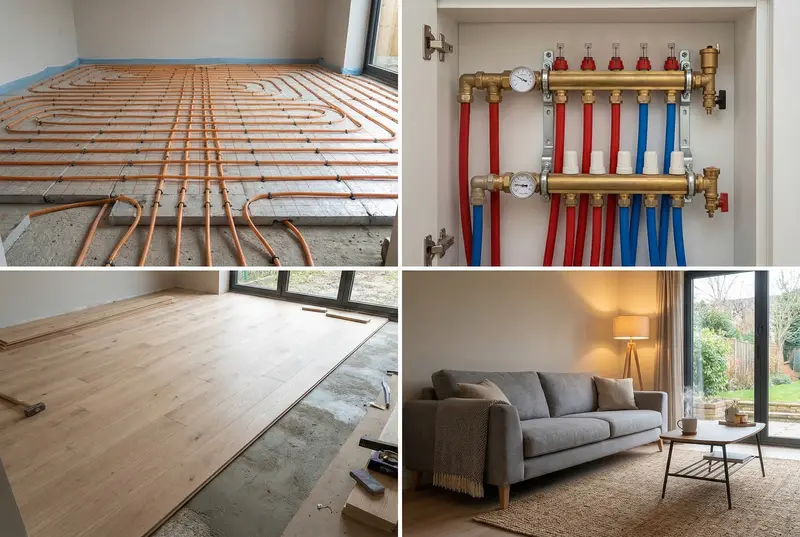
A professional underfloor heating installation in Canterbury follows a clear sequence, though the detail varies depending on your property and whether you're going for a wet (hydronic) or electric system. Wet systems are the more popular choice for whole-floor heating because they run off your existing boiler or a heat pump, making them cheaper to run day to day. Electric mat systems suit smaller areas like bathrooms or single rooms where disruption needs to be minimal. The process begins with a site survey, where an installer will assess your floor construction, existing heating system, and room layout. For a wet system, a manifold is installed — usually in a utility room or cupboard — and pipework is laid in a continuous loop across the floor either embedded in a liquid screed or clipped to insulation boards between joists. Insulation is non-negotiable: without it, you're heating the ground rather than the room. Once the pipework is pressure tested and the screed poured (where applicable), there's a curing period of several weeks before the system is commissioned. Thermostats and zone controls are wired in, the system is filled, bled, and balanced, and you'll be shown how to programme it. From start to finish, a full ground floor installation in a typical Canterbury semi typically takes three to five days on site, not including screed curing time.
Why Choose a Local Canterbury Specialist
Choosing a Canterbury-based installer rather than a national firm makes a real practical difference. Local tradespeople will have worked in the city's mix of Edwardian semis, post-war homes, and newer builds, and they'll understand the quirks that come with each — tight floor voids, older pipe runs, and the moderately hard water conditions that affect long-term system performance. They can also respond quickly if a question comes up after commissioning, and they're easier to hold accountable. Word of mouth matters in a city the size of Canterbury, and a local installer has a genuine stake in doing the job well.
Frequently Asked Questions
Can underfloor heating be installed in an Edwardian semi in Canterbury without major disruption?
Yes, but it takes more planning than a solid floor installation. Suspended timber floors require either routing pipework between joists from below or using a low-profile overlay system on top. Both approaches work well — the choice depends on access and how much floor height you can afford to lose. A good installer will survey the floor void first and talk you through the options honestly.
How does Canterbury's hard water affect an underfloor heating system?
Canterbury's moderately hard water means limescale can build up inside manifolds and pipework over time, reducing efficiency. The fix is straightforward: during installation, the system should be filled with treated water containing a quality inhibitor, and a magnetic filter fitted to catch any debris. This is standard practice for any competent installer in the area and adds very little to the overall cost.
Will underfloor heating work with my existing boiler in Canterbury?
Possibly, but it depends on the boiler's age and output. Underfloor heating runs most efficiently at lower flow temperatures — around 35–45°C — which suits modern condensing boilers well. Older or oversized boilers may struggle to modulate down to these temperatures effectively. Your installer should carry out a boiler assessment as part of the survey, and if an upgrade is needed, they'll flag it upfront.
How long does it take before you can use underfloor heating after installation in Canterbury?
If a liquid screed has been poured, you'll need to wait for it to cure fully — typically four to six weeks — before the heating can be commissioned at full temperature. The screed is brought up to temperature gradually during this period to prevent cracking. Electric systems without screed can often be used much sooner, sometimes within days of installation once adhesive or tile grout has set.
Other Plumbing Services in Canterbury
What do you need?
Select your service and urgency level