Underfloor Heating in Blackburn
Underfloor heating has become one of the most sought-after home upgrades in Blackburn over the past decade, and it's easy to see why. With Lancashire winters being reliably damp and chilly, the idea of stepping onto a warm floor rather than a cold one in the morning is genuinely appealing. Beyond comfort, underfloor heating distributes heat more evenly than radiators, works efficiently at lower water temperatures, and frees up wall space that would otherwise be taken up by bulky panels. For homeowners in Blackburn looking to invest seriously in their property, it's one of the most practical upgrades available — particularly when paired with a modern heat pump or condensing boiler.
Plumbing Conditions in Blackburn
Soft water — Pennine catchments
Mixed housing stock across different eras. With 22% of properties built before 1919, older pipework and drainage systems are common — specialist knowledge of period properties matters.
Underfloor Heating in Blackburn — Local Expertise
Blackburn's housing stock is wonderfully varied, and that variation matters enormously when it comes to underfloor heating installation. The town has a significant number of Edwardian semis — particularly in areas like Revidge and Beardwood — where suspended timber ground floors are common. These properties can absolutely have underfloor heating installed, but it typically requires an electric mat or a low-profile wet system rather than a full screed pour. Post-war estates across Blackburn, such as those built through the 1950s to 1970s, often have solid concrete floors that are ideal candidates for a wet underfloor heating system embedded in a new screed layer. Newer developments on the outskirts of Blackburn frequently come with underfloor heating pre-installed, but older systems sometimes need upgrading or extending. One piece of good news for Blackburn homeowners: the town is supplied with soft water from Pennine reservoirs, which means far less limescale build-up inside pipework and manifolds — this genuinely extends the lifespan of a wet UFH system and reduces maintenance headaches over time.
How We Work
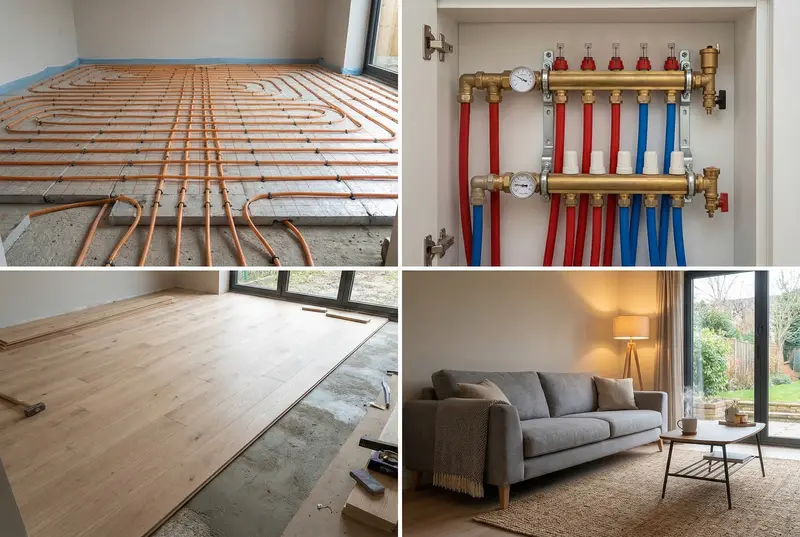
The installation process for underfloor heating in Blackburn typically begins with a site survey and heat loss calculation. A competent installer will assess the floor construction type, insulation levels, room dimensions, and your existing heat source before recommending either a wet (hydronic) system or an electric system. Wet systems are the more popular choice for whole-house installations — they connect to your boiler or heat pump via a manifold and circulate warm water through a network of pipes laid across the floor. Electric systems, meanwhile, use resistance mats or cables and are often better suited to single rooms, bathroom renovations, or properties where lifting the whole floor isn't practical. Once the system type is agreed, the floor preparation begins. For a wet system in a solid-floor property, this usually involves laying 50–100mm of insulation board, fixing the pipe circuits to a mesh, then pouring a self-levelling screed over the top. The screed typically needs 7–10 days to cure before the system is commissioned slowly — a gradual warm-up process that prevents cracking. Thermostatic controls and zone valves are then fitted so you can control different areas of your Blackburn home independently. For timber floors, a lower-profile dry system using aluminium heat spreader plates is usually the right approach, keeping floor height increase to a minimum. Throughout, a good installer will leave you with full documentation including pipe layouts — essential if any future work is ever needed.
Why Choose a Local Blackburn Specialist
Choosing a local Blackburn installer over a national firm really does make a difference for a job like this. Someone who regularly works across Blackburn's varied housing stock — from the Victorian and Edwardian terraces near the town centre to the newer builds out towards Darwen and Great Harwood — will immediately understand the floor construction challenges your property is likely to present. They'll also have relationships with local merchants, meaning quicker access to parts if anything needs adjusting during or after installation. And if something needs attention in six months' time, a local tradesperson is far easier to get back on site than a company based two counties away.
Frequently Asked Questions
Can underfloor heating be installed in an Edwardian semi in Blackburn without major disruption?
Yes, though it requires a slightly different approach. Edwardian semis typically have suspended timber floors, which aren't suited to a poured screed. Instead, a dry low-profile system using aluminium spreader plates and a thin electric mat or small-bore wet pipes is usually the most practical solution. It adds minimal floor height and avoids the need to remove and replace the entire floor structure.
How does Blackburn's soft water supply affect an underfloor heating system?
It's actually a real advantage. Soft water from Pennine reservoirs contains very little calcium or magnesium, which means limescale build-up inside the pipework and manifold is minimal. This reduces the risk of blockages, maintains flow efficiency over time, and generally means the system requires less maintenance than it would in a hard water area. It's worth inhibiting the system correctly regardless, but the soft water supply is a genuine plus.
How long does underfloor heating installation take in a typical Blackburn home?
For a full ground floor wet system in a solid-floor property, expect the installation itself to take two to four days, followed by around seven to ten days for the screed to cure before the system can be gradually commissioned. Electric mat installations in individual rooms can often be completed in a single day. The overall timeline from survey to a fully operational system is typically two to four weeks including planning and materials lead time.
Is underfloor heating compatible with the combi boiler in my Blackburn home?
In many cases, yes — a combi boiler can run underfloor heating, though you may need a blending valve fitted to reduce the water temperature to the lower flow temperatures UFH systems prefer (typically 35–45°C rather than the 70–80°C radiators use). An installer will assess whether your existing boiler has sufficient output for the added demand. Older or undersized combis may need upgrading, particularly if you're heating a larger Blackburn property.
Other Plumbing Services in Blackburn
What do you need?
Select your service and urgency level